About Felicia filifolia (Vent.) Burtt Davy
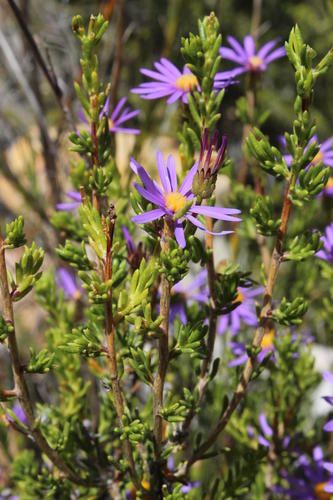
Felicia filifolia (Vent.) Burtt Davy is a diploid species with nine sets of homologous chromosomes (2n=18), divided into four distinct subspecies with the following characteristics and distribution. Felicia filifolia subsp. filifolia, the nominate subspecies, is a mostly strongly branched, woody, largely hairless, medium-sized shrub that reaches 60–150 cm (24–59 in) in height. It has dark blackish brown, often slightly fibrous bark. Its leaves are arranged alternately, either clustered on short shoots or uniformly arranged on long shoots. Leaves are hairless overall, with woolly hair only on the upper side of the leaf base. The leaves are more or less succulent, narrowly needle-shaped, 8–30 mm (0.31–1.18 in) long and approximately ½ mm (0.02 in) in diameter. They usually have a distinctly callous tip, are more or less wrinkled, and contain resin vessels internally. Medium-sized flower heads grow at the tips of short shoots or long shoots; they are either seated or borne on stalks up to 10 cm (3.9 in) long. The involucre is 6–8 mm (0.24–0.31 in) in diameter, made of three to four whorls of overlapping, lance-shaped, hairless bracts. The bracts range in color from tawny to greenish, with tips often tinged red, and have a papery margin that is more or less lined with a regular row of hairs. Outer bracts measure 1½ mm (0.06 in) long by ½ mm (0.02 in) wide; middle bracts measure 3 mm (0.12 in) long by 1 mm (0.04 in) wide; inner bracts measure 5 mm long by ½ mm wide. Each flower head holds 10 to 15 female, medium or light purple, rarely white ray florets, about 1 cm long and 1½ mm wide. These ray florets surround numerous bisexual yellow disc florets that develop a burgundy wash later, which measure 4–6 mm (0.16–0.24 in) long. Each of the two style branches has a long triangular appendage. The pappus consists of numerous yellowish white bristles that do not detach. While bristles vary in length, they do not form two distinct rows. Longer pappus bristles are 5–7 mm (0.2–0.28 in) long with teeth along their length; shorter bristles are scaly and ½–1 mm (0.02–0.04 in) long. The dry, one-seeded, indehiscent fruits called cypselae are obovate to elliptic, about 4 mm (0.16 in) long and 1½ mm (0.06 in) wide, covered in even silky hair. Mature cypselae have a brownish scaly surface and a light ochre-coloured marginal ridge. Felicia filifolia subsp. bodkinii is shorter than the nominate subspecies, reaching about 90 cm (35 in) tall. It has thick, succulent leaves without a narrowed base, that are nearly fully round in cross-section, about 2 cm long and 1 mm across. Leaves are arranged alternately at regular intervals along long shoots, and short shoots are either absent or very few. Its relatively large flower heads have an involucre about 10 mm in cross-section, and sit at the tips of long shoots. Outer bracts are 1½ mm (0.06 in) long and ½ mm (0.02 in) wide, while inner bracts are 5 mm long and 1.2 mm wide. Near Graaff Reinet, this subspecies occurs without ray florets. Felicia filifolia subsp. schaeferi is a low-growing plant that reaches a maximum height of 25 cm (9.8 in). Its succulent leaves are crowded along the stem, up to 15 mm long, often spread forward, and are narrowed at the base. Flower heads are borne on stems up to 10 cm long. In Felicia filifolia subsp. schlechteri, flower heads are almost exclusively borne on 2–10 cm long stalks. Its succulent leaves are round in cross-section, and longer than the leaves of the nominate subspecies, measuring 1.8–4 cm, with an average length of 2½ cm. Leaves are typically oriented upwards and pressed against the stem. Regarding distribution, the nominate subspecies filifolia has a large range, occurring southeast of a line running from approximately 25° south in eastern South Africa to approximately 30° south in the west. Subspecies bodkinii occurs from Namaqualand in the north to Ceres and Humansdorp in the east. Subspecies schaeferi can be found from Namibia southwards to Worcester in the west and Willowmore in the east. Subspecies schlechteri grows in the Klein Karoo, between Ceres in the west and Grahamstown in the east.