About Felicia echinata (Thunb.) Nees
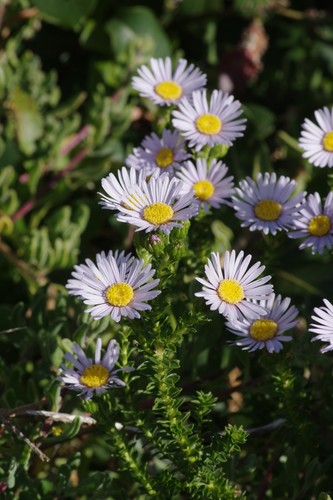
Felicia echinata is an upright, heavily branched shrublet that reaches up to 1 meter (3.3 feet) in height. Its well-branched stems bear alternately arranged, often densely packed leaves. These leaves are thick, inclined, overlapping, and measure 10–14 mm (0.39–0.55 in) long and 3–5 mm (0.12–0.20 in) wide. The leaves are either hairless overall or have hair along the margins, with hairs present on the upper leaf surface and many roundish glands beneath the upper surface. Like almost all species in the Asteraceae family, Felicia echinata produces small 5-merous individual florets clustered into characteristic composite flower heads. Each head is surrounded by an involucre made of three or four whorls of lanceolate bracts: the outer bracts are 4 mm (0.16 in) long and 1 mm (0.039 in) wide, while the inner bracts reach 9 mm (0.35 in) long and 1.2 mm (0.047 in) wide. All bracts are covered in rough hairs, which become glandular near the tip of the bract. The center of the flower head holds many yellow disc florets that are 3–4 mm (0.12–0.16 in) long. Around this center is a single whorl of around 25 ligulate florets, most often bluish-purple and rarely white, that measure 13 mm (0.51 in) long and 1.8 mm (0.071 in) wide, and are hairy at their base. These florets grow on a shared receptacle 15 mm (0.59 in) across, and no individual floret is subtended by its own bract. The one-seeded fruits (called cypselas) are inverted, egg-shaped to oval, and range in color from yellow-brown to reddish. They have two prominent vascular bundles along their edges, and are topped with a ring of many 4 mm (0.16 in) long, bone-colored hairs. These hairs have small teeth along their length and are slightly wider at the tip. Cypselas from ligulate florets have hairless surfaces, while those from disc florets have very short surface hairs. Solitary flower heads grow at the tip of 0–4 cm (0.0–1.6 in) long peduncles, arranged into few-headed, umbel-like inflorescences. This species is diploid, with a base chromosome number of 9, giving a diploid count of 2n=18. It grows on sand dunes and along road verges. Its flowers bloom during Southern Hemisphere spring, from August to October. As an endemic of the Cape Floristic Region, F. echinata only occurs in a narrow coastal strip along the south coast between Mossel Bay and Bathurst. Plants can produce seed once they reach 1½ years of age. Seeds develop between August and October and are dispersed by wind. Felicia echinata adapts easily to cultivation, requiring well-drained soil and a sunny location, and has horticultural potential for use as a rockery plant.