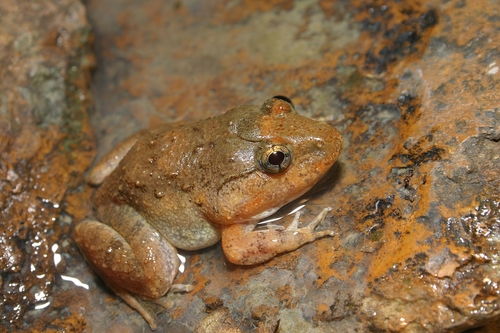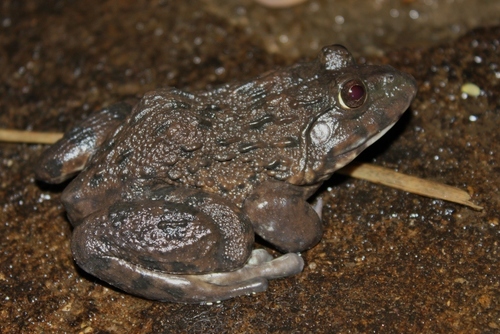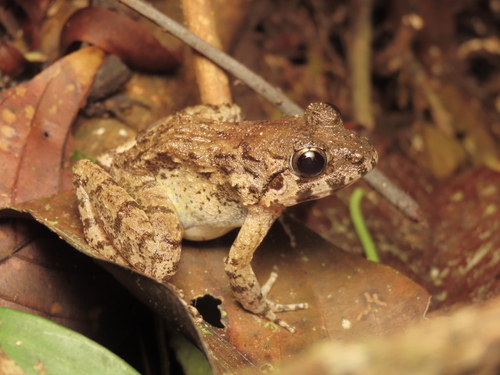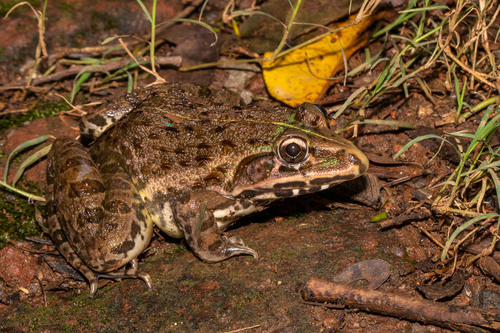
About Fejervarya limnocharis (Gravenhorst, 1829)
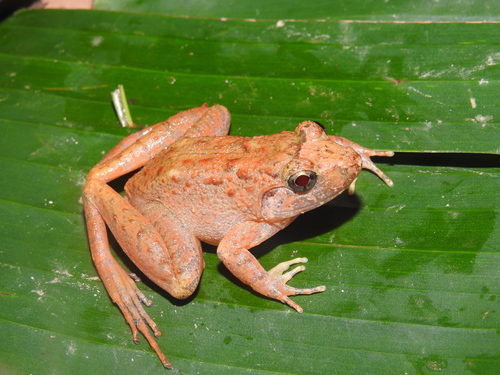
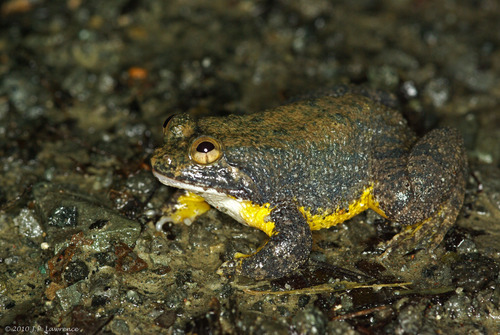
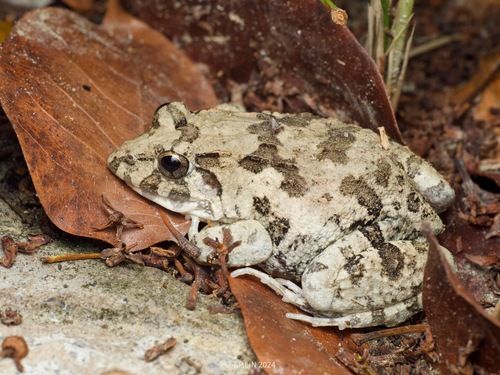
This frog species, Fejervarya limnocharis, has a pointed snout that projects beyond the mouth. Its canthus is obtuse, and its loreal region is oblique and more or less concave. The internarial space is longer than the interorbital width, and interorbital width is much smaller than the width of the upper eyelid. The tympanum is distinct, and measures half to two-thirds the diameter of the eye. Its fingers are obtusely pointed; the first finger is longer than the second, and its subarticular tubercles are very prominent. The tibiotarsal articulation reaches the tympanum or naris. Its toes are obtuse or have slightly swollen tips, and are half webbed; the subarticular tubercles are small and prominent. The body has small tubercles, and sometimes small longitudinal folds are present. The ventrum is smooth, except the posterior portions of the belly and thighs, which are granular. Males have a loose gular region with a brown or blackish W-shaped mark, stronger fore limbs, and pad-like subdigital tubercles under the first finger. Snout-vent length ranges from 39 to 43 mm. In coloration, the dorsal surface is gray brown or olive, sometimes suffused with bright carmine. There is a V-shaped dark mark between the eyes, and a yellow vertebral stripe is present in most individuals. The lips and limbs are barred, with a light line running along the calf. The lateral sides of the thighs are yellow and marbled with black. The ventrum is white, and the male's throat is mottled with brown. This species forms a species complex with several genetic variants that may represent multiple distinct species. Fejervarya limnocharis inhabits parts of Southeast Asia and Indochina. Earlier misidentifications led to erroneous extralimital reports of this species from South Asia. According to the Amphibian Species of the World, records of this species outside of Indonesia, Malaysia, Thailand, Burma, Cambodia, Laos, and Vietnam almost certainly represent other species. In Malaysia, Fejervarya limnocharis is one of the few frog species commonly found in oil palm plantations, alongside Microhyla heymonsi and Hylarana erythraea.