About Feihyla kajau (Dring, 1983)
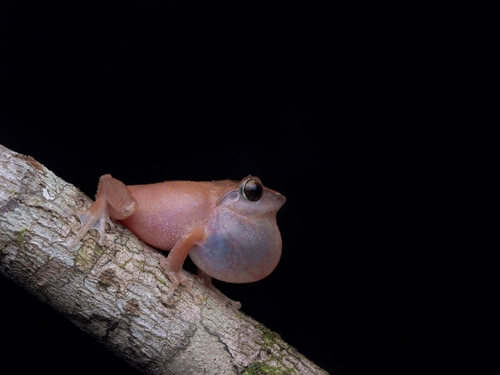
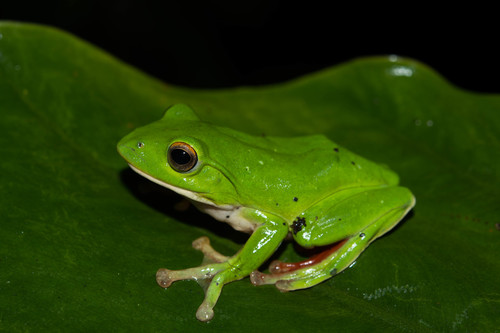
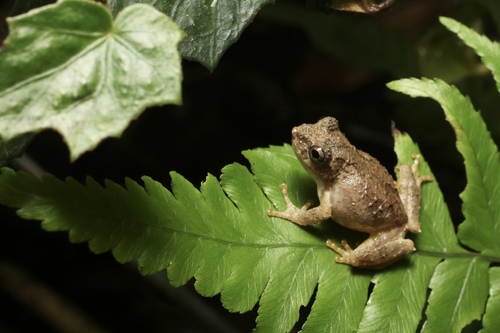
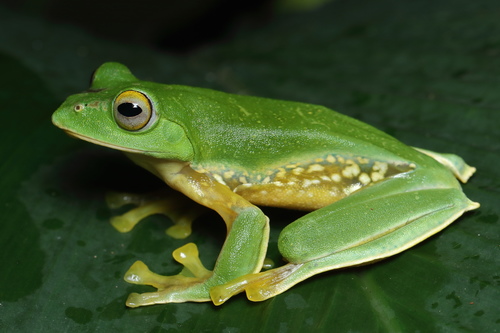
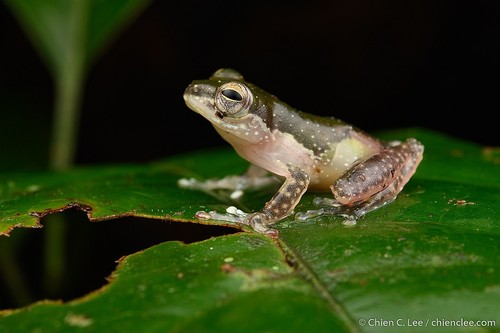
For adult Feihyla kajau, males reach a snout–vent length of 20 mm (0.8 in), while females grow larger. Adults have a slender body, a very short blunt snout, and a small, inconspicuous tympanum. The tips of the fingers and toes are broadly rounded; outer fingers have basal webbing, and toes are half-webbed. Dorsal skin is finely shagreened. The dorsum is green, ending abruptly at the flanks; it is brown in the posterior pelvic region, and scattered with small white dots across the upper body. The venter is white on its anterior portion and transparent posteriorly. The iris is silvery on the lower half and golden on the upper half, with dark reticulation, a golden ring surrounding the horizontally oval pupil. Males produce a soft, high-pitched advertisement call. Tadpoles have a maximum total length of 26.7 mm (1.1 in). Their dorsum is brown, with scattered light bronze pigmentation on the forehead and trunk. The underside is transparent, making internal organs visible, and the eyes are positioned dorsolaterally. Feihyla kajau inhabits primary and slightly disturbed lowland rainforests on flat and hilly terrain, most often at elevations below 700 m (2,300 ft) above sea level, and occasionally up to 1,000 m (3,300 ft). Individuals perch on low vegetation that overhangs small rocky streams or swampy, muddy pools. Females lay eggs in clutches of approximately 7–10 on leaf surfaces. This species can be common in habitats that are suitable for it. Portions of its range are threatened by logging concessions, small-scale subsistence logging, oil palm plantations, and property development. Feihyla kajau occurs in several protected areas.