About Favites pentagona (Esper, 1790)
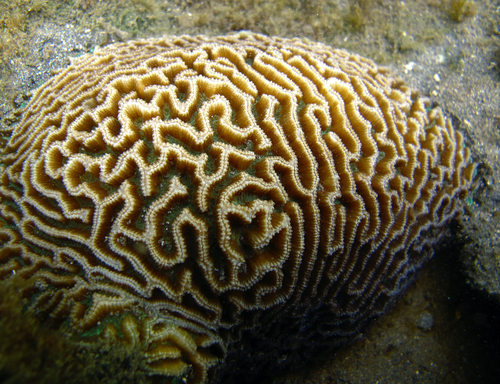
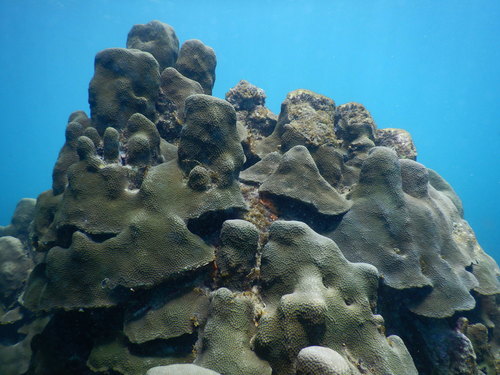
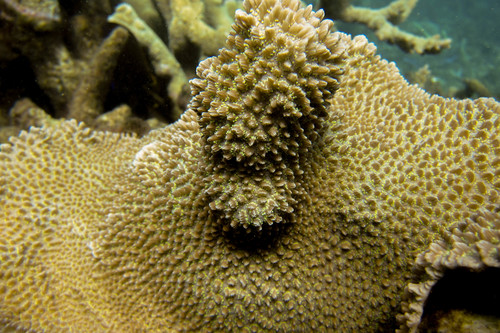
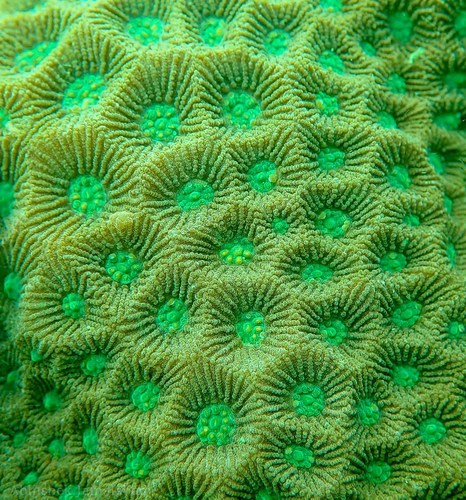
Colonies of Favites pentagona are encrusting or massive, and sometimes develop lobes that form irregular columns. Colonies can grow to about one metre across. The individual corallites (stony cups that hold each polyp) are less than 6 mm in diameter. Corallite walls are thin, sharply angled, and several polyps may share a common wall. Palliform lobes are clearly visible on the polyp's oral disc, and only a small number of septa are present. This coral is often vividly colored, with contrasting coloration: the oral discs are often green, while the coenosarc (the living tissue that covers the skeleton between individual polyps) is brown, red, or purple. Favites pentagona is native to the Indo-Pacific region, where it lives in shallow tropical and subtropical seas. Its range extends from the Red Sea and South Africa east to India, Indonesia, Japan, and Australia, where it occurs in both Western Australia and the Great Barrier Reef. It can be found at depths down to 25 metres, and is common on rocky reefs, outer reef channels, reef slopes, and lagoons. Favites pentagona is a zooxanthellate coral, meaning it hosts symbiotic unicellular dinoflagellates in its tissues. These symbionts synthesize nutrients using energy from sunlight, which benefits the host coral. It is an aggressive coral species. At night, it extends its polyps to feed on plankton, and expands elongated sweeper tentacles armed with stinging cells far beyond the edge of its colony base. This behavior prevents it from being crowded or overgrown by other organisms. It removes accumulated sand from its surface by inflating its polyps to dislodge the sediment. F. pentagona is a simultaneous hermaphrodite, and releases eggs and sperm in well-formed gamete bundles. In any given location, spawning is typically synchronous, with all colonies releasing their gamete bundles at the same time. The bundles rise to and float at the sea surface, which maximizes the chance of successful fertilization. F. pentagona is susceptible to black band disease and white plague, two coral diseases that have become more common since the 1990s.