About Favia fragum (Esper, 1793)
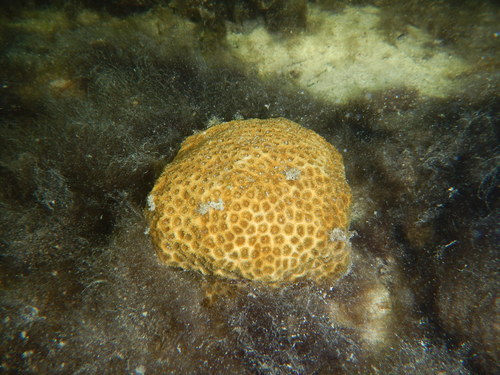
Commonly called golfball coral, Favia fragum (Esper, 1793) is a small coral that is typically hemispherical in shape, with multiple large corallites packed closely together. It can grow in groups, or occasionally grow as an encrusting coral. Each corallite contains one to three polyps; corallites are normally round, but may become elongated and oval when polyps bud and a new corallite forms. Corallite walls usually have four complete whorls of septa, which do not project noticeably from the coral’s surface. The costae of separate corallites are distinct from each other. This coral is usually yellow or pale brown in color. Golfball coral occurs in the tropical Atlantic Ocean, at depths down to 30 metres (98 ft). Its range extends from the west coast of equatorial Africa to South America, the Caribbean Sea, and the southern United States. It is an inconspicuous species that lives on coral reefs, on rocks, in seagrass meadows, and among seaweed. The IUCN Red List of Threatened Species classifies Favia fragum as a species of least concern, because it is widespread and common, and habitat loss from coral reef destruction is unlikely to significantly impact its populations. Experiments have found that on degraded reefs with abundant macroalgae, Favia fragum coral larvae settle in equally large quantities on seaweed and on rubble substrates. Researchers have observed that larvae settle on Halimeda opuntia, an ephemeral alga that does not support post-settlement survival. This pattern may have meaningful consequences for coral recruitment on degraded reefs.