About Fasciolaria tulipa (Linnaeus, 1758)
Scientific name: Fasciolaria tulipa (Linnaeus, 1758).
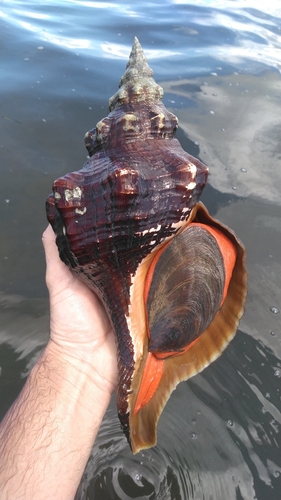
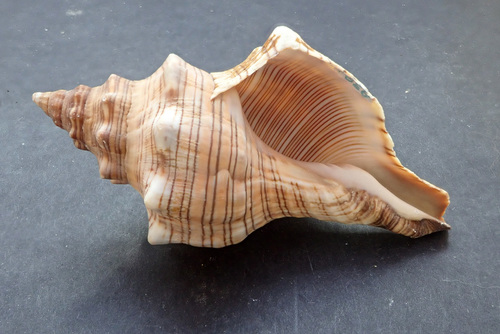
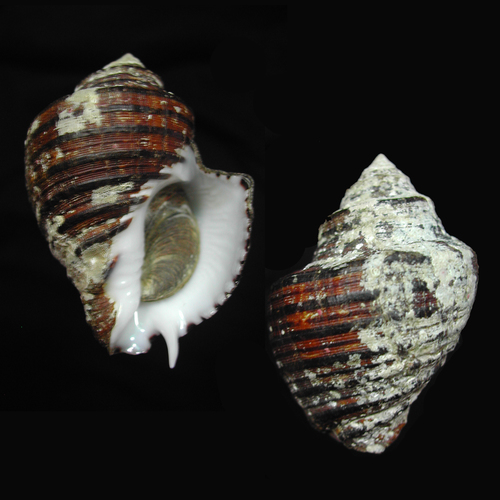
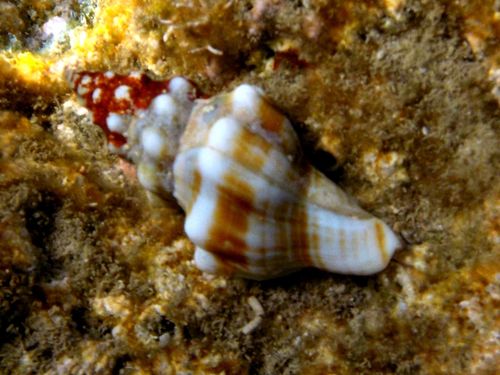
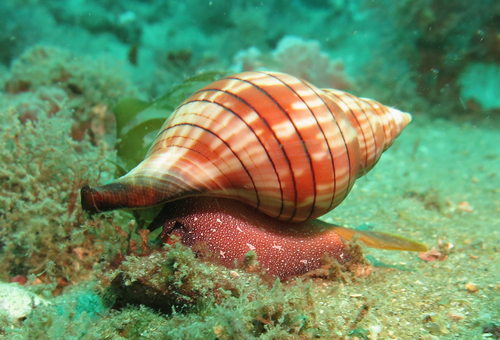
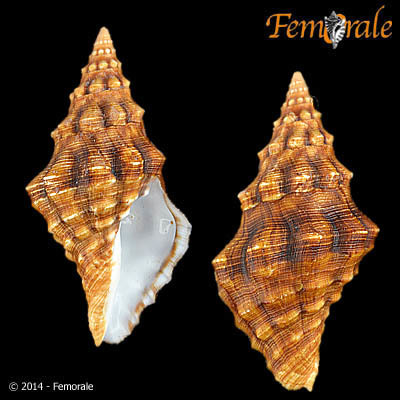
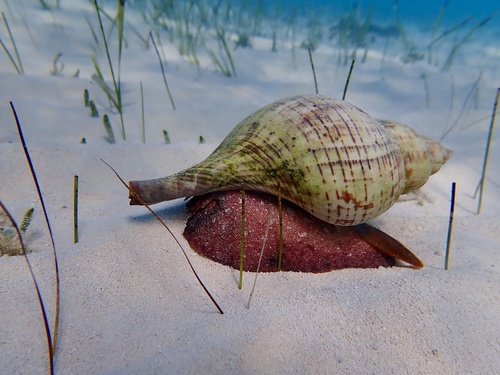
The shell of this species, commonly called the tulip shell, has a fusiform shape and an overall smooth surface, with fine growth lines. Small denticles line the inner edge of its delicate outer lip. The shell ranges in color from whitish to tan, marked with rows of darker brownish blotches of varying sizes. Symmetrical rows of thin spiral lines run across these blotches along the shell whorls, which are usually around 9 in number. Adult tulip snails have shells that measure 2.5 to 9.5 inches (6.4 to 24.1 cm) in length.
Fasciolaria tulipa has one of the largest geographic distributions among any western Atlantic Fasciolariid. It occurs along the coast of North Carolina, extending south and west to the Gulf coast of Texas, across the West Indies (where it has been identified at all water depths and on all islands), to northern Brazil, spanning coordinates from 35°N to 4°N latitude and 97.22°W to 51°W longitude. This species lives in the benthic zone, recorded at a maximum depth of 73 meters. It is commonly found in seagrass beds and sand flats in marine environments, and also often inhabits shallow waters such as estuaries and inlets. It is frequently encountered in the Gulf of Mexico along Florida’s gulf coast and near the Florida Keys.
In 1969, a population survey in Alligator Harbor off the northwest coast of Florida found a density of one individual per 917 square meters, and little was originally known about the species’ behaviors and ecological interactions. It is now confirmed that F. tulipa lives in the benthic zone of temperate habitats, around seagrass beds and tidal flats. It is larger than its close relative F. hunteria. Due to its habitat and size, this tulip snail is cannibalistic, meaning it preys on other individuals of the same species. Both juvenile and adult F. tulipa are preyed on by horse conchs, carnivorous crabs, other carnivorous snails, other crustaceans, sea stars, and bony fishes. When threatened or sensing potential danger, the tulip snail retracts into its shell and uses its operculum to seal the aperture to evade predation. It can also thrash its muscular foot to escape a predator’s grasp as an additional defense.
Fasciolaria tulipa reproduces sexually through internal fertilization. Five distinct reproductive stages have been observed: rest, gametogenesis, mature, spawn, and post spawn. During the rest stage, little to no reproductive activity occurs, and newly hatched larvae grow to reach sexual maturity. In the gametogenesis stage, mature gametes are produced and accumulate, preparing the individual for the mature and spawn stages. The mature and spawn stages are the period of highest reproductive activity, when eggs are laid. After spawning comes the post spawn stage, when eggs hatch and enter the larval stage. The cycle repeats by returning to the rest stage once the larval stage concludes.
Observed spawning occurs from January through October, with peak spawning in October. The post spawn stage peaks in November, right after the spawning peak. The rest stage occurs in December, and gametogenesis begins again in January. While each stage has an annual peak, individual snails can be in any reproductive stage at any time of year, and different individuals will be in different stages at the same time.
Eggs are enclosed in smooth, opaque, white egg capsules. Each capsule holds 14 embryos that hatch out from the capsule. Egg capsules are laid in large clusters, attached to hard surfaces on or near the seafloor. Larvae develop using nutrients from within the egg capsule, and become free-swimming for up to six days after hatching. Males and females can be distinguished by their reproductive organs. Females have ovaries, cement glands located in the center of the foot, and a large pallial oviduct. Males have testes, a narrow vas deferens, a prostate gland, and a penis.