About Falcunculus frontatus (Latham, 1802)
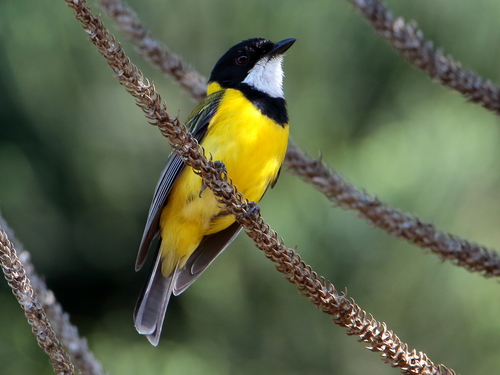
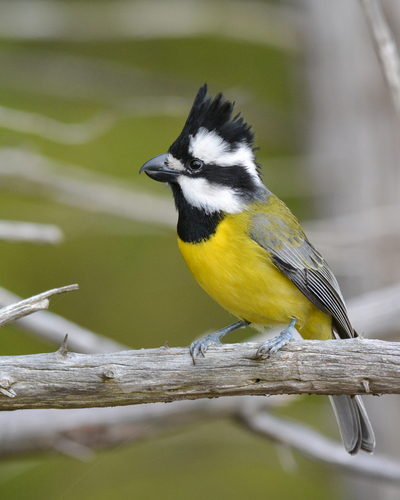
The eastern shriketit, Falcunculus frontatus (Latham, 1802), measures 15–19 cm (5.9–7.5 in) in total length, with a wingspan of 24–29 cm (9.4–11.4 in). Males weigh 26.5–40 g (0.9–1.4 oz), while females weigh 23–33 g (0.8–1.2 oz). This species has an olive-brown to olive-green mantle, back, and rump, with yellow underparts. Its head has broad white patches divided by a thick black eyeline, and a second black band runs across the crown from the bill to the nape. Males have an erectable crest and a black throat, while females have an olive-brown throat. The species has a large bill that it uses to lever and strip bark. Juveniles share the adult head pattern, but have buffy-white throats, breasts, and bellies, and browner wings. The eastern shriketit is endemic to Australia. Its range extends from the Atherton Tablelands in tropical Queensland, south through New South Wales and Victoria (including the Murray-Darling basin), to the Mount Lofty Ranges and Fleurieu Peninsula in South Australia. It is most common in north-central and coastal Victoria, and in New South Wales east of the Great Dividing Range; populations in Queensland are more scattered. Its preferred habitat is the canopy of eucalypt forests and open woodlands. It also occurs less often in stands of mallee, cypress-pine, coastal tea-tree, and banksia, lives in trees along rivers, and is occasionally found in rainforests. It is either sedentary or locally nomadic.