About Falculea palliata I.Geoffroy Saint-Hilaire, 1836
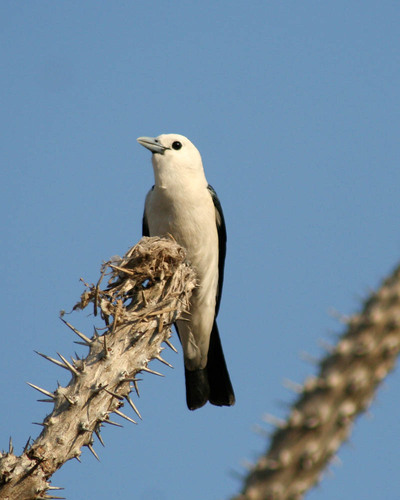
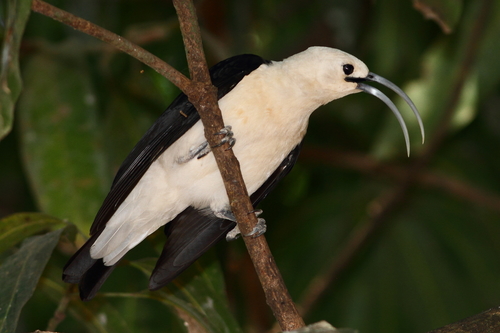
The sickle-billed vanga (Falculea palliata) is the largest species in the vanga family. Adults measure 32 cm (13 in) in length and weigh between 106 and 119 g (3.7–4.2 oz). Its most prominent feature is a strongly decurved bill, which reaches 77 mm (3.0 in) in length; the bill is blue-grey, fading to ivory at the tip. This bird has distinctively colored plumage: its head, breast, and belly are white, while its back, wings, and tail are black with a blue sheen. The iris is brown, and the orbital ring surrounding the eye is black. Its strong legs are colored dark grey to pale blue. There is no sexual dimorphism in this species. Juvenile sickle-billed vangas are similar in appearance to adults, but the black feathers on their back and wings are tipped with buff. This species is endemic to Madagascar, where it lives across the western side of the island. Its range extends from sea level up to 900 metres (3,000 ft) in elevation. It inhabits dry deciduous forest and thorn-forest, and can also be found in open savanna and wooded areas around villages. The sickle-billed vanga is non-migratory. It is common throughout its native range, and receives protection in several Malagasy national parks and protected areas including Andohahela National Park, Ankarafantsika National Park, and Berenty Reserve. For these reasons, the IUCN has evaluated this species as Least Concern.