About Falco tinnunculus Linnaeus, 1758
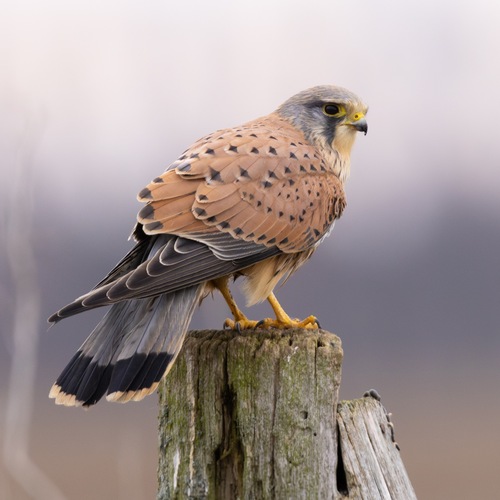
The common kestrel, with scientific name Falco tinnunculus Linnaeus, 1758, has a total head-to-tail length of 32–39 cm (12+1⁄2–15+1⁄2 in) and a wingspan of 65–82 cm (25+1⁄2–32+1⁄2 in). Females are noticeably larger than males: adult males weigh 136–252 g (4+3⁄4–8+7⁄8 oz), averaging around 155 g (5+1⁄2 oz); adult females weigh 154–314 g (5+3⁄8–11+1⁄8 oz), averaging around 184 g (6+1⁄2 oz). Compared to other birds of prey, common kestrels are small, but they are larger than most songbirds. Like other species in the Falco genus, they have long wings and a distinctive long tail. Their upper plumage is mainly light chestnut brown with blackish spots, while the underside is buff with narrow blackish streaks; the remiges are also blackish. Unlike most raptors, common kestrels have sexual colour dimorphism: males have fewer black spots and streaks, plus a blue-grey cap and tail. Females have brown tails with black bars, and both sexes have a black tail tip with a narrow white rim. All common kestrels have a prominent black malar stripe, just like their closest relatives. The cere, feet, and a narrow ring around the eye are bright yellow, while the toenails, bill, and iris are dark. Juveniles resemble adult females, but their underside streaks are wider, and the yellow colour of their bare parts is paler. Hatchlings are covered in white down feathers, which is replaced by a buff-grey second down coat before they grow their first true plumage. For behaviour and ecology: in the cool-temperate parts of its range, the common kestrel migrates south for winter; it is sedentary in other parts of its range, though juvenile common kestrels may wander to find a suitable place to settle as they mature. It is a diurnal species that lives in lowland areas, and prefers open habitats including fields, heaths, shrubland, and marshland. It does not need woodland to be present, as long as there are alternative perching and nesting sites such as rocks or buildings. It can thrive in treeless steppe, where abundant herbaceous plants and shrubs support a population of prey animals. The common kestrel adapts easily to human settlements, as long as enough large areas of vegetation are available, and it can even be found in wetlands, moorlands, and arid savanna. It can be found from sea level up to lower mountain ranges, reaching elevations of up to 4,500 m (14,800 ft) above sea level in the hottest tropical parts of its range, but only reaches about 1,750 m (5,740 ft) in the subtropical climate of the Himalayan foothills. The IUCN does not consider this species to be globally threatened. Its populations were affected by the indiscriminate use of organochlorines and other pesticides in the mid-20th century, but because it is an r-strategist that can multiply quickly when conditions are good, it was less affected than other birds of prey. The global population has fluctuated considerably over the years but remains generally stable overall; it is roughly estimated at around 1–2 million pairs, with around 20% of these pairs located in Europe. A recent population decline has occurred in parts of Western Europe such as Ireland. The subspecies F. t. dacotiae is quite rare, with fewer than 1000 adult individuals recorded in 1990, while the ancient western Canarian subspecies F. t. canariensis numbered about ten times that amount in the same year. For food and feeding: when hunting, the common kestrel characteristically hovers about 10–20 m (35–65 ft) above the ground to search for prey, either by flying into the wind or soaring using ridge lift. Like most birds of prey, common kestrels have keen eyesight that lets them spot small prey from a distance. Once prey is spotted, the bird makes a short, steep dive toward the target; this differs from peregrine falcons, which rely on longer, higher dives to reach full speed when targeting prey. Kestrels are often found hunting along the sides of roads and motorways, where road verges support large numbers of prey. This species can see near ultraviolet light, which lets it detect the urine trails around rodent burrows, as these trails glow in ultraviolet colour under sunlight. Another favoured, less conspicuous hunting technique is to perch slightly above ground cover to survey the area. When the bird sees prey moving past, it pounces on it. They also move through a hunting ground in low, ground-hugging flight, ambushing prey when they encounter it. Common kestrels eat almost exclusively mouse-sized mammals. Voles, shrews, and true mice make up three-quarters or more of the biomass consumed by most individuals. On oceanic islands, where mammals are often scarce, small birds (mainly passerines) may make up the bulk of the common kestrel's diet. In other regions, birds are only an important food source for a few weeks each summer, when inexperienced fledglings are abundant. Other appropriately sized vertebrates such as bats, swifts, frogs, and lizards are only eaten rarely. However, common kestrels are more likely to prey on lizards in southern latitudes. In northern latitudes, kestrels more often deliver lizards to their nestlings during midday, and this tendency increases as ambient temperature rises. Seasonally, arthropods may be a main prey item. Generally, common kestrels eat invertebrates such as camel spiders and earthworms, but mainly eat large-sized insects including beetles, orthopterans, and winged termites. A common kestrel needs the equivalent of 4–8 voles per day, depending on its energy expenditure (time of year, amount of hovering, etc.). They have been recorded catching multiple voles in succession and caching some for later consumption. On average, an individual nestling consumes 4.2 g of food per hour, which is equivalent to 67.8 g per day (3–4 voles per day).