About Falco subniger G.R.Gray, 1843
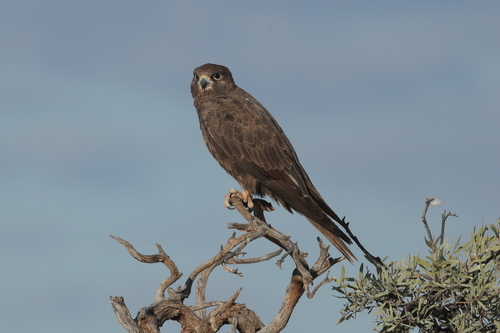
This description of Falco subniger (black falcon) draws on recent work from multiple authors, including Debus & Davies 2012, Debus & Olsen 2011, Morcombe 2002, and Birds in Backyards n.d. For adult black falcons measured from beak to tail, total length ranges from 45 to 56 cm, with an average of 50 cm. The tail makes up approximately half of the bird's total length. Females are larger than males, which is a form of sexual dimorphism. Average weight is 833 g for females and 582 g for males. Wingspan ranges from 95 to 115 cm. Adult plumage is uniformly dark brown to sooty black; juveniles are generally darker than adults. Underwing feathers are two-tone, with flight feathers being slightly paler. Adults may have a noticeable dark stripe below the eye. Occasionally, individuals have a white chin, spots on the underwing coverts, or bars on the undertail coverts. The cere, eye ring, and feet are pale grey or pale blue-grey; the eye is dark brown, the tip of the beak is black, and the talons are black. Chicks are covered in white down. The black falcon has a streamlined body, a relatively long tail, a slim build, and long pointed wings that taper toward the wing tip. For identifying a flying black falcon, Debus & Davies recommend focusing on the bird's silhouette, including wing shape and body proportions, flight style, and vocalisations, rather than fine details of colouration. Australian falcons can be distinguished from hawks by their toothed upper mandible, which has a matching notch in the lower mandible, and their long pointed wings. The brown falcon (Falco berigora), a common widespread Australian species, is the raptor most likely to be confused with the black falcon, especially juvenile brown falcons and black morph brown falcons. Debus & Olsen note that many observations and behaviours of brown falcons have incorrectly been assigned to black falcons due to misidentification. The two species differ in the relative length of the exposed tarsi, the lower visible portion of the leg, compared to the thigh feathers, as well as in flight style, wing position, and the presence of bold underwing barring and tail barring, which only occur on the brown falcon. Black falcons are widely distributed across mainland Australia, excluding densely forested areas. The species is only occasionally observed in the southern interior of Western Australia, and is sparse in coastal areas of south-eastern Australia. BirdLife International records occasional non-breeding vagrant individuals in New Zealand. The species' total estimated distribution area is 5,910,000 km². Black falcons most often inhabit arid and semi-arid zones, and are typically found near watercourses or use stands of isolated trees. They hunt over open wooded grasslands, saltbush plains, bluebush plains, and other low vegetation. In arid regions, they hunt over wetlands or near artificial or temporary water bodies, areas that tend to support the highest abundance of birdlife. The size of the black falcon's home range has not been confirmed, but it is thought to be larger than 100 km². The species ranges over wide areas during the non-breeding season, but some individuals stay in regular non-breeding territories for long periods. Black falcons both harass other bird species, including other raptors and corvids, and are harassed by these species in return. They may rest on power poles during the day, but do not perch on wires.