About Falco subbuteo Linnaeus, 1758
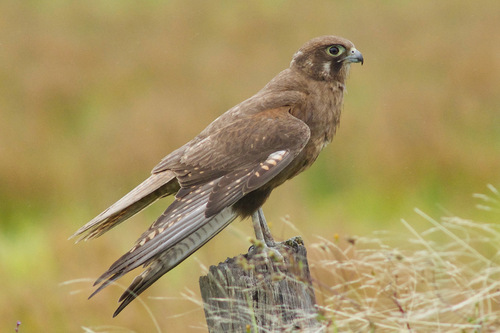
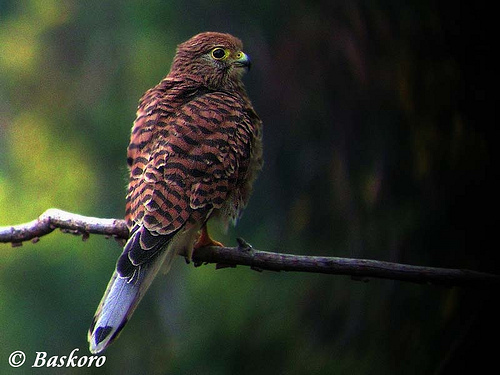
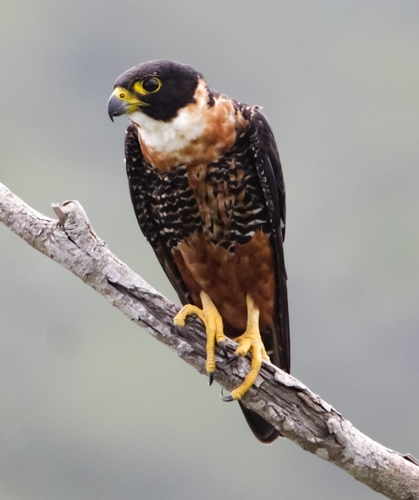
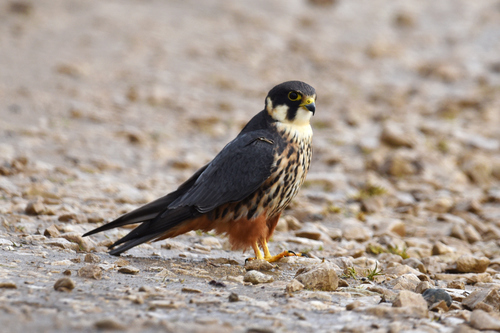
Description: Adult Falco subbuteo are slate-grey on their upper bodies, with a dark crown and two short black moustache stripes. The throat is solid unstreaked white; the thighs and undertail coverts are solid unstreaked rufous. The remaining underparts are whitish, marked with black streaks. The red "trousers" and vent are visible when seen at close range. Adult males and females have similar plumage. Juveniles are generally much browner overall, with scaled-pattern upper parts and streaked buffy thighs and undertail coverts. This falcon species has a distinct first-summer plumage. Adults measure 29–36 cm (11–14 in) in length, have a wingspan of 74–84 cm (29–33 in), and weigh 175–285 g (6.2–10.1 oz).
Distribution and habitat: This species breeds across the Palearctic realm. The nominate subspecies F. s. subbuteo is a long-distance migrant, and winters in Africa. The subspecies F. s. streichi is mainly non-migratory and resident. It is a rare vagrant in North America, with extralimital records from Massachusetts, Washington, and Alaska in the United States, and from Newfoundland and British Columbia in Canada. It has also been sighted in Australia and Brazil.
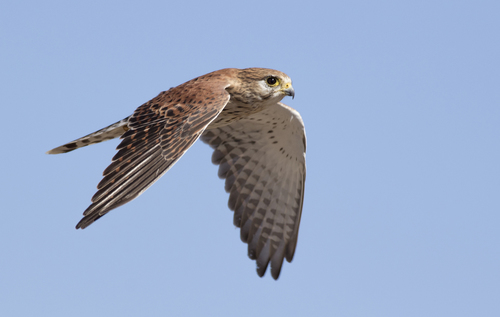
Behaviour and ecology: It occurs in open country habitats including farmland, marshes, taiga and savannah. It is widespread in lowlands with scattered small woods. It is an elegant bird of prey, with long pointed wings and a square tail that give it a sickle-like shape in flight; when gliding with folded wings it often resembles a swift. It is fast and powerful in flight. It hunts large insects such as dragonflies, transferring caught prey from its talons to its beak to eat while soaring slowly in circles. It also captures small bats and small birds in mid-flight. Its speed and aerobatic skill allow it to catch swallows and even swifts on the wing, and barn swallows or house martins have a specific alarm call for this falcon. It is known to harass swallows while the swallows are roosting and dispersing from roosts. When not breeding, it is crepuscular, and hunts primarily during the morning and evening. During migration, individuals may travel in small groups. Hobbies nest in old nests built by crows and other bird species. The tree chosen for nesting is most often one in a hedge or on the extreme edge of a small wood, allowing the bird to observe intruders from a considerable distance. The female lays 2–4 eggs. Incubation is reported to take 28 days, and both parents share this duty, although the female does the majority of the work. It is a very bold and courageous bird, and was historically used in falconry, trained to hunt birds such as quails, larks, hoopoes, and drongos.