About Falco sparverius Linnaeus, 1758
Under traditional classification, the American kestrel (Falco sparverius Linnaeus, 1758) is the smallest raptor in the Americas. This species is sexually dimorphic, though there is some overlap in plumage coloration between males and females. Adults measure 22 to 31 cm (8.7 to 12.2 in) in total length, with a wingspan of 51–61 cm (20–24 in). Females are larger than males, with a typical size difference of 10% to 15% within a single subspecies, a smaller difference than seen in larger falcon species. Northern hemisphere subspecies from more northern regions tend to be larger: a large northern female can be roughly twice the size of a small southern male. Males typically weigh 80–143 g (2.8–5.0 oz), while females weigh 86–165 g (3.0–5.8 oz). In standard body measurements, the wing bone is 16–21 cm (6.3–8.3 in) long, the tail is 11–15 cm (4.3–5.9 in) long, and the tarsus is 3.2–4 cm (1.3–1.6 in) long.
Physically, American kestrels are leaner and less muscular than larger falcons. Their pectoral flight muscles make up only around 12% of their total body weight, compared to around 20% for strong-flying falcons like the peregrine falcon. Their wings are moderately long, fairly narrow, and taper to a point. This less muscular body type is adapted for energy-conserving ambush hunting, rather than expending large amounts of energy on extended flight and long tail chases of avian prey. Despite their lean build, they have strong talons and beaks for their size, and can kill prey quickly. Their lean build and energy-conserving strategy mean they require a lower daily food intake than more heavily muscled raptors, yet still have enough strength to commonly take bird prey as large as themselves, and occasionally even larger prey. The success of this body form and hunting strategy is reflected in the species' widespread abundance across a large range throughout the Americas. The American kestrel's flight is less dramatic and swift than that of more muscular falcons such as merlins and peregrines, but its efficient adaptation to a broader diet of more readily available smaller prey, and lower daily food requirement, has led to a much larger global population.
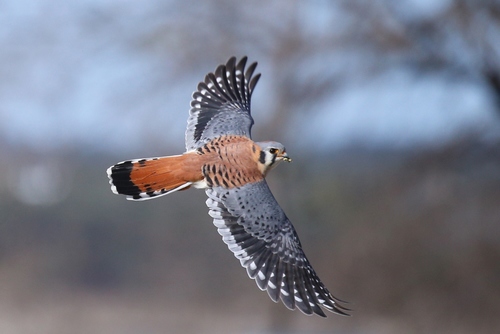
Unlike many other raptor species, American kestrel sexes differ more in plumage than in size. Males have blue-grey wings with black spots, white undersides with black barring, a rufous back with barring on the lower half, and white bellies and flanks with black spotting. The male's tail is also rufous, with a white or rufous tip and a black subterminal band. Females have rufous backs and wings with dark brown barring, creamy to buff undersides with heavy brown streaking. The female's tail is rufous with numerous narrow dark black bars, which distinguishes it clearly from the male's tail. Juveniles have coloration patterns similar to adults. In both sexes, the head is white with a bluish-grey crown. There are two narrow, vertical black facial markings on each side of the head, while other falcons only have one. Two black spots called ocelli are present on each side of the white or orangish nape. The function of these spots is debated, but the most widely accepted theory is that they act as "false eyes" to help protect the bird from potential attackers.
American kestrels occupy a wide variety of habitats, including grasslands, meadows, deserts, and other open to semi-open regions, and can also be found in both urban and suburban areas. Suitable kestrel habitat must include perches, open space for hunting, and cavities for nesting (either natural or man-made). The species can survive in very diverse conditions, ranging from above the Arctic Circle to the tropics of Central America, and to elevations over 4,500 m (14,800 ft) in the Andes Mountains. Its distribution extends from northern Canada and Alaska to Tierra del Fuego, the southernmost tip of South America. It is the only kestrel found in the Americas, though this traditional classification is genetically inaccurate. It has occurred as a vagrant in the United Kingdom, Denmark, Malta, and the Azores.
American kestrels breeding in Canada and the northern United States typically migrate south for the winter, some joining smaller resident kestrel populations in Mexico, and some traveling as far south as Central America and the Caribbean. Birds breeding south of roughly 35° north latitude are usually year-round residents. Migration patterns also depend on local weather conditions. American kestrels breeding at lower latitudes (specifically below 48ºN) arrive earlier at breeding grounds after warmer springs, while birds from higher latitudes return to their breeding grounds at the same time each year. These patterns suggest short-distance migrant populations are better able to cope with climate change.
Wintering habitat choice differs by sex. Females are found in open areas more often than males during the non-breeding season. A common explanation for this behavior is that larger females arrive at preferred habitat first and exclude males from their territory. The American kestrel is not long-lived; wild birds have a lifespan of less than 5 years. The oldest recorded banded wild individual lived 11 years and 7 months, while captive kestrels can live 14–17 years. In one study of 1,355 reported deaths, human activity (including direct killing and roadkills) accounted for 43.2% of deaths, while predation (including by larger birds of prey) accounted for 2.8%. This statistic is likely biased, as reported deaths are usually found near or in human-populated areas. In Florida, American kestrels may be preyed on by certain growth stages of invasive snakes including Burmese pythons, reticulated pythons, Southern African rock pythons, Central African rock pythons, boa constrictors, yellow anacondas, Bolivian anacondas, dark-spotted anacondas, and green anacondas.
American kestrels reach sexual maturity by their first spring. In migratory populations, males arrive at breeding grounds before females, and females then select a mate. Pair bonds are strong, often permanent. Pairs usually reuse previous nesting sites in consecutive years, which gives them an advantage over younger or invading individuals, as they already know the local hunting grounds, neighbors, predators, and other site features. Males perform elaborate dive displays to advertise their territory and attract mates, which consist of repeated climbs and dives, with three or four "klee" calls at the peak of each dive. Females are promiscuous for about one to two weeks after arriving at the nesting site, a behavior thought to stimulate ovulation. Food transfers from males to females occur from roughly four to five weeks before egg laying through one to two weeks after laying.
American kestrels are cavity nesters, but can adapt to a wide variety of nesting situations. They generally prefer natural cavities such as tree hollows with closed tops and tight-fitting entrances, which provide maximum protection for eggs and young. Kestrels will occasionally nest in holes created by large woodpeckers, or use abandoned nests of other birds including red-tailed hawks, merlins, and crows. They have been recorded nesting on cliff ledges, building tops, and abandoned cavities in cacti, and also commonly use man-made nesting boxes. Three to seven eggs (most typically four or five) are laid approximately 24–72 hours apart. Two supernormal clutches of eight eggs and one clutch of nine eggs have been documented; one egg from each of the eight-egg and nine-egg clutches successfully hatched. Average egg size is 32 mm × 29 mm (1.3 in × 1.1 in), which is 10% larger than the average for birds of this body size. Eggs are white to cream colored with brown or grey splotching. Incubation usually lasts 30 days, and is mainly the responsibility of the female, though the male incubates 15–20% of the time. Lost eggs are typically replaced within 11–12 days. Hatching occurs over three to four days. Hatchlings are altricial, and are only able to sit up after five days. They grow rapidly, reaching adult weight after 16–17 days. After 28–31 days, their wings are fully developed and they leave the nest.
Young American kestrels may breed at one year old, and the species has an approximate life expectancy of three to five years in the wild. In ecological terms, the American kestrel's reproductive pattern leans toward the small bird "r selection" strategy, under r/K selection theory, which describes two generalized evolutionary pathways driven by selective pressures. R-selected species prioritize high population growth, typically exploit less-crowded ecological niches, and produce many offspring, each of which has a relatively low probability of surviving to adulthood. K-selected species, by contrast, display traits associated with living at densities close to the environment's carrying capacity, are typically strong competitors in crowded niches, and invest more heavily in fewer offspring, each with a relatively high probability of surviving to adulthood. American kestrel is one of the few raptor species that leans toward r-selection, between the two extremes: they can breed at one year old, have few non-breeding adults in their populations, produce larger broods, and have a higher population growth rate than larger raptors, which typically lean toward K-selection. Even so, older breeding pairs generally have larger broods and produce more viable offspring than younger members of the species.
One common use of American kestrels is in falconry. They are often considered a good beginner bird for falconry, though maintaining the bird's aggressive hunting drive requires careful weight control, which takes skill. Experienced falconers who bring out the species' full capabilities report that American kestrels are highly reliable for hunting common game such as sparrows and starlings. More aggressive individuals can sometimes capture prey up to roughly twice their own body weight, allowing occasional capture of larger game birds such as quail and dove. However, falconers seeking reliable catches of this larger game generally prefer larger falcons or hawks. The advantage American kestrels offer experienced falconers is their suitability for simple, urban falconry that does not require large tracts of land or hunting dogs. This form of falconry is sometimes called "micro-falconry" or "micro-hawking". Other small raptor species commonly used in micro-falconry are merlins, the sharp-shinned hawk (the smallest Accipiter), and the European kestrel.
Hunting with American kestrels requires adapting to the species' specific strengths and weaknesses. It is a very small falcon, and even for its size it is less muscular than other small falcons such as the athletic, swift merlin. It is more adapted to ambush hunting and short chases than the longer aerial chases that larger falcons often use. When used within its limits, it is effective. Experienced falconer Matthew Mullenix, author of American Kestrels in Modern Falconry, summed up the species' abilities compared to merlins as follows: Kestrels are thin-winged, flat-chested, under-powered and lack acceleration compared to merlins, Mullenix notes, but states this is not a damning flaw, just like differences between red-tailed hawks and larger hawks do not negate the effectiveness of well-trained red-tailed hawks. Mullenson adds that the main factor in choosing between a kestrel and a merlin is hunting habitat: merlins excel in open country such as cattle pasture, while kestrels are recommended for hunting in towns or suburbs, especially when hunting from a car. A secondary factor is intended quarry: merlins are best suited for snipe, dove, quail, and open-country sparrows; both species are effective against most blackbirds (Icteridae); starlings in close cover and house sparrows in thick cover are extremely vulnerable to kestrels, while the same prey in open areas are better hunted with merlins, and thick-cover quarry is the type of hunt that American kestrels are perfectly suited for. Once committed to an attack, trained kestrels generally follow through to the end: they will stoop into cover, chase prey on foot, hold onto quarry twice their size, and never release voluntarily voluntarily. While they have small feet, they have the strongest feet for their size, and on average American kestrels hold starlings better than merlins, and will willingly tackle larger quarry than any male merlin.
American kestrels do not learn the "waiting on" technique (climbing to a high position to perform a diving stoop on flushed prey) as easily as some larger falcons, especially peregrine falcons, though some individual kestrels do master this skill. Falconers sometimes train them to climb to a stooping position by using tidbits on kites or balloons that the kestrels learn to climb after. More common hunting techniques for falconry are "slipping" the kestrel after spotted game from the falconer's fist, or releasing it from a vehicle window close to spotted quarry, which fit more naturally with the kestrel's natural wild ambush hunting methods. Falconers flying American kestrels should be alert to protect the falcon from larger predators that may attack, especially when the kestrel is distracted on the ground with captured prey. Domestic cats and dogs are the greatest threat to kestrels on the ground, but Cooper's hawks are well known to boldly attack kestrels. This mid-sized American hawk has enough size and strength to carry a kestrel away, though falconers often successfully recover the kestrel unharmed by acting quickly to intimidate the larger hawk into releasing it.
American kestrels are bred in captivity for falconry, and are among the easier falcon species to breed. They are also sufficiently common that first-year migratory "passage" birds are relatively easy to trap. Wild-caught kestrels tame down fairly quickly: they will usually eat from a falconer's hand the day after capture, be in training within a week, and be ready to hunt in three to five weeks. A very tame American kestrel will allow a falconer to pick it up around the body with one hand while accepting tidbits with the other, which is very useful for checking or treating injury or illness. Migratory raptors native to the United States are protected by the 1918 Migratory Bird Treaty Act, so American kestrels are illegal to possess without a permit (such as a falconry permit) in the United States, Canada, and Mexico.