About Falco rusticolus Linnaeus, 1758
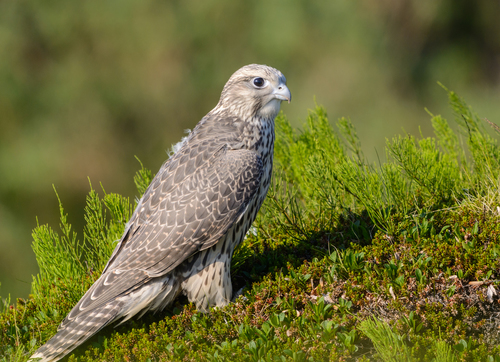
The gyrfalcon (scientific name: Falco rusticolus Linnaeus, 1758) is the largest falcon in the world. It is around the same size as the largest buteos, and is likely slightly heavier than them. Male gyrfalcons measure 48 to 61 centimetres (19 to 24 inches) in length, weigh 805 to 1,350 grams (1 pound 12+1⁄2 ounces to 2 pounds 15+1⁄2 ounces) with reported average weights of 1,130 g (2 lb 8 oz) or 1,170 g (2 lb 9+1⁄2 oz), and have a wingspan ranging from 110 to 130 cm (43 to 51 in). Female gyrfalcons are larger and bulkier than males: they are 51 to 65 cm (20 to 25+1⁄2 in) long, have a 124 to 134 cm (49 to 53 in) wingspan, weigh 1,180 to 2,100 g (2 lb 9+1⁄2 oz to 4 lb 10 oz) with average weights of 1,585 g (3 lb 8 oz) or 1,752 g (3 lb 13+3⁄4 oz). One unusually large female gyrfalcon from eastern Siberia was recorded to weigh 2,600 g (5 lb 12 oz). For standard measurements, the wing chord is 34.5 to 41 cm (13.6 to 16.1 in), the tail is 19.5 to 29 cm (7.7 to 11.4 in), the culmen is 2 to 2.8 cm (3⁄4 to 1+1⁄8 in), and the tarsus is 4.9 to 7.5 cm (1+7⁄8 to 3 in). Compared to the peregrine falcon (which it competes with and occasionally hunts), the gyrfalcon is larger, with broader wings and a longer tail. It has a different general structure from buzzards, as it has pointed wings. The gyrfalcon is a highly polymorphic species, so its plumage varies a great deal. The common archetypal morphs are named "white", "silver", "brown", and "black", and plumage can range across a full spectrum from all-white to very dark. The brown morph gyrfalcon can be distinguished from the peregrine falcon by cream streaking on the nape and crown, and the lack of a well-defined malar stripe and cap. The black morph is similar to the brown morph, but has a strongly black-spotted underside, unlike the fine barring seen on peregrine falcons and brown morph gyrfalcons. White morph gyrfalcons are the only falcons that are predominantly white. Silver gyrfalcons resemble a larger-sized light grey lanner falcon. There are no color differences between sexes of this species; juvenile gyrfalcons are darker and browner than adult gyrfalcons. Black coloration in gyrfalcons appears to be sex-linked and occurs mostly in females. It has been difficult for breeders to produce males darker than the dark end of the slate grey range. A color variation called "black chick" has appeared in captive breeding programs.