About Falco rupicoloides A.Smith, 1829
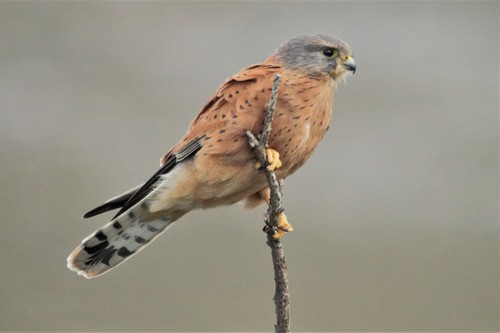
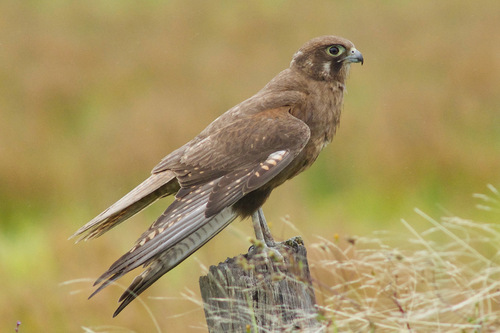
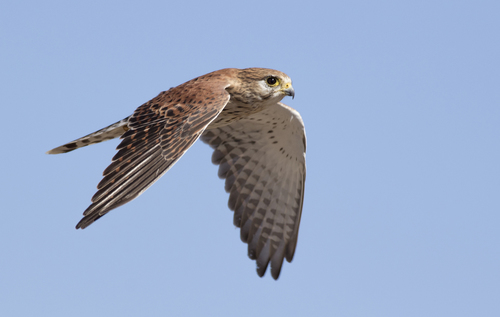
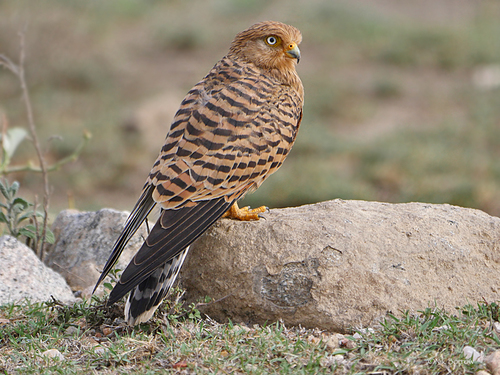
Adult greater kestrels (Falco rupicoloides) have predominantly pale rufous plumage on both their upper and lower bodies. The back, upperwings, and flanks feature black barring, while the breast has dark streaks, and the head is also streaked. Unlike common and lesser kestrels, this species does not have a malar stripe. The rump and tail are grey with black bars, and the tail ends in a white tip. In flight, the bird's whitish underwings create a contrast with its darker body. The iris is whitish, which sets this species apart from all similar species. The bill is mostly blue-grey, and the feet and cere are yellow. Juvenile birds have a rufous rather than grey tail, streaked flanks, and a dark eye. This falcon measures 29–37 cm (11–15 in) in length, with a wingspan of 68–84 cm (27–33 in). The southern subspecies F. r. rupicoloides weighs between approximately 181–334 grams (0.400–0.736 lb). The subspecies F. r. arthuri is smaller, weighing 165–252 grams (0.364–0.556 lb). The northern subspecies F. r. fieldi is also small, and paler than the other two subspecies. The species is typically silent, but produces a shrill, repeated call. This bird occurs in open, arid areas, where it lives in grassland, savanna, and semi-desert habitats. It is often associated with acacias, and prefers areas with ground cover lower than 50 cm. It can be found from sea level up to 2150 meters, and is most common between 800 and 1800 meters. It is fairly common and widespread across the southern parts of its range, but becomes scarce and patchily distributed further north. The subspecies F. r. rupicoloides breeds in Namibia, Botswana, Zimbabwe, parts of Angola and Zambia, and most of South Africa excluding the wetter regions of the south and east. F. r. arthuri is found in Kenya and northern Tanzania, while F. r. fieldi occurs in Ethiopia, Eritrea, northern Somalia, and likely northern Kenya. The species' total range covers approximately 3.5 million square kilometers. Its population is stable, and is estimated to number between 100,000 and 200,000 breeding pairs. Most individuals are sedentary, though some are nomadic or dispersive. The breeding season for Falco rupicoloides varies by region. In the southern part of the range, breeding runs from July to April, peaking between September and December. In Kenya and Tanzania, breeding can occur in any month, but is concentrated between April and July. In Somalia, the breeding season lasts from April to August. Greater kestrels breed using abandoned nests built by other bird species, such as nests of Cape crows or pied crows. Breeding nests are typically placed 2 to 20 meters above the ground in a tree, and may sometimes be located on a telegraph pole or pylon. Females lay between two and seven eggs, with three or four eggs being the most common clutch size. Eggs are incubated for 22 to 23 days, with the female performing most of the incubation. Chicks fledge 30 to 34 days after hatching, and remain dependent on their parents for at least an additional 26 days.