About Falco rufigularis Daudin, 1800
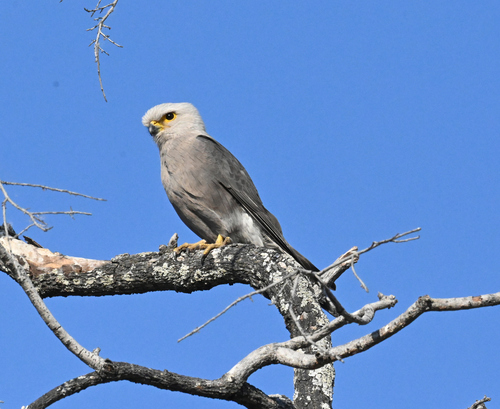
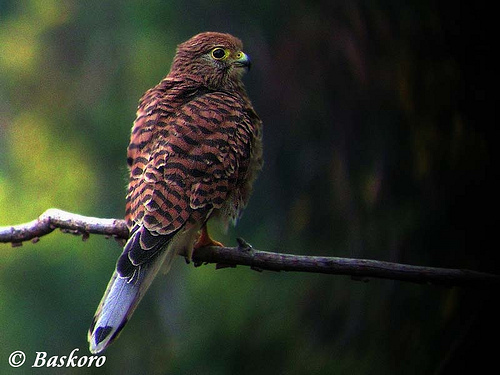
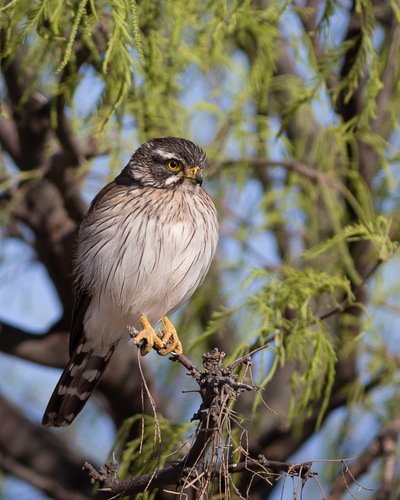
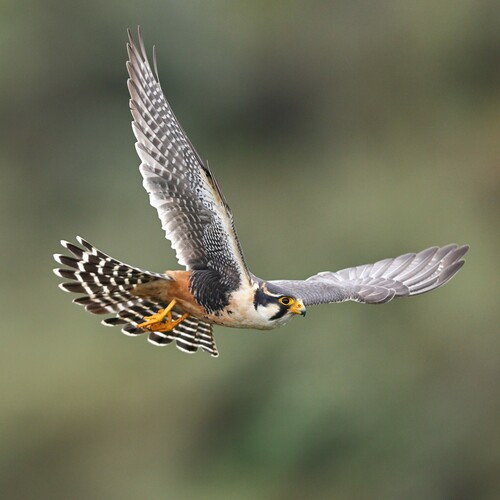
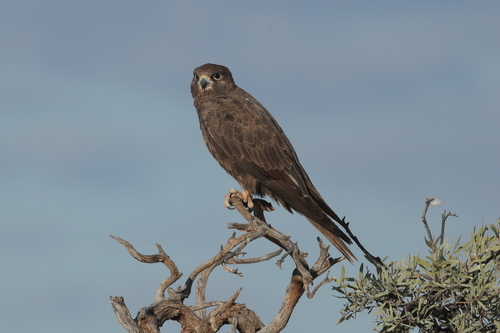
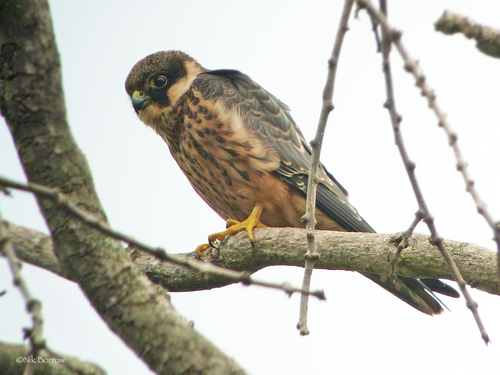
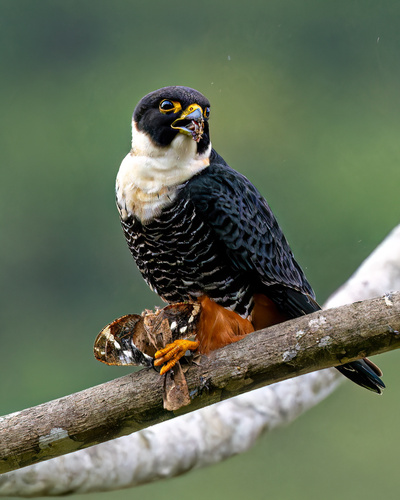
The bat falcon (scientific name: Falco rufigularis Daudin, 1800) measures 23 to 30 cm (9.1 to 12 in) in length. Males weigh 108 to 150 g (3.8 to 5.3 oz) and have a wingspan of 51 to 58 cm (20 to 23 in), while females are larger, weighing 177 to 242 g (6.2 to 8.5 oz) with a wingspan of 65 to 67 cm (26 to 26 in). It has long wings and a moderately long square-tipped tail. Males and females have similar plumage. Adult bat falcons have blue-black heads and upperparts, with grayish edges on feathers from the upper back to the uppertail coverts. Their throat, upper breast, and the sides of the neck range from white to buff, sometimes with a cinnamon tint; the rest of the breast is black with fine white bars. Their belly, thighs, and undertail coverts are chestnut-rufous. Their tail is blackish with thin white or grayish bars and a white or buff tip. The underside of the wings is black with fine white bars. Their cere and the bare skin around the eye are bright yellow, the iris is black-brown, and the legs and feet are orange-yellow. Juveniles are duller and browner than adults, with a buffer throat, a tawny tint to the breast barring, and black bars or spots on the undertail coverts. The three recognized subspecies are similar overall, differing mainly in the tone of their plumage. The three subspecies have distinct distribution ranges: F. r. petoensis ranges from northern Mexico south through all of Central America, to the west of the Andes in Colombia, Ecuador, and extreme northwestern Peru; F. r. rufigularis is found in Trinidad and from eastern Colombia east through Venezuela and the Guianas, and south through eastern Ecuador, eastern Peru, northern and eastern Bolivia, southern Brazil, and northern Argentina; F. r. ophryophanes is distributed in central Brazil and adjacent eastern Bolivia, Paraguay, and northeastern Argentina. A juvenile male of the subspecies F. r. petoensis wandered to Santa Ana National Wildlife Refuge in Alamo, Texas, in December 2021, which marks the only recorded record of the species in the United States; it stayed in the area until early March. F. r. rufigularis is resident on Trinidad and has been recorded as a vagrant on Tobago. The bat falcon lives in tropical forest. It prefers unbroken mature forest, but can also be found at forest edges, in gallery forest, wooded savanna, cleared land with some remaining trees, and even in suburban and urban areas. In terms of elevation, it mostly occurs from sea level to around 1,700 m (5,600 ft), with one single record of the species at about 3,250 m (10,700 ft) in Bolivia.