About Falco novaeseelandiae J.F.Gmelin, 1788
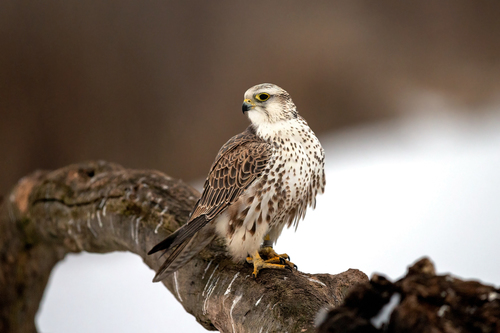
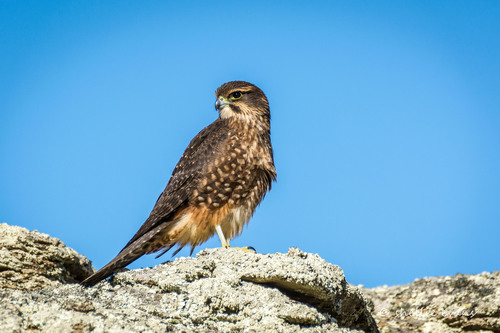
Falco novaeseelandiae, the New Zealand falcon, has three distinct forms that differ in size, colouration, and preferred habitat. The eastern falcon is larger and paler, the bush falcon is smaller and darker, and the southern falcon falls between the other two forms in size and colouration, with habitat preferences more similar to the bush falcon. On average, eastern falcons have more white bars on their tail feathers than the other two forms. Bush falcons primarily inhabit forests, while eastern falcons occupy open steppe habitats; bush falcons also have shorter wings for improved manoeuvrability within dense forest. Male New Zealand falcons are roughly two-thirds the size of females. For the eastern form, average wingspans measure 83 cm (33 in) for females and 72 cm (28 in) for males. Eastern form males weigh 300 to 350 g (11 to 12 oz), while bush form males weigh 250 to 300 g (8.8 to 10.6 oz). Eastern form females weigh 450 to 600 g (16 to 21 oz), and bush form females weigh 400 to 500 g (14 to 18 oz). Southern falcon weights fall between the eastern and bush forms.
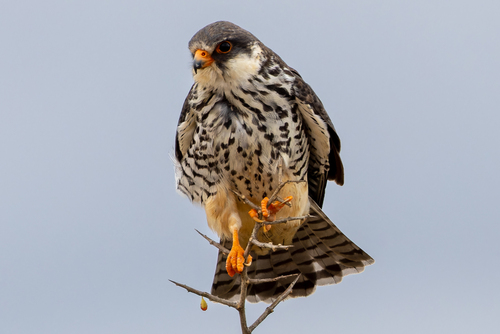
Adult New Zealand falcons have black, barred rufous, or grey plumage on their crown, nape, and back. Their tail is black with white bars of varying number. Wing tips are rounded, and inner wing feathers are black or grey with barring. A cream streak runs down the throat from the beak, the breast is cream with vertical black or dark brown streaks, and the abdomen is cream with streaked rufous markings. The base of the beak, eyes, and legs are all yellow; the beak itself is black with a tomial tooth. Claws are black, eyes are dark brown, and legs are dull yellow, which become vibrantly yellow in males during the breeding season. Juvenile New Zealand falcons have darker overall colouration and faint tail bars, with a brown breast and cream abdomen marked by fine brown streaks. The soft body parts that are yellow in adults are olive green, sky blue, or dull grey in adolescent falcons under 9 months old. Full adult plumage is achieved by 16 months of age.
The New Zealand falcon is endemic to New Zealand. Eastern falcons are native to open country and steppes in the eastern and central South Island, nesting on steep slopes or rock ledges. Bush falcons inhabit native podocarp broadleaf forests of the North Island, hunting at forest edges and nesting in pre-existing tree structures such as epiphytes and tree cavities in mature trees, or on sheltered ground. Southern falcons are found in the Auckland Islands, Stewart Island, and Fiordland, occupying coastal forest habitats, with ecological traits more similar to the bush falcon than the geographically closer eastern falcon. Native habitats of the New Zealand falcon have been reduced by human land development for agriculture, vineyards, forestry, and housing, which has impacted nest sites and prey abundance. The falcon's range has expanded to include human-modified landscapes such as pine plantations in the North Island and farmlands in the South Island. Falcons have been recorded living in or near exotic pine plantation stands since the 1990s, nesting in unplanted stands or stands less than 5 years old. Vegetation regeneration in older stands prevents ground nesting by falcons. Eastern falcons from the South Island have been translocated to Marlborough vineyards, and have bred successfully there since 2006 with the support of supplementary feeding, pest control, and predator-proof nest sites.
The New Zealand falcon is a sedentary bird that remains within or close to its home range most of the time. Home range size varies between 15 km² and 200 km², depending on local food availability. Outside of the breeding season, solitary falcons or pairs use permanent sheltered roosts; during the breeding season, falcons will use a temporary roost if their nest site is far from their permanent roost. Falcons are known to sunbathe for up to 30 minutes in the morning, positioning their darker back toward the sun. The New Zealand falcon is aggressive toward non-prey animals. When confronting another falcon, a swamp harrier, or large prey on the ground, the falcon shifts its weight back toward its fanned tail, opens its wings slightly, keeps its eyes focused on the opponent, and keeps its feet free to attack. It will sometimes lie on its back and defend itself with its feet. When intruders such as swamp harriers and humans approach too close to a nest, the falcon produces loud 'kekking' calls and stoops toward the intruder's head. Aggression toward other New Zealand falcons occurs during the breeding season and subsides outside of the breeding season. Observations of captive falcons stooping at rabbits and a cat suggest this behaviour is playful or territorial rather than hunting-related. Falcons of all ages and both sexes engage in play, which is initiated by turning the head upside down. They will chase, swoop, and mock-attack each other; solitary falcons will attack sticks, grass clumps, or roots. Breeding pairs often play together. Sometimes prey is caught and released multiple times before being killed, as a form of play or practice.
The New Zealand falcon has a high-pitched 'kek kek kek' call that is most often used for territory defence, with the male's call pitched higher than the female's. Adults also use a chitter call to communicate with one another, particularly after copulation. The kekking call consists of 3–12 syllables, is used by both sexes year-round, and carries over long distances. The chitter call has 3–6 syllables and is used when interacting with other falcons. There is also a 'chup' call that resembles the first syllable of a chitter, commonly used during play. When facing serious threats from other predators, falcons produce a 'squeal' call; this call is also sometimes used by captive falcons during handling. Both endoparasites and exoparasites have been recorded on the New Zealand falcon, but are not considered a major threat. Lice are common on fledglings, but their abundance decreases once down is replaced by adult feathers.
The New Zealand falcon hunts a wide variety of live prey, with its diet mostly consisting of introduced and native birds caught in flight. Prey composition largely reflects local species abundance, with little active selection for specific prey. The most common avian prey includes introduced finch, lark, pipit, and thrush species, as well as silvereyes, blackbirds, and yellowhammers. Other avian prey includes other passerines, waterfowl, seabirds such as gulls, domestic poultry and gamebirds such as ring-necked pheasants, parakeets, pigeons, and even herons. The falcon is adept at capturing introduced birds, which make up a slightly larger proportion of its diet than their proportional local abundance. There is little preference for prey size, with birds ranging from the 7 g (0.25 oz) grey warbler to the 1,300 g (46 oz) pheasant successfully hunted. While the falcon evolved in the absence of native mammalian prey, small mammals including hares, rabbits, stoats, mice, and rats now make up a small portion of its diet. They also hunt skinks and hard-bodied insects including beetles, locusts, cicadas, and dragonflies. The falcon also occasionally feeds on carrion, including fish, and one individual has been recorded feeding on the fruits of Styphelia nesophila.
As diet composition closely matches local species abundance, studies of the three forms have found slightly different dietary results. Eastern falcons have a recorded higher proportion of mammalian prey than bush falcons. Bush falcons in pine plantations hunt a higher proportion of introduced birds. Southern falcons hunt forest birds and seabirds when seabirds return to shore at dusk; one southern falcon was recorded eating a 975 g (34.4 oz) little blue penguin. The New Zealand falcon faces little food competition: there are no native mammalian predators in New Zealand, and the only other two native birds of prey are both nocturnal. It does compete with the swamp harrier, which hunts while flying; this competition lessens over winter, when swamp harriers rely more on carrion that New Zealand falcons do not eat.
The New Zealand falcon uses many hunting techniques to catch its diverse range of live prey, including multiple aerial hunting techniques for catching avian prey in the air or on the ground, which are often used in combination. It often hunts near forest edges or rivers where there are breaks in cover. It can search for prey from a stationary perched position, while flying, or by stalking on the ground. When still-hunting, it will perch and preen in an apparently inactive state, moving perches roughly every 10 minutes until it detects prey. It uses two aerial searching techniques: it can soar and search 50 to 200 m (160 to 660 ft) high, which often leads to a direct or stooping attack on high-flying prey; the more effective search strategy is contour-hugging, a fast flight that follows the shape of the landscape and allows the falcon to sneak up on and attack agile birds. These techniques lead to quick tail-chases and attacks rather than stalking like other birds of prey, due to the falcon's fast flying speed. Stalking occurs on the ground, usually after the falcon spots prey from above or after chased prey escapes to the ground. When prey escapes into dense foliage, the falcon will dive after it to flush prey out with impact, then resume the chase. It has flexible and resilient feathers that protect it from injury during this behaviour, unlike other raptors. The falcon also has excellent hearing and can locate prey by sound, particularly bird chicks in nests. It will not dive into water after prey. Once prey is located, it is attacked quickly.
The most common attack method is a direct flying attack, usually made at low elevations with the falcon positioned above the prey. It approaches with loud, fast flapping flight, using foliage cover or rapid approach to take prey by surprise. This is the first attack method used by young falcons and has a success rate of around 40%. It is efficient against slow prey, and when combined with contour-hugging, it can be successful against fast, agile prey. If the first attack on a bird fails, a tail-chase will continue for up to 15 minutes before the falcon catches the prey or abandons the chase. The falcon stays 2 to 4 m (6.6 to 13.1 ft) behind the fleeing bird, and can prevent prey from diving into cover by positioning itself underneath and cutting off the escape route. In the air, the falcon can also use stooping: it dives 100 to 200 m (330 to 660 ft) and strikes prey with its feet. Steeper dives are used on larger birds, and multiple stoops can push prey to the ground, leaving it vulnerable to a direct attack. Stooping can be used as a surprise attack from greater height, but is most common within tail-chases and in cooperative hunting where two falcons take turns climbing and stooping to wear out prey. The most successful attack method is the glide attack, used from a perched position. The falcon glides down and builds speed, then quickly opens its wings and tail feathers before attacking prey. This attack is quiet, quick, and very successful, but is not commonly used by falcons in open areas.
The New Zealand falcon has also been recorded hunting on the ground, extracting nestlings from tree-hole or crevice nests, and stalking lizards. On the Auckland Islands, they hunt seabirds at night under the forest canopy, and enter seabird burrows to catch live chicks. After subduing avian, mammalian, or reptilian prey, the New Zealand falcon kills it by dislocating the neck vertebrae with its beak. This usually occurs on the ground, but can also happen in the air. The falcon then picks up the prey and moves it to a more suitable location to feed. It starts by eating the back of the head, then consumes the entire head. Many cases of small mammals and birds found dead with their heads missing are attributed to the New Zealand falcon. The falcon then feeds downward from the neck, plucking feathers from birds but not removing fur from mammals. Bits of the legs and wings are left uneaten, and plucked feathers can be used to identify prey type. After feeding, the falcon cleans itself and flies elsewhere to rest. Indigestible consumed parts are later regurgitated as a pellet. Captured insects are held in one foot and killed by crushing either the head or thoracic region; inedible parts are discarded. Captive falcons or wild individuals with siblings will spread their wings and tail to cover their newly killed prey in a behaviour called 'mantling', before moving the prey elsewhere to eat.
The New Zealand falcon does not eat carrion unless it has been taught to do so; captive falcons are trained to recognise provided meat as food. It does cache prey that it has caught but not finished eating, and will take multiple days to consume a large prey item. Falcons will often kill multiple birds in a row without eating them, instead caching each kill and returning to hunt more. Caching sites for eastern falcons include high bushes, tussocks, tree stumps, and small trees, all under 3 m in height. Prey is stuffed into a small space, and the falcon will check and adjust the prey until it is properly positioned. Caching occurs throughout the year but is more frequent when prey is abundant. Cached prey is mostly used to feed nestlings, or during hot midday summer periods when falcons are lethargic. Intact seeds have been recorded in New Zealand falcon pellets, previously attributed to secondary consumption from eating frugivorous birds, but there has been one observation of a falcon directly consuming an orange alpine fleshy fruit from Leucopogon fraseri. Examination of the faecal sac found intact seeds from that plant and another species, Gaultheria depressa. Captive falcons have also been observed eating fruit provided to them. Like other raptors, the New Zealand falcon uses rangle (stomach stones) to aid digestion.