About Falco mexicanus Schlegel, 1850
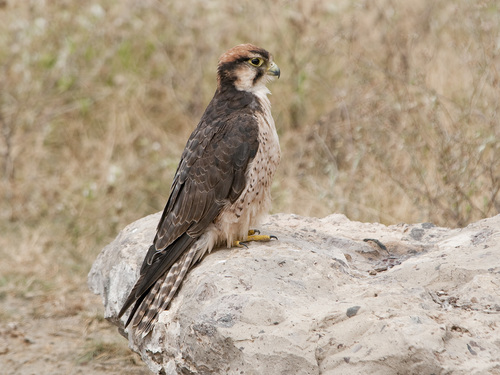
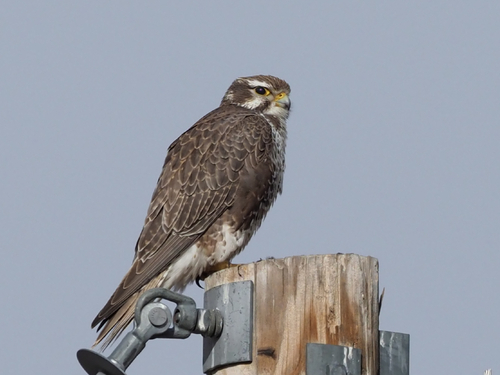
The prairie falcon, scientifically named Falco mexicanus, is a medium-sized falcon native to western North America. It is a distinct species separate from the peregrine falcon, despite sharing some visual similarities. It is an arid-climate branch derived from an earlier peregrine falcon lineage, and as a result, it can survive on a poorer, more opportunistic diet than peregrines, and is typically lighter in weight than peregrines with a similar wingspan. Having evolved in harsh desert environments that often have low prey density, the prairie falcon is an aggressive, opportunistic hunter that preys on a wide variety of mammals and birds, and occasionally takes reptiles. It regularly hunts prey ranging in size from sparrows or finches to birds around its own weight, and sometimes takes much larger prey. It is the only larger falcon species native exclusively to North America; other larger falcon species found on the continent, such as the cosmopolitan-distributed peregrine falcon, live throughout the Americas and beyond. Prairie falcons are year-round residents ranging from Canada (mainly Alberta, British Columbia, and Saskatchewan) through the western United States (west of the Mississippi) and south into northern Mexico. Their natural habitat is open, particularly arid country: in summer, this includes alpine tundra, shortgrass prairie, and high desert, while in winter they range more broadly into low deserts and occasionally occur in towns. Their breeding range extends from southern Saskatchewan, Alberta, and south-central British Columbia south through the western United States (roughly between the eastern edge of the Mountain Time Zone and the Cascade Mountains, as well as California's Central Valley) to the Mexican states of Baja California, Durango, and northern San Luis Potosí. They are far less migratory than other North American falcons, but in winter they partially leave the northernmost and highest-elevation sections of their breeding range, spreading west to California's deserts and Pacific coast, east to around the 100th meridian, and south to Baja California Sur, Jalisco, and Hidalgo. Like many raptors and falconiformes, the prairie falcon is popular in falconry. It is the most common falcon captured from the wild for falconry in the United States, due to its abundance and relative ease to obtain. Falconers value it for its aggressiveness, agility, and determination to take down game. While some falconers find prairie falcons hard to train and unpredictable, others note that with proper training that accounts for their impatient nature, they can be as effective as peregrine falcons. Biologist and falconer Bruce Haak wrote in his book The Hunting Falcon, "In the field, the prairie falcon leaves no doubt that it can hold its own against the peregrine as a stylish and dedicated hunting companion." Smaller, more agile males are especially effective at catching small game birds such as doves, quail, and smaller ducks, while larger, more powerful females consistently catch larger game up to the size of large ducks and even pheasants. Some prairie falcons will strike even larger game such as geese and greater sage-grouse, but attempting this puts the falcon at risk of injury. Greater sage-grouse are particularly challenging prey: males can weigh as much as 8 pounds, and their hard musculature means inexperienced falcons can easily be injured during a high-speed stoop. Only a skilled falcon can manage a forceful, careful, accurate strike to the head or wing to bring down a sage-grouse cleanly. Experienced falconers usually prefer larger female peregrines, gyrfalcons, or gyr-peregrine hybrids for this difficult prey, though some female prairie falcons do successfully learn to take down large game. Proper training for prairie falcons includes providing plenty of food when raising them, to prevent them from developing the habit of calling constantly for food, and extensive "manning," or regular close contact and handling, during training. Unlike peregrines, prairie falcons do not respond well to training with a swung lure, because missing the trigger triggers their impatience. The best method to teach prairie falcons to climb and hold a "wait on" position before stooping on game is a reward system: when the falcon reaches the correct position several hundred feet or more above the falconer, the falconer flushes game or provides a live bird such as a pigeon for the falcon to chase. Because prairie falcons are so eager to hunt and chase, they must be patiently taught to trust that when they hold the proper waiting on position, the falconer will reliably flush game. As the falcon learns this, it becomes an effective hunting partner with the falconer. In recent years, the availability of commercially bred falcons has reduced the need to capture wild prairie falcons for falconry. Prairie falcons, along with peregrines and gyrfalcons, are now commonly available through captive breeding. Prairie falcons are also sometimes hybridized with peregrine falcons or gyrfalcons to produce birds that combine the prairie falcon's aggressiveness and heat tolerance with the easier trainability and slightly greater strength of larger peregrine subspecies, or the greater horizontal speed and significantly larger size and strength of gyrfalcons.