About Falco femoralis Temminck, 1822
The scientific name of the aplomado falcon is Falco femoralis Temminck, 1822. This falcon has a very slender build, with long wings and a long tail. It is similar in length to a small peregrine falcon (F. peregrinus), measuring 30–40 cm (12–16 in) long, with an average wingspan of around 90 cm (35 in), but only weighs half as much. Males weigh 208–305 g (7.3–10.8 oz), while females weigh 270–460 g (9.5–16.2 oz).
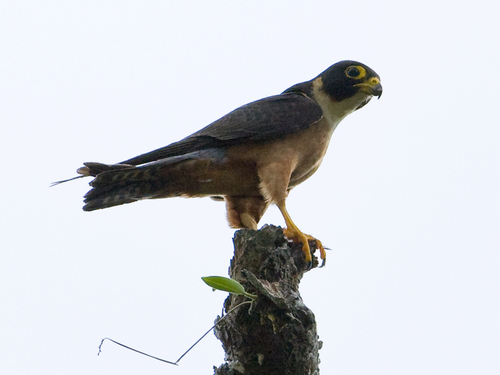
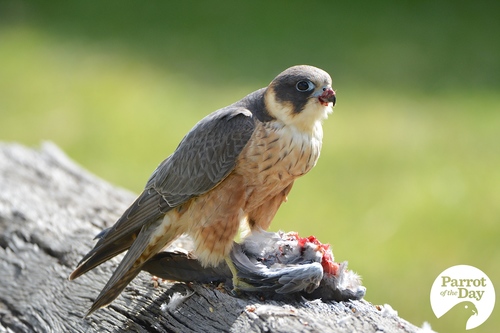
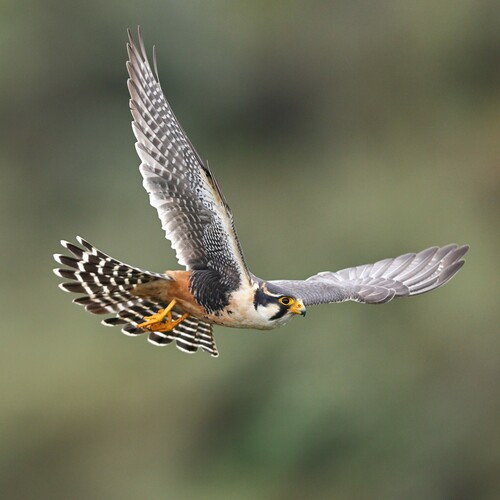
Adult aplomado falcons have dark blue-grey upperparts and most of the head, with the characteristic falcon "moustache" that contrasts sharply with a white throat and white eyestripe. The upper breast matches the white of the throat, and black patches on each side of the lower breast meet in the middle. Below these black patches, the belly and thighs are light cinnamon. The tail is black with narrow white or grey bars and a white tip. The cere, eye-ring, and feet are yellow or yellow-orange. Aside from females being larger than males, the two sexes look similar.
Juvenile aplomado falcons are very similar to adults, but their upperparts and belly band are blackish brown, their chest is streaked with black, the white areas on the head and breast are buffy, the cinnamon underparts are paler, and their feet are also paler. This species can be confused with the bat falcon (F. rufigularis) and the orange-breasted falcon (F. deiroleucus), which share similar black-white-rust underpart patterns. However, those two species have a build more like the peregrine falcon, solidly blackish heads, and darker rufous bellies.
Preferred habitat for the aplomado falcon is dry grasslands, savannas, and marshes. In Brazil, it is commonly seen in some large cities including São Paulo. Its range extends locally from northern Mexico and Trinidad to southern South America, but it has gone extinct across many parts of its former range, including all of northern and central Mexico except for a small area of Chihuahua. Despite this local extinction, it is globally widespread enough to be assessed as a Species of Least Concern by the IUCN.
The aplomado falcon feeds on large invertebrates and small vertebrates, with small birds making up the overwhelming majority of its prey. Mixed-species feeding flocks in open cerrado and grassland will enter a frenzied alert state when they spot an aplomado falcon, as small birds fear this predator more than most others. It is often seen soaring at twilight to hunt insects, which it eats while still in flight. It also hunts over burning fields, where many individuals of this species may gather. Cooperation between individual aplomado falcons, usually pairs, has been recorded. In Brazil, aplomado falcons have been observed following maned wolves (Chrysocyon brachyurus) and chasing birds that the wolves flush out.
Prey items typically weigh between one-fifth and one-half of the falcon's own weight, but larger females have occasionally been recorded eating birds larger than themselves, such as a cattle egret (Bulbucus ibis) or a plain chachalaca (Ortalis vetula). It builds a stick platform nest at any height in a bush or tree, and lays two or three eggs per clutch.