About Falco columbarius Linnaeus, 1758
The merlin (Falco columbarius Linnaeus, 1758) measures 24–33 cm (9.4–13.0 in) in length with a 50–73 cm (20–29 in) wingspan. Compared to most other small falcons, it is more robust and heavily built. Males average around 165 g (5.8 oz) and females typically weigh about 230 g (8.1 oz), though there is considerable variation across the species' range and, especially in migratory populations, over the course of a year. Adult males may weigh anywhere from 125–210 g (4.4–7.4 oz), while adult females weigh 190–300 g (6.7–10.6 oz). Individual wings measure 18.2–23.8 cm (7.2–9.4 in), the tail measures 12.7–18.5 cm (5.0–7.3 in), and the tarsus measures 3.7 cm (1.5 in). This size difference between sexes is a common sexual dimorphism among raptors; it allows males and females to hunt different prey and reduces the territory size required to support a mated pair.
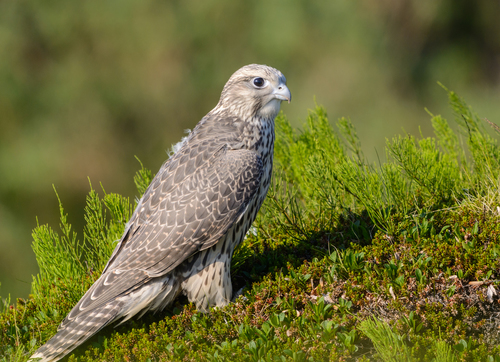
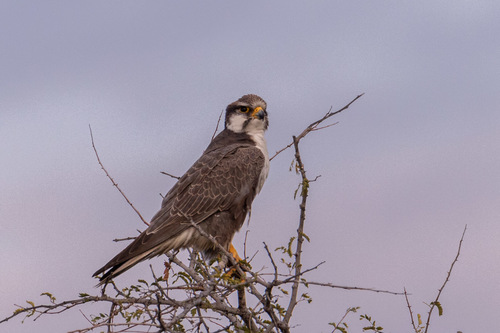
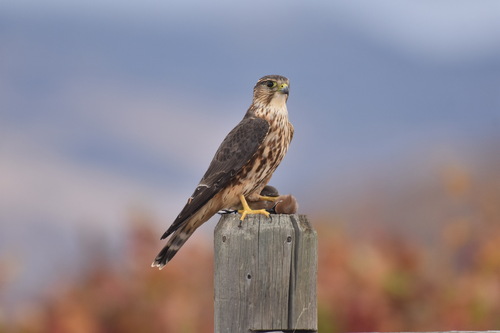
Male merlins have a blue-gray back, which ranges from near black to silver-gray across different subspecies. Their underparts are tinted from buff to orange and are more or less heavily streaked with black to reddish brown. Females and immature merlins are brownish-gray to dark brown on their upperparts, and whitish buff with brown spots on their underparts. Apart from a faint whitish supercilium and a faint dark malar stripe—patterns barely visible in both the palest and darkest individual merlins—the merlin's face has less distinct patterning than the faces of most other falcons. Nestlings are covered in pale buff down feathers that lighten to whitish on the belly.
The merlin's remiges are blackish, and the tail usually has three to four wide blackish bands. Very light males only have faint, narrow medium-gray bands, while in the darkest birds the dark bands are very wide, so the tail appears to have narrow lighter bands instead. In all merlins, however, the tail tip is black with a narrow white band at the very end; this pattern is possibly plesiomorphic for all falcons. Overall, the merlin's tail pattern is quite distinct, only resembling that of the aplomado falcon (F. berigora) and, for light merlins, some typical kestrels. The eye and beak are dark, and the beak has a yellow cere. The feet are also yellow, with black claws.
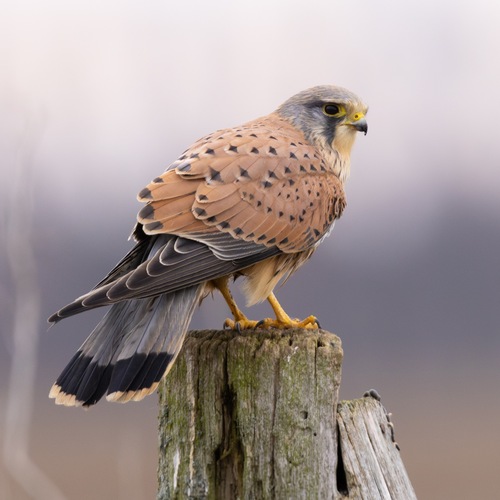
Light American male merlins may look similar to the American kestrel (F. sparverius, which is not a typical kestrel), but male merlins have gray backs and tails instead of the American kestrel's reddish-brown coloration. Light European males can be told apart from kestrels by their mainly brown wings. In northern South Asia, wintering male merlins may be confused with the red-necked falcon (F. chicquera) if the merlin flies away from the observer and the red-necked falcon's red crown and finely black-barred underparts are not visible.
Merlins live in fairly open landscapes, including willow or birch scrub, shrubland, taiga forest, parks, grasslands such as steppe and prairies, and moorland. They are not highly habitat-specific and can be found from sea level up to the treeline. In general, they prefer a mix of low and medium-height vegetation with scattered trees, and avoid dense forests as well as treeless arid regions. During migration, however, they will use almost any type of habitat.
Most merlin populations are migratory, wintering in warmer regions. Northern European birds move to southern Europe and North Africa, while North American populations migrate to the southern United States and northern South America. In milder coastal parts of the merlin's breeding range, such as Great Britain, the Pacific Northwest, western Iceland, and Central Asia, merlins only leave higher ground to move to coasts and lowland during winter. Migration to breeding grounds begins in late February, with most birds passing through the United States, Central Europe, and southern Russia in March and April, and the last stragglers arriving at the breeding range towards the end of May. Migration to winter quarters, at least in Eurasia, peaks in August and September, while in Ohio, just south of the breeding range, the subspecies F. c. columbarius is typically recorded as a southbound migrant as late as September or October. In Europe, merlins roost communally during winter, often alongside hen harriers (Circus cyaneus). Communal roosting is rare in North America.
Merlins depend on speed and agility to hunt their prey. They often hunt by flying fast and low, typically less than 1 m (3.3 ft) above the ground, using trees and large shrubs to sneak up on prey by surprise. However, they actually capture most of their prey in mid-air, and will perform "tail-chases" after startled birds. Across its native range, the merlin is one of the most skilled aerial predators of small to mid-sized birds, more versatile than larger hobbies (which prefer to attack in mid-air) and more nimble sparrowhawks (which usually target birds resting or sleeping in dense vegetation). Breeding pairs often hunt cooperatively, with one individual flushing prey towards its mate.
Merlins will readily take prey flushed by other sources, and for example have been observed following sharp-shinned hawks (Accipiter striatus) to catch birds that escape this ambush predator into open air. They are quite bold, and will readily attack anything that moves conspicuously. Merlins have even been observed attempting to "catch" automobiles and trains, and to feed on captive birds such as those caught in the mist nets used by ornithologists. Even under poor conditions, roughly one in 20 targets is usually caught, and under good conditions almost every other attack is successful. Sometimes, merlins cache food to eat later.
Especially during the breeding season, most prey is small birds weighing 10–40 g (0.35–1.41 oz). Almost any such species is taken, with local preferences for whichever is most abundant—including larks (Alaudidae), pipits (Anthus), finches (Fringillidae), house sparrows (Passer domesticus), other Old World sparrows (Passeridae), northern wheatears (Oenanthe oenanthe), thrushes (Turdus), kinglets (Regulidae), and buntings (Emberiza)—and inexperienced yearling birds are a favorite target. Small birds generally avoid hunting merlins when possible. In the Cayman Islands, where merlins only occur in winter, bananaquits have been recorded dying of an apparent heart attack or stroke, with no physical harm, when a merlin chased them and they could not escape.
Larger birds (such as sandpipers, flickers, other woodpeckers, ptarmigan, other grouse, ducks, and even rock doves as heavy as the merlin itself) and other animals—insects (especially dragonflies, moths, grasshoppers, butterflies, and beetles), small mammals (especially bats, shrews, rabbits, voles, lemmings, and other small rodents), reptiles (such as lizards and snakes), and amphibians—supplement the merlin's diet. These larger prey items are more important outside the breeding season, when they can make up a large part of the merlin's diet. However, for example in Norway, while small birds are certainly the staple food of breeding merlins, exceptional breeding success appears to require an abundance of Microtus volves.
Corvids are the main threat to merlin eggs and nestlings. Adult merlins may be preyed on by larger raptors, especially peregrine falcons (F. peregrinus), eagle-owls (for example, the great horned owl, Bubo virginianus), and larger Accipiter hawks (for example, the northern goshawk, A. gentilis). In general, however, carnivorous birds avoid merlins due to their aggressiveness and agility. The merlin's drive to chase larger raptors away from its territory is so strong that it is an identifying characteristic. As quoted from a popular raptor watching reference: "An observer may use this aggressive tendency for identification purposes and as a means of detection. High-flying merlins often betray themselves and distinguish themselves because they are vigorously harassing another raptor (even ones as large as the Golden Eagle)."
Breeding typically occurs in May and June. Though pairs are monogamous at least for a single breeding season, extra-pair copulations have been recorded. Most nest sites have dense vegetative or rocky cover; the merlin does not build a proper nest of its own. Most merlins use abandoned nests built by corvids (particularly crows of the genus Corvus and magpies of the genus Pica) or hawks, located in conifer or mixed tree stands. On moorland, especially in the UK, the female will usually dig a shallow scrape in dense heather to use as a nest. Other merlins nest in crevices on cliff faces and on the ground, and some may even use buildings.
Three to six eggs, usually 4 or 5, are laid. The rusty brown eggs average about 40 mm × 31.5 mm (1.57 in × 1.24 in). The incubation period is 28 to 32 days. Around 90% of incubation is done by the female, while the male hunts to feed the family. Newly hatched merlins weigh about 13 g (0.46 oz). The young fledge after around 30 more days, and remain dependent on their parents for up to an additional 4 weeks. Sometimes first-year merlins (especially males) act as "nest helpers" for an adult pair. More than half—often all or almost all—eggs in a clutch survive to hatching, and at least two-thirds of the hatched young fledge. However, as noted above, in years with little supplementary food, only 1 young out of 3 may survive to fledging. The merlin becomes sexually mature at one year of age and usually attempts to breed immediately. As of 2009, the oldest known wild merlin was recorded in its 13th winter.
In medieval Europe, merlins were popular in falconry: the Book of St. Albans listed it as "the falcon for a lady", where it was noted for classic "ringing" (rapid upward circling) pursuits of the English skylark. Though the merlin is only slightly larger than the American kestrel in dimensions, it averages one third to one half larger by weight, with this extra weight mostly being additional muscle that gives the merlin greater speed and endurance than the kestrel. Like the American kestrel, the merlin allows modern falconers to hunt year-round against sparrows and starlings, in urban settings that do not require large tracts of land or hunting dogs, with the added advantage of being able to reliably take small game birds such as dove and quail during hunting season. A large, exceptionally aggressive female merlin may take prey as large as pigeons and occasionally even small ducks. Merlins also provide an exciting flight style, generally flying closer to the falconer than large falcons, so the flight can be more clearly seen and enjoyed. In addition to horizontal tail-chases like American kestrels, merlins will also "ring up" in pursuit of prey that tries to escape by climbing higher, and perform high-speed diving stoops on prey below them like larger falcons. Quoting from a popular falconry book on how readily merlins chase a swung lure: "Every stoop, outrun, dodge, and aerial maneuver of a hard flight to real quarry can be duplicated with no risk of loss of the falcon. Merlins regularly flown to the lure take most field quarries with such ease and such assurance as to make the field flight the less interesting and exciting of the two."
Expert falconer Matthew Mullenix, author of the book American Kestrels in Modern Falconry, compared the American kestrel and merlin: "What a merlin gives you is raw power: lots of it. It brings an ability to negate wind as a factor, to stay airborne at a tremendous clip then gear down further at any time for more performance. One merlin can dominate an entire flock of frightened birds, directing its fate as a whole. The flock responds like bait fish to a barracuda and for precisely the same reason. Merlins demonstrate total mastery of their element." Regarding suitable game for these two species, he stated: "To snipe, dove, quail and open-country sparrows, merlins are best suited. For most blackbirds (Icteridea), either falcon can prove effective. Starlings in close are extremely vulnerable to kestrels; but in the open are best prey for merlins."