About Falco cenchroides Vigors & Horsfield, 1827
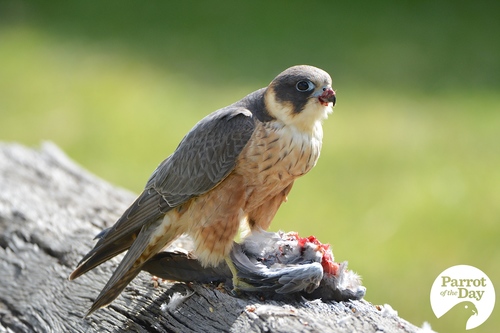
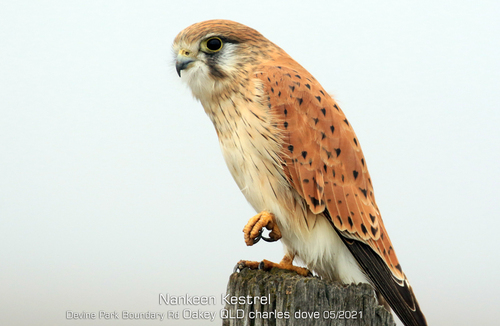
The nankeen kestrel, Falco cenchroides Vigors & Horsfield, 1827, is a small, slim falcon. It measures 28 to 35 cm (11 to 14 in) in length, with a wingspan of 66 to 78 cm (26 to 31 in). Males weigh 121 to 195 g (4.3 to 6.9 oz), while females weigh 115 to 273 g (4.1 to 9.6 oz). This species has pale rufous upperparts with contrasting black flight feathers, finely streaked white underparts, and a black subterminal band. Its cere, eye-ring, and legs are yellow. Males have a pale grey crown and tail with a darker grey tear-mark, while females and juveniles have a pale rufous crown and a finely barred rufous tail. Plumage details vary considerably, and some individuals can appear very scruffy. However, the species is easy to identify by its slim build, small size, and distinctive straight-winged hovering habit. The only other Australasian raptors that hover are elanid kites, which are much lighter in color and slightly larger, and the brown falcon, which is much larger, more heavily built, and only hovers occasionally. Overall, the nankeen kestrel resembles a pale, less patterned, smaller derivative of the Eurasian kestrel, which is what it in fact is, aligning with Gloger's Rule and Bergmann's Rule.
A very common, easily observed raptor, the nankeen kestrel is found in Australia, New Guinea, and nearby islands, and is an irregular visitor to New Zealand. It occupies any type of land that is not too densely vegetated, and favors temperate grasslands and open woodlands in particular. In the tropical north and the sandy deserts of western Australia, its distribution is patchy and seasonal. It can be spotted on coastal cliffs in Western Australia during windy conditions, and is also often seen perched on phone lines and power lines. Like many Australian birds, it has no clear migratory pattern: established pairs on southern grasslands remain resident year-round, but many other individuals migrate north during the austral winter, or roam the arid interior to follow food supplies. Nankeen kestrels are typically seen singly or in pairs, but can gather into loose flocks of up to 30 when conditions are favorable. Pairs are usually monogamous, and may or may not disperse to separate areas during the non-breeding season. They nest in any convenient structure, such as a tree hollow, cliff ledge, or disused corvid nest, and do not modify or add to the nest themselves.