About Falco ardosiaceus Vieillot, 1823
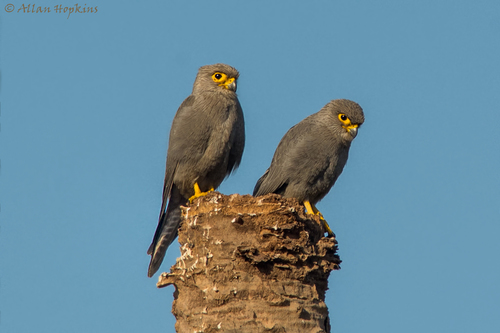
This species, the grey kestrel (Falco ardosiaceus Vieillot, 1823), is a fairly small, stocky kestrel with a large, flat-topped head and fairly short wings that do not extend past the tip of the tail when the bird is at rest. It measures 28–33 cm in length, has a wingspan of 58–72 cm, and weighs up to 300 grams. Females are 4-11% larger and 5-11% heavier than males. Adult plumage is uniformly dark grey, with the exception of darker wingtips, faint dark streaking on the body, and slightly barred flight feathers. The feet and cere are yellow, and there is bare yellow skin surrounding the eye. The species most similar to the grey kestrel is the sooty falcon, which has a more rounded head, long wings that extend past the tail, and less yellow skin around the eye. Juvenile grey kestrels are browner than adults, with a greenish cere and greenish skin around the eye. Juvenile Dickinson's kestrels are similar in appearance to juvenile grey kestrels, but have a barred tail and more strongly barred underwings. The grey kestrel is generally silent outside of the breeding season, but it produces a shrill, chattering call and a rattling whistle. The grey kestrel inhabits savannas, open woodland, and forest clearings. It favors areas that contain palm trees, especially those located near water. It often perches on exposed branches, telegraph poles, and wires. It is widespread across West and Central Africa, but is absent from densely forested regions, including parts of the Congo Basin. Its range extends east to Ethiopia and the western parts of Kenya and Tanzania. In the south, it reaches northern parts of Namibia and Zambia, and vagrants have been recorded in Malawi. The total range of the species covers approximately 12 million km². In West Africa, the species undergoes some seasonal movement, shifting northward during the wet season and southward during the dry season.