About Fagus sylvatica L.
Fagus sylvatica L., commonly known as European beech, is a large tree. It can reach up to 50 metres (160 feet) in height and 3 metres (10 feet) in trunk diameter, though most mature specimens grow 25–35 m (82–115 ft) tall with a trunk up to 1.5 m (5 ft) across. A 10-year-old sapling typically reaches around 4 m (13 ft) in height. When left undisturbed, European beech can live up to 300 years; one individual at the Valle Cervara site is over 500 years old, making it the oldest known beech in the northern hemisphere. In managed cultivated forest stands, trees are usually harvested between 80 and 120 years of age. The species takes 30 years to reach full maturity, which is 10 years faster than American beech. Tree shape varies with growing location: in closed forests, F. sylvatica grows over 30 m (98 ft) tall, with branches forming high on the trunk. In open areas, it typically grows only up to 20 m (66 ft) tall, but develops a thicker trunk, broader crown, and overall more massive form.
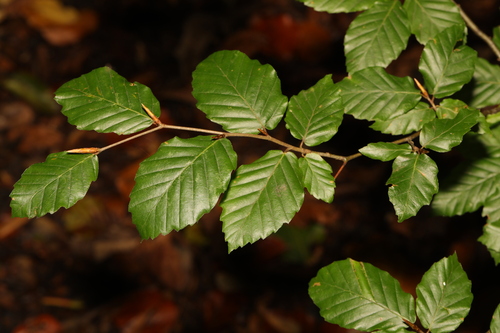
Its leaves are alternate, simple, and have either smooth margins or slightly crenate edges. They measure 5–10 cm (2–3+7⁄8 in) long and 3–7 cm (1.2–2.8 in) wide, with 6–7 veins per side of the leaf; this differs from Fagus orientalis, which has 7–10 veins per side. When margins are crenate, only one tip occurs at the end of each vein, with no additional points between veins. Buds are long and slender, 15–30 mm (5⁄8–1+1⁄8 in) long and 2–3 mm (3⁄32–1⁄8 in) thick; flower buds are thicker, reaching 4–5 mm (1⁄8–1⁄4 in) across. Beech leaves often do not drop (abscise) in autumn, remaining on the tree through winter until spring; this process is called marcescence. Marcescence is most common in young saplings and clipped beech hedges, which stay attractive as screens through winter, and it also frequently occurs on the lower branches of mature trees.
European beech is monoecious. Male flowers grow in small catkins, a characteristic trait of the Fagales order. Female flowers develop into small triangular beechnuts, which measure 15–20 mm (5⁄8–3⁄4 in) long and 7–10 mm (1⁄4–3⁄8 in) wide at their base. Two nuts form inside each protective cupule, and they mature in autumn 5–6 months after pollination. Heavy production of flowers and seeds occurs most often in years following a hot, sunny, dry summer, and rarely occurs two years in a row. Trees may produce small amounts of seed as early as 10 years old, but do not produce heavy seed crops until they are at least 30 years old.
Spring leaf budding in European beech is triggered by a combination of day length and temperature. Bud break occurs annually between mid-April and early May, often within a window of just a few days. This timing is more consistent in the northern part of the species' range than the southern, and more consistent at 600 m (2,000 ft) elevation than at sea level.
Distribution and habitat European beech is the most abundant hardwood species in Austrian, German, and Swiss forests. Its native range extends from northern Europe (including Sweden, Denmark, Norway, Germany, Poland, Switzerland, Bulgaria, western Ukraine, and Romania) through central and western Europe to France, southern England, and northern Spain (where it grows only in the Cantabrian, Iberian, and Central mountain ranges), Italy, and east to northwest Turkey. In northwest Turkey, it forms an interspecific cline with Fagus orientalis (oriental beech), which replaces F. sylvatica further east. In the Balkans, F. sylvatica hybridizes with oriental beech, producing the hybrid named Fagus × taurica Popl. (also referenced as Fagus moesiaca (Domin, Maly) Czecz.). In the southern part of its range near the Mediterranean and on Sicily, F. sylvatica only grows in mountain forests between 600–1,800 m (1,969–5,906 ft) in altitude.
Although F. sylvatica is often considered native to southern England, recent evidence indicates it did not arrive in England until around 4000 BCE, roughly 2,000 years after the English Channel formed following the last ice ages. It may have been introduced early by Stone Age humans who used its nuts for food. It is classified as native in southern England, and non-native in northern England, where it is often removed from designated native woods. Localised pollen records from the Iron Age have been recorded in northern England by Sir Harry Godwin. Changing climatic conditions may increase stress on beech populations in southern England, and while current beech population levels may not be sustainable at some southern sites, conditions in north-west England are expected to remain favourable or even improve for the species. It is commonly planted throughout Britain.
The origin of Norwegian beech populations is also debated. If native, they would mark the northern edge of the species' natural range, but molecular genetic evidence indicates these populations were intentionally introduced from Denmark before and during the Viking Age. Beech growing in Vestfold and at Seim north of Bergen, Norway, now spreads naturally and is regarded as native.
European beech tolerates a wide range of soil types, but requires a humid atmosphere (with well-distributed annual precipitation and frequent fog) and well-drained soil. It prefers moderately fertile, either calcified or lightly acidic soil, so it grows more often on hillsides than at the bottom of clay-filled basins. It withstands cold winter temperatures well, but is sensitive to spring frost. In Norway's oceanic climate, planted trees grow successfully as far north as Bodø Municipality, and can produce seedlings and spread naturally in Trondheim. In Sweden, beech does not grow as far north as it does in Norway.
In southern Britain's woodlands, beech is dominant over oak and elm south of a line running from north Suffolk across to Cardigan; oak is the dominant forest tree north of this line. One notable European beech forest is the Sonian Forest (Forêt de Soignes/Zoniënwoud) located southeast of Brussels, Belgium, considered one of the most beautiful beech forests in Europe. Beech is a dominant tree species in France, making up approximately 10% of French forests. The largest virgin beech forests are Uholka-Shyrokyi Luh (8,800 hectares / 22,000 acres) in Ukraine and Izvoarele Nerei (5,012 ha / 12,380 acres in a single forest body) in Semenic-Cheile Carașului National Park, Romania. These forests host Europe's largest predators: brown bear, grey wolf, and lynx. Many trees in Izvoarele Nerei are over 350 years old, and some trees in Uholka-Shyrokyi Luh reach over 500 years of age.
Cultivation European beech is a very popular ornamental tree for parks and large gardens in temperate regions across the world. In North America, it is preferred over the native American beech (F. grandifolia); although American beech tolerates warmer climates, it grows more slowly and takes an average of 10 years longer to reach maturity. The town of Brookline, Massachusetts is home to one of the largest groves of European beech trees in the United States. The 2.5-acre (1 ha) public park called 'The Longwood Mall' was planted before 1850, making it the oldest stand of European beech in the U.S. European beech is often clipped to create attractive hedges.
Since the early 19th century, horticulturalists have developed many cultivars of European beech through repeated selection. Common cultivars include: copper beech or purple beech (Fagus sylvatica purpurea), a mutation first recorded in 1690 in the Possenwald forest near Sondershausen, Thuringia, Germany. It is estimated that around 99% of all copper beeches worldwide descend from this original mutated individual. Copper beech has purple leaves, and many selections turn deep spinach green by mid-summer. In the United States, Charles Sprague Sargent noted the earliest appearance of copper beech in a nursery catalogue in 1820; by 1859, a copper beech over fifty feet high was recorded on the estate of Thomas Ash, Esq. at Throggs Neck, New York, which would have been at least forty years old at the time; fern-leaf beech (Fagus sylvatica Heterophylla Group), with deeply serrated to thread-like leaves; dwarf beech (Fagus sylvatica Tortuosa Group), with a distinctive twisted trunk and branches; weeping beech (Fagus sylvatica Pendula Group), with pendulous branches; Dawyck beech (Fagus sylvatica 'Dawyck'), with fastigiate (columnar) growth, available in green, gold, and purple forms, named after Dawyck Botanic Garden in the Scottish Borders; and golden beech (Fagus sylvatica 'Zlatia'), with golden leaves in spring.