About Fagus orientalis Lipsky
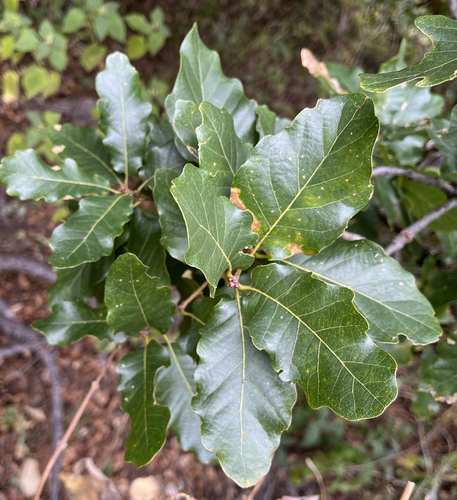
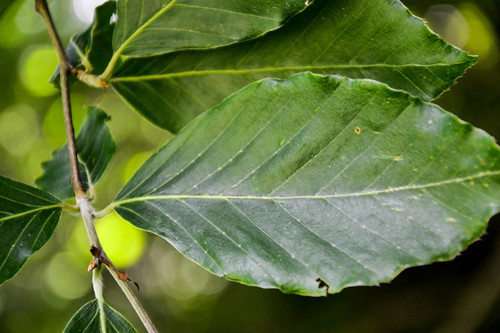
Fagus orientalis Lipsky, commonly known as Oriental beech, is a large deciduous tree. Exceptional specimens can reach up to 45 m (148 ft) in height and 3 m (9.8 ft) in trunk diameter, but most mature trees grow between 25–35 m (82–115 ft) tall, with a trunk diameter up to 1.5 m (4 ft 11 in). Like all beech species, it has smooth, grey bark. Its leaves are alternately arranged, simple in shape, and have either entire margins or slightly crenate edges. The leaves measure 7–15 cm (2.8–5.9 in) long and 5–9 cm (2.0–3.5 in) broad, with 7–13 veins on each side of the leaf, in comparison to 6–7 veins found in the closely related Fagus sylvatica. Its buds are long and slender, 15–30 millimetres (0.59–1.18 in) long and 2–3 mm (0.079–0.118 in) thick. Flower buds are thicker, growing up to 4–5 mm (0.16–0.20 in) thick. The species produces small catkin flowers that emerge shortly after leaves in spring. The seeds are small triangular nuts, 15–20 mm (0.59–0.79 in) long and 7–10 mm (0.28–0.39 in) wide at the base. Two nuts develop inside each protective cupule, and mature in autumn 5–6 months after pollination. The cupule of Fagus orientalis differs from that of European beech (Fagus sylvatica): it has flattened, slightly leaf-like appendages at its base, while European beech cupules have slender, soft spines instead. The natural distribution of Fagus orientalis ranges from the Strandja mountain range of southeastern Bulgaria and northeastern Greece, extending into northwest and northern Turkey, with isolated local populations in southern Turkey. It grows in moist mountain habitats, and is often found growing in mixed stands alongside Abies nordmanniana. The wood of Fagus orientalis is heavy, hard, strong, and highly shock-resistant, properties that make it well suited for steam bending. The wood is also harvested for fuelwood, and is used in construction, particleboard manufacturing, furniture production, flooring, veneer, mining poles, railway ties, and paper manufacturing.