About Fagus grandifolia Ehrh.
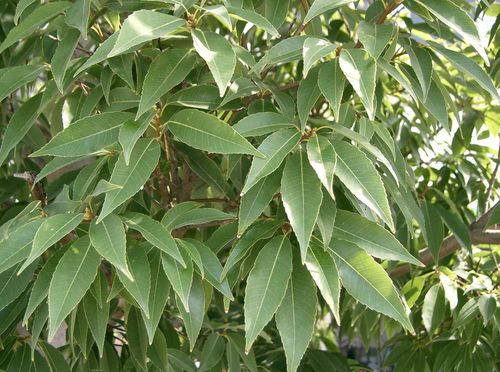
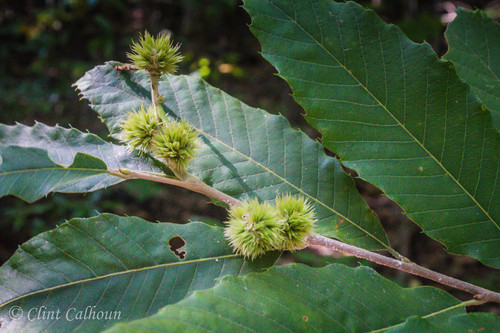
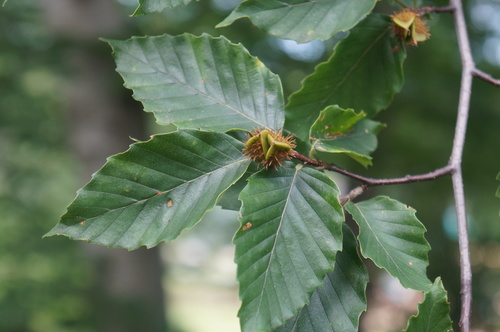
Fagus grandifolia Ehrh., commonly American beech, is a large deciduous tree that reaches 16–35 meters (52–115 feet) in height, with smooth silver-gray bark. Its winter twigs are distinctive among North American trees: they are long and slender, measuring 15–20 mm (5⁄8–3⁄4 in) by 2–3 mm (3⁄32–1⁄8 in), and their buds have two rows of overlapping scales. Beech buds are noticeably thin and long, with a shape resembling cigars, and this trait makes identifying beech trees relatively easy. The leaves are dark green with a yellow underside, simple, and sparsely toothed, with a small tooth at the end of each vein. They measure 6–12 centimeters (2+1⁄4–4+3⁄4 inches) long, rarely reaching 15 cm (6 in), and have a short petiole. This species is monoecious, meaning individual trees bear both male and female flowers. Its fruit is a small sharply angled nut, which grows in pairs inside a soft-spined, four-lobed husk. It has two methods of reproduction: the standard dispersal of seedlings, and growth from root sprouts that develop into new trees. American beech is native to eastern North America, with an extant native range extending from Nova Scotia west to southern Ontario in southeastern Canada; in the United States, its range extends west to Wisconsin and south to eastern Texas and northern Florida. Mature specimens are rare in lowland areas, because early settlers recognized that the presence of this tree indicated good farmland. American beech is a shade-tolerant species, most commonly found in late-succession forests. Few other tree species within its natural range have a shade tolerance comparable to sugar maple. Ecological succession is the process by which forest composition changes over time, a pattern typically observed on sites that have experienced disturbance. While American beech sometimes grows in pure stands, it is more often found growing alongside sugar maple (forming the beech–maple climax community), yellow birch, and eastern hemlock. It typically grows on moist, well-drained slopes and in rich bottomlands. Near the southern edge of its range, it often shares canopy dominance with southern magnolia. Though it has a reputation for slow growth, sometimes growing only 13 feet in 20 years, growth is much faster when the tree grows in rich soil with plenty of moisture. American beech prefers locations that are well-watered and well-drained, and it cannot tolerate urban pollution, salt, or soil compaction. It casts heavy shade, and it has much higher moisture requirements than oaks, so it develops a dense, shallow root system. The annual nut crop (mast) produced by American beech provides food for many animal species. Among vertebrates alone, these animals include ruffed grouse, wild turkeys, other birds, raccoons, foxes, white-tailed deer, rabbits, squirrels, opossums, pheasants, black bears, and porcupines. Beech nuts were one of the main food sources for the now-extinct passenger pigeon, and the clearing of beech and oak forests is cited as one of the major factors that may have contributed to the bird's extinction. Some caterpillars of the Lepidoptera order feed on beech foliage. Deer will occasionally browse on beech leaves, but the species is not a preferred food source. American beech is an important forestry tree. Its wood is hard and difficult to cut or split, though at 43 pounds per cubic foot (0.69 g/cm3) it is not exceptionally heavy, and it rots relatively easily. It is used for a wide range of purposes, most notably bentwood furniture, since beech wood bends easily when steamed. It also makes high-quality firewood that burns for a long time. It is sometimes planted as an ornamental tree, but even within its native range, it is planted far less often than European beech. While American beech can tolerate hotter climates, European beech grows faster, is more tolerant of pollution, and is easier to propagate. American beech does not produce large quantities of nuts until it is around 40 years old, and it begins producing large nut crops at 60 years old. The oldest documented American beech is 246 years old. Its fruit is a triangle-shaped husk that holds 2–3 nuts inside, but many of these nuts do not fully develop, especially on solitary trees. Beech nuts are sweet and nutritious; they can be eaten raw by both wildlife and humans, or they can be cooked. They can also be roasted and ground to use as a coffee substitute. The leaves are edible when cooked. The inner bark can be dried and ground into flour for bread to use as emergency food.