About Fagus crenata Blume
Fagus crenata Blume is a tree species that can reach 35 meters (115 ft) in height, with a rounded crown formed by thick, low branches. Its bark is smooth, ranging from light-grey to white, and mottled with pale gray, dark gray, and greenish-gray tones. This species often develops buttress roots, and may also grow surface roots to obtain more oxygen to support growth and fruiting.
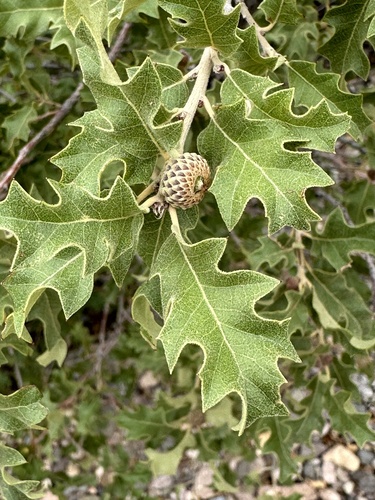
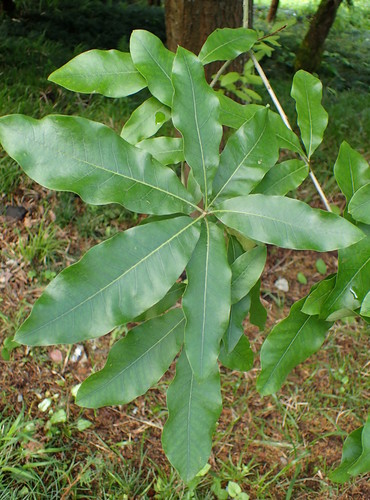
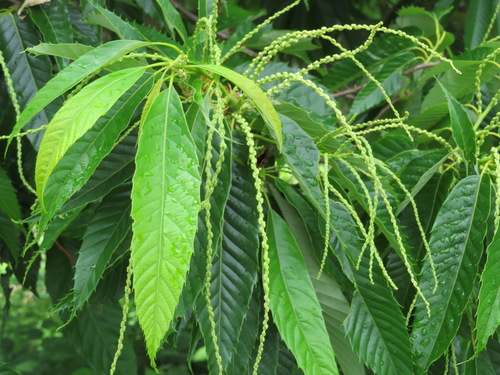
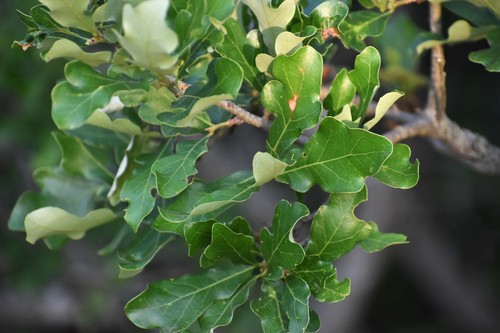
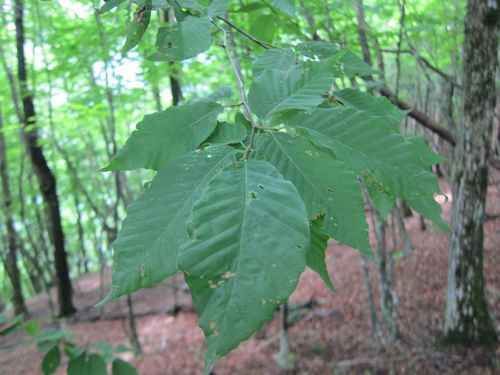
The simple leaves of Fagus crenata are arranged alternately along branches, and grow 7.5 to 15 centimeters (3.0 to 5.9 in) long and 2.5 to 8 centimeters (0.98 to 3.15 in) wide. Leaves are serrated, obovate, and broadest near the base, with 7 to 11 pairs of veins. In autumn, leaves turn rusty red, yellow, and brown. The average lifespan of F. crenata is 233 years; the oldest recorded individual, found on Okushiri Island, is 374 years old.
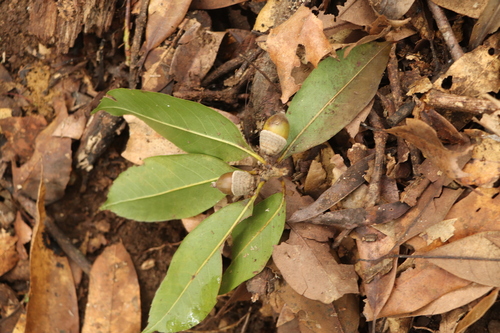
Fagus crenata produces nuts that are 15 millimeters (0.6 in) long, 3-winged, and held on a short thick stalk, enclosed within a spiny husk. Flattened green whiskers grow at the base of the nut husk. Ripe nuts are edible, but raw unripe nuts are toxic to humans because they contain saponic glycoside, which causes stomach problems. Seeds are dispersed by synzoochory, carried by rodents and birds. The small flowers are wind-pollinated, monoecious, and allogamous. Fagus crenata has a slow growth rate. It tolerates acid, neutral, and alkaline soils, but grows best in well-drained loamy and sandy soil. While it can survive in deep shade, it prefers full sun and hot summers.
Fagus crenata is endemic to Japan, where it is widespread and often a dominant canopy tree in Japan's cool-temperate deciduous forests. It is frequently found growing alongside Quercus crispula (Japanese oak) and Acer mono (Painted maple), with F. crenata acting as the dominant of the three canopy species. Wind storms are the most significant cause of canopy damage in these forests. In parts of F. crenata's range, other common associated deciduous trees include Fagus japonica, Magnolia obovata, Fraxinus lanuginosa, Acer japonicum, Quercus serrata, and Carpinus laxiflora.
Shirakami-Sanchi, a Japanese protected forest and UNESCO World Heritage Site located in Aomori Prefecture and Akita Prefecture, features old-growth F. crenata forests. It is the largest remaining virgin beech forest in East Asia, and the last remaining virgin F. crenata forest in Japan. Fagus crenata ranges from the Oshima Peninsula (including Okushiri Island) in Hokkaidō, south to the Ōsumi Peninsula in Kyūshū.
Genetic divergence between F. crenata populations in the Tōhoku region and Hokkaido began more than 20,000 years ago, before the Last Glacial Maximum (LGM). Expansion of F. crenata from northern Tōhoku region of Honshu into Hokkaido began around 6,000 years before present, which left F. crenata trees on Okushiri Island with a genetic admixture of both Tōhoku and Hokkaido population groups. As temperatures warmed after the end of the LGM, the range of F. crenata shifted northward. Its current northern limit lies around 7 kilometers (4.3 mi) east of the Kuromatsunai Depression at the northern end of the Oshima Peninsula, in southwestern Hokkaido, a transitional zone between the temperate forest zone and the temperate broadleaf and mixed forests zone.
In north-east Honshu, F. crenata forms large stands from sea level up to 1,400 meters (4,600 ft). In the southwestern portion of its range, it is restricted to mountainous areas and occurs only in small, isolated populations. It grows in well-drained, loamy or sandy soils. Fagus japonica occurs mainly on the Pacific side of Japan, at lower elevations than F. crenata, though the two species are occasionally found growing together. Fagus crenata grows in hardiness zones 4–7.
In ecological terms, Fagus crenata is not generally affected by serious diseases, but can be attacked by aphids, wooly aphids, vine weevils, caterpillars, and spider mites. The stag beetle Dorcus montivagus feeds exclusively on dead beech wood, almost always that of F. crenata. Human disturbance, combined with F. crenata's low mortality and growth rate, allows the species to spread further north in Hokkaido. Fagus crenata has a low rate of genetic inbreeding, due to its wind-pollination, self-incompatibility, and inbreeding depression. Quercus crispula regrows foliage faster after insect defoliation than F. crenata.
Reproduction in Fagus crenata significantly alters nitrogen and ammonium uptake and allocation. Large amounts of nitrogen are directed to developing nuts, which reduces the nitrogen available for new shoots and leaves, and also reduces the amount of nitrogen present in soil. During masting years, the tree increases nitrogen uptake and reuses stored nitrogen from other organs such as cupules and senescing leaves to support nut ripening. Nut production varies several hundred-fold between masting and non-masting years.
Climate change is causing a reduction in the total area of Fagus crenata forests. Tropospheric ozone (O3), which is phytotoxic to forests, has a detrimental effect on F. crenata: it causes increased leaf senescence, sluggish stomatal response, and decreased photosynthetic rate. Budburst timing in F. crenata is strongly linked to temperature, late spring frosts, and heat. Genetic differentiation from these differing conditions produces different phenological responses to climate; northern populations have earlier budbursts due to genetic alterations.
Dasyscyphella longistipitata is a fungus that is symbiotic with Fagus crenata, and grows solely on the species' cupules. As a result, the fungus has the same distribution and northward expansion pattern after the last Pleistocene era as F. crenata, and acts as a key decomposer of woody debris.
In cultivation, F. crenata prefers light or medium well-drained soil, including chalky soils, clay, soil with high organic matter, and loam. It prefers soils that are either more acidic than pH 6.0, or more alkaline than pH 8.0. It requires sun but is tolerant of shade. It withstands cold weather well, but also requires hot summers, and grows very slowly. Because its roots often grow near the surface, there is typically little or no undergrowth beneath F. crenata trees. Seeds should be sown immediately after ripening in autumn. Seedlings grow slowly in their first few years, and can be damaged by frosts.
For human uses, ripe nuts, nut oil, and seeds are edible, and young green leaves are cooked and eaten. Fagus crenata provides good wildlife cover and shade, and is grown for bonsai, where it is popular because cultivated bonsai specimens retain the appearance of full-sized forest trees. As a dense hardwood, it is used for firewood, furniture, and construction.