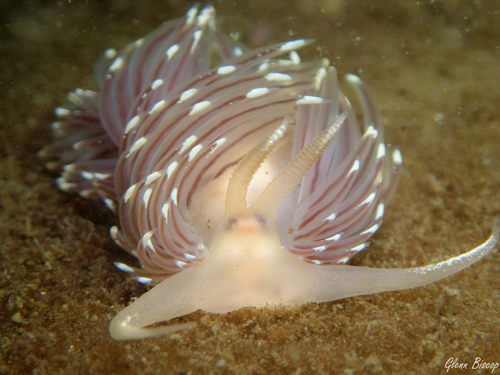
About Facelina bostoniensis (Couthouy, 1838)
This species has the scientific name Facelina bostoniensis (Couthouy, 1838).
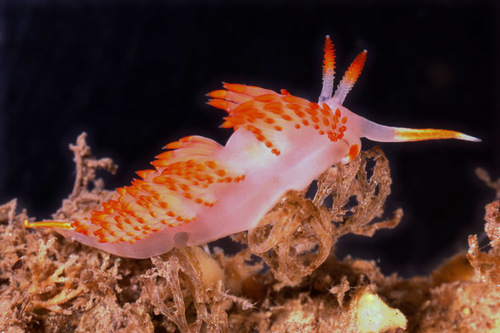
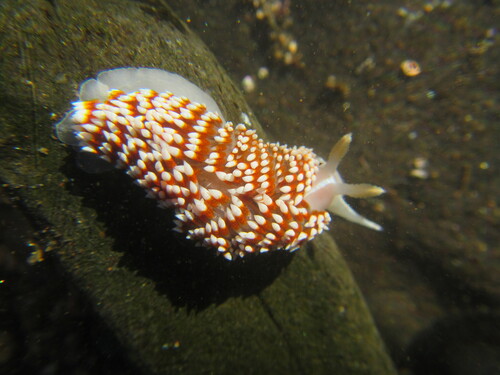
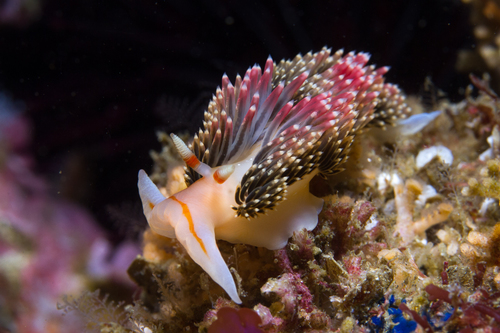
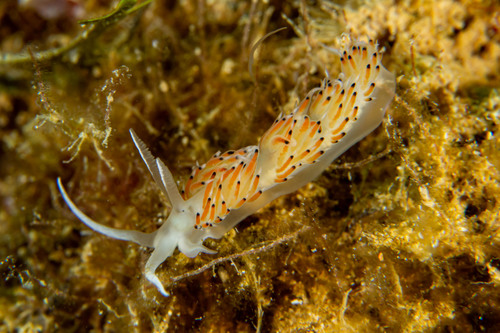
The body of Facelina bostoniensis is translucent white, with a pink tint around the mouth. The oesophagus, located just behind the rhinophores, is clearly visible as a curved red tube. Patches of white pigment appear on the head between the rhinophores, and extend down the animal's tail. Some individuals have small patches of blue iridescence around the head, and rarely, specimens with extensive blue colouration are found. The rhinophores are annulate, and the oral tentacles are very long; both types of tentacles are tipped with white pigment. Large individuals can reach approximately 55 mm in total length.
This species was first described from Massachusetts Bay, and it occurs on both sides of the North Atlantic Ocean. It is commonly found in tidepools on the lower shore, among hydroids in fast-flowing water, and in very sheltered muddy areas. Facelina bostoniensis feeds on a wide range of hydroids, and may also attack and consume other aeolid nudibranchs.