About Extatosoma tiaratum (Macleay, 1826)
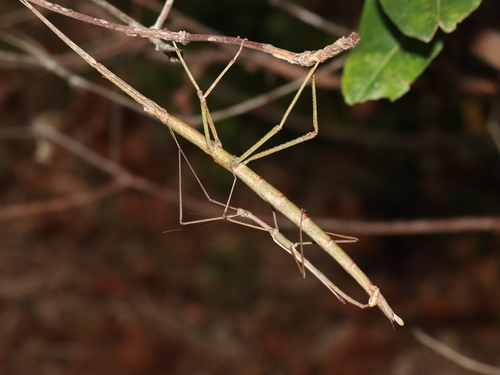
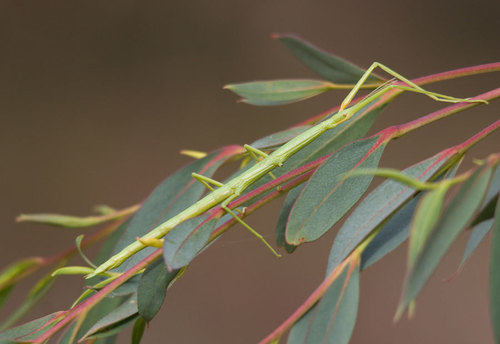
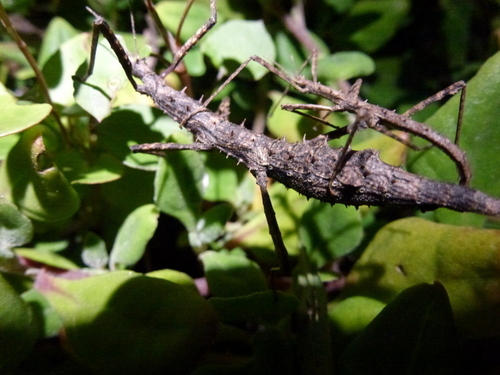
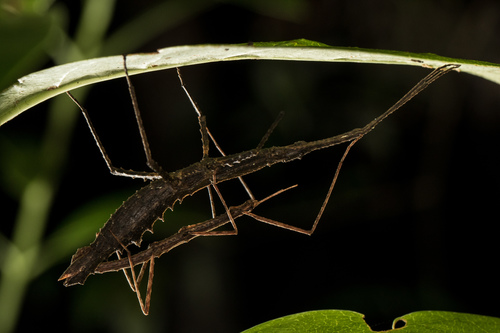
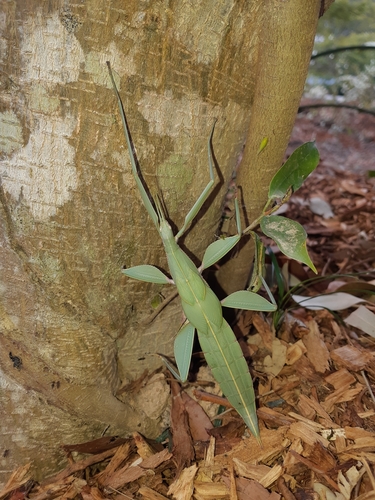
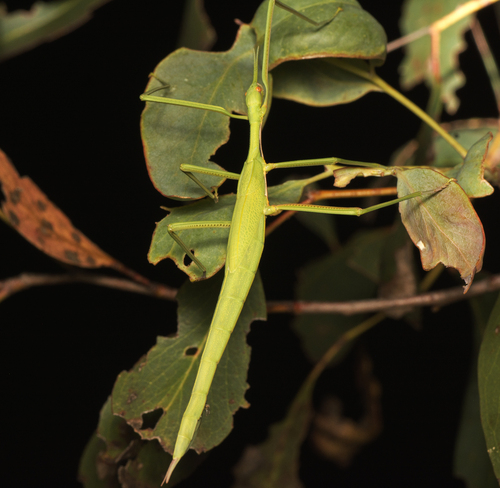
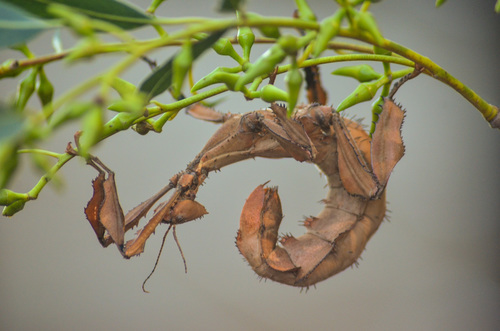
Adult female Extatosoma tiaratum are covered in thorn-like spikes that serve for both defense and camouflage. Their long, rounded bodies reach approximately 20 cm (8 inches) in length. Females are further described as heavy-bodied, brachypterous, with numerous spines and integumental expansions on the face and legs, including a tuft of spines on the conical occiput of the hypognathous head. As noted, female wings are too small for flight, particularly when the female is gravid. Like many similar insects (including other phasmids and mantises), Extatosoma tiaratum exhibits clear sexual dimorphism: males are smaller and thinner, growing to only around 11 cm (4.5 inches) in length, and have three ocelli. Males lack the thorny outgrowths seen on females, with the exception of spikes around the face. They have long wings, are good fliers, and will readily take flight when disturbed or when searching for females. Extatosoma tiaratum is endemic to Australian rainforests. Most of its range covers eastern New South Wales and eastern Queensland, but there is one old record of the species from eastern Victoria, and it is also found in South Australia where it may be introduced. The closely related, similar-looking species Extatosoma popa is native to New Guinea. Extatosoma tiaratum typically reproduces sexually, and eggs produced this way hatch four months after being laid. When no males are present in a population, this stick insect can reproduce via parthenogenesis instead. Unfertilized eggs laid through parthenogenesis take up to nine months to hatch, with an extreme captive observation of over 400 days, and all eggs hatch into female offspring. In both sexual and parthenogenetic reproduction, the female flicks eggs out by swinging her tail, sending the eggs up to several feet away to land on the forest floor. Eggs must be kept relatively cool, below 25 °C, or they are very unlikely to hatch. Fertilized eggs from sexual reproduction produce both male and female offspring, while unfertilized parthenogenetic eggs only produce female offspring. Parthenogenesis in this species occurs via automixis with terminal fusion of haploid nuclei from the same individual's meiosis, which results in a loss of heterozygosity in the offspring. The outer surface of Extatosoma tiaratum eggs contains lipids and other organic compounds that ants recognize as food. Ants carry the eggs back to their colony, eat the edible outer portion, and discard the still intact eggs into their waste piles. For captive breeding, ants removing the edible outer layer is not required for proper egg development. Eggs hatch into healthy nymphs without this step, and the removed outer layer is not easily visible anyway. This species is relatively common in captivity. It is used in laboratory research, kept for school projects, similar to the species Carausius morosus, and is a popular pet among exotic insect breeders in North America and Europe. One breeder specifies that for two adult female Extatosoma tiaratum with a body length of 127mm, the enclosure needs to be at least 600mm high, 300mm deep and 300mm wide. Even though the egg gestation period lasts several months, this species is a prolific breeder. Breeders note that the species' habit of flicking eggs means the eggs can be heard clicking against the glass of terraria. Some breeders in the United Kingdom have introduced new genetic material from overseas populations, to address concerns about reduced vitality from inbreeding in captive stock. Females live around 18 months, while males only live 6 to 8 months.