About Exoglossum maxillingua (Lesueur, 1817)
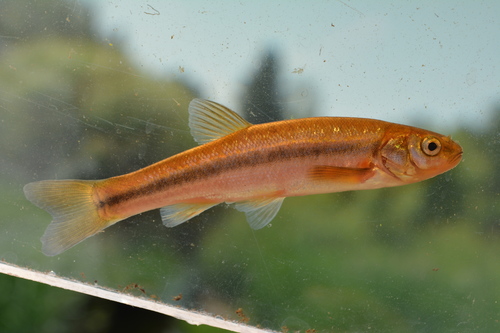
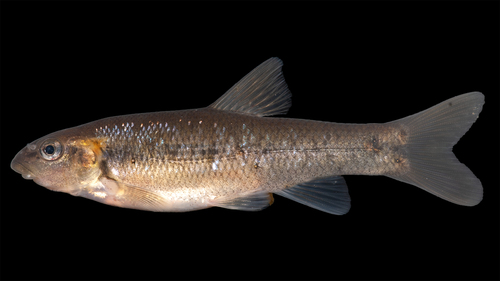
The common name "cutlips minnows" is also used to refer to the entire genus Exoglossum. Exoglossum maxillingua, commonly called the cutlips minnow, is a species of freshwater ray-finned fish that belongs to Leuciscidae, the fish family that includes shiners, daces, and minnows. It is a medium-sized, olive-green minnow with an average length of 6 inches, native to North America, and has a distinctly shaped lower jaw that sets it apart from all other minnows: its lower jaw is three-lobed, with the middle lobe protruding outward like a tongue. This species ranges from the St. Lawrence River and Lake Ontario southward into Virginia. This is the northernmost extent of the cutlips minnow's range, and the species is listed as threatened in the Canadian province of Ontario; it may have never been common within the province. Cutlips minnows live in running streams, and prefer clear, stony pools while avoiding rapids. The cutlips minnow's distinctive mouth allows it to scrape tiny shellfish from rocks to feed. While molluscs appear to be its primary food source, it also eats insect larvae and diatoms. When food is scarce or competition for food is high, this species exhibits an unusual feeding behaviour called "eye-picking": cutlips minnows will pluck out the eyes of other members of their own species or individuals of other species to supplement their regular diet. Cutlips minnows are nest builders: male cutlips minnows construct nests made of stones, and some of these nests reach up to 18 inches across. Spawning occurs in late spring, and during this time the male attempts to crowd females into his nest to spawn. The cutlips minnow is not a popular bait fish because of its muted colouration, but it takes a hook easily and is a favoured panfish in some areas.