About Exocarpos latifolius R.Br.
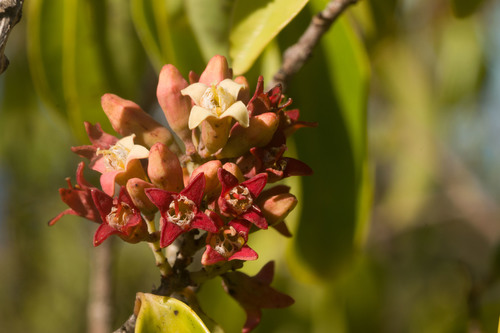
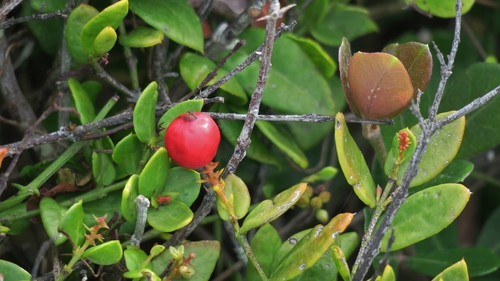
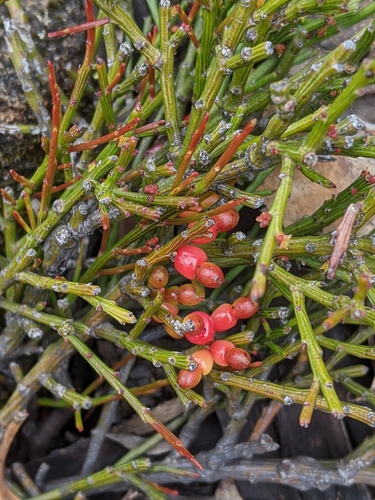
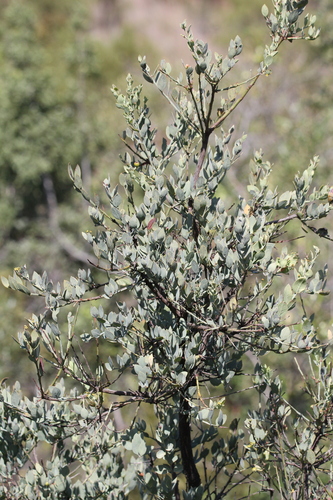
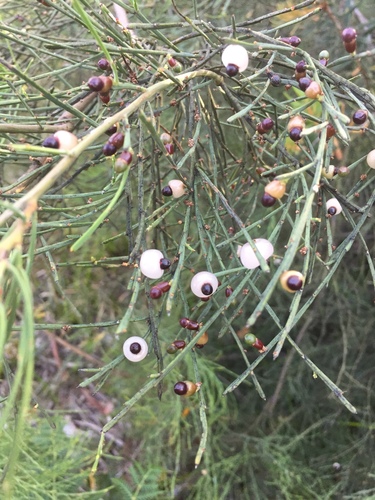
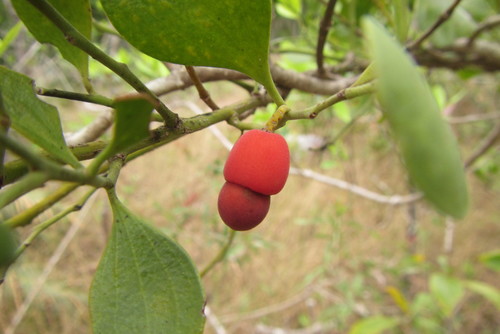
Exocarpos latifolius R.Br. is a species of parasitic tree in the plant family Santalaceae. Its common names include broad leaved ballart, scrub sandal-wood, scrub cherry, oringorin, broad leaved cherry, and native cherry. This species grows in monsoon forest, littoral rainforest, and occasionally in more open forest types across Malesia and Northern Australia. It is a small tree or large shrub that reaches up to 10 metres in height, and is hemiparasitic on the roots of other trees. Its leaves are approximately as broad as they are long, reaching around 4 cm in length. Flowers grow in slender spikes that are mostly approximately 1 cm long. The fruit is a globular nut carried on a short stalk; as the fruit ripens, the stalk swells and turns red, giving the fruit a structure like an inside-out cherry. The fruit itself is 4–6 mm long and is inedible, while the edible swollen stalk was used as a traditional food source by Aboriginal Australians. The genus name Exocarpos comes from Latin meaning "outer", referring to the seed that sits on the outside of the fruit. The wood of this tree is very fine-grained with little distinct grain pattern, but often has striking colour variation, and was historically used for cabinet work. This tree was used for many purposes by Aboriginal Australians beyond food: its bark was used as a contraceptive, its burned leaves repel insects, and leaves were prepared into a solution to treat sores. The 1889 book The Useful Native Plants of Australia records that Indigenous Australians of Queensland called this tree "Oringorin", lists its common names as Broad-leaved "Native Cherry" and "Scrub Sandalwood", and also states that "The fruit is edible".