About Exocarpos cupressiformis Labill.
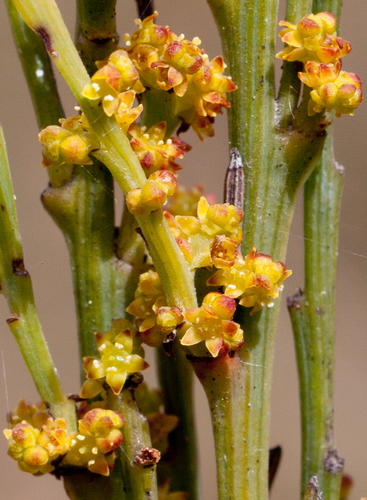
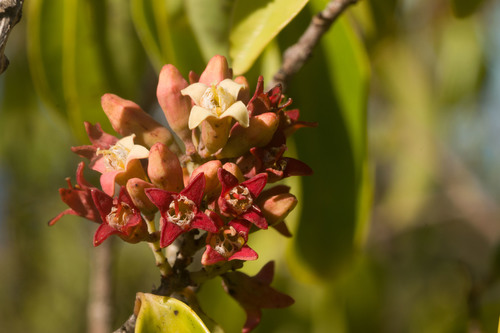
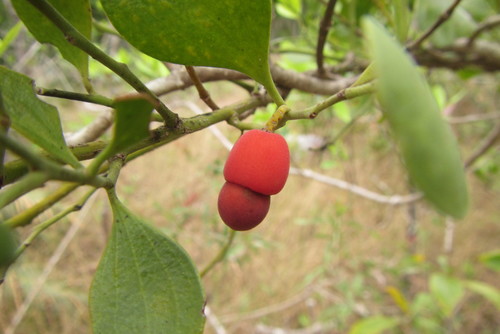
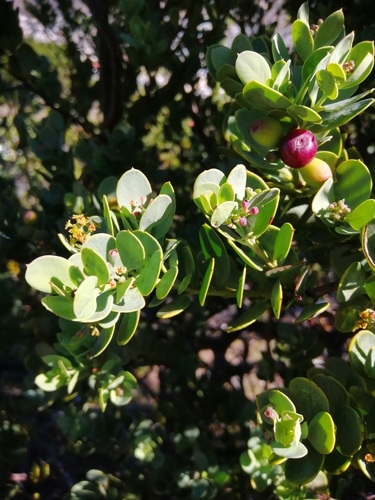
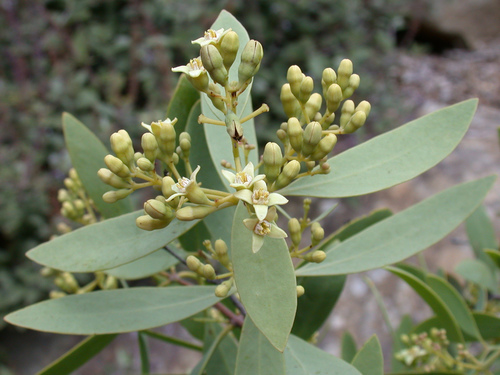
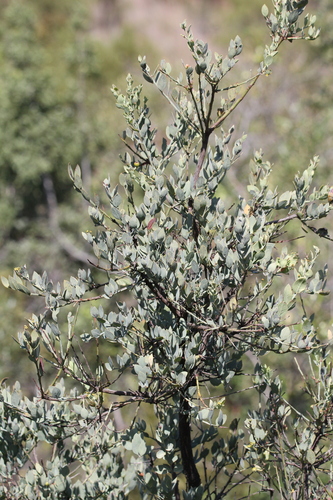
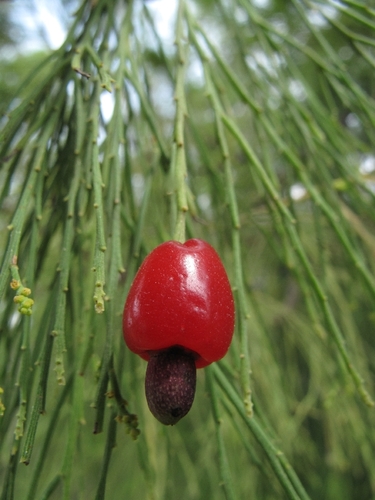
Exocarpos cupressiformis Labill., commonly known as cherry ballart, superficially resembles cypress. It grows as a large shrub or small tree, reaching 3 to 8 metres (9.8 to 26.2 feet) tall, and often has a pyramidal shape. There are no authoritative published accounts of its host plants or parasitism, and most available information on this topic is anecdotal. Like many other members of the Santalaceae family, E. cupressiformis is hemiparasitic on the roots of other trees, particularly eucalypts, during its early developmental stages. This parasitism survives best in shallow soils. Mature plants are less reliant on parasitism, as the photosynthetic structures in their stems are fully established. Its leaves are reduced to small scales, and photosynthesis takes place in the plant’s green, drooping stems. Its inconspicuous flowers grow in clusters along short spikes that are 3–6 mm long. Only one flower on each spike develops into a fruit. The true fruit is an inedible, globular, hard, greenish nut 4-6 mm long that contains a single seed. This nut sits on top of a short pedicel. As the fruit develops, the pedicel swells to 5-6 mm in diameter and turns yellow or red, forming the edible “cherry”. Unlike European cherries, which are unrelated to this species, cherry ballart fruits do not have a hard stone inside. The true seed-containing fruit, which is a nut similar to an acorn, grows on the outside of the fleshy false fruit, which is actually the swollen pedicel. This arrangement gives the genus its name Exocarpos: the name comes from the Ancient Greek words ἔξω (éxō, meaning “outside”) and καρπός (karpós, meaning “fruit”), so the genus name translates to “outside fruit”. E. cupressiformis is native to Australia, where it grows in eastern Australia in sclerophyll forests, especially in shallow soils and on granite outcrops. Its range is extensive, extending from Queensland to Victoria, from the coast to the leeward fringe of the Great Dividing Range, and also including Tasmania. In more southern parts of South Australia, the species grows in several isolated forest pockets. These include a stretch from the Mount Lofty Ranges down the Fleurieu Peninsula to Kangaroo Island, southern parts of the Yorke Peninsula and Eyre Peninsula, and the area around Mount Remarkable National Park. Anecdotal reports claim that cherry ballart foliage is toxic to livestock, but this claim is not mentioned in any published literature. Visible browse lines show that the plant is readily eaten by wild herbivores. Indigenous Australians used the plant’s wood to make spearthrowers and bull roarers. The pale wood has a very fine grain with little natural patterning, but often has striking colour variation. Historically, the timber was used to make furniture, gun stocks, and tool handles. It is also suitable for carving and turning, so it is now used to make decorative and ornamental craft and art pieces. The edible fleshy pedicel, or “cherry”, was used as food by Indigenous Australians and early European settlers. This “fruit” is harvested when it is so ripe that it is ready to fall from the tree, and it can be eaten either raw or cooked. The 1889 book *The Useful Native Plants of Australia* records that Indigenous Australians in Queensland called this plant Tchimmi-dillen or Coo-yie, and notes: “The fruit is edible. The nut is seated on the enlarged succulent pedicel. This is the poor little fruit of which so much has been written in English descriptions of the peculiarities of the Australian flora. It has been likened to a cherry with the stone outside (hence the vernacular name) by some imaginative person.” Early European settlers used cherry ballart branches as Christmas trees.