About Exobasidium vaccinii (Fuckel) Woronin
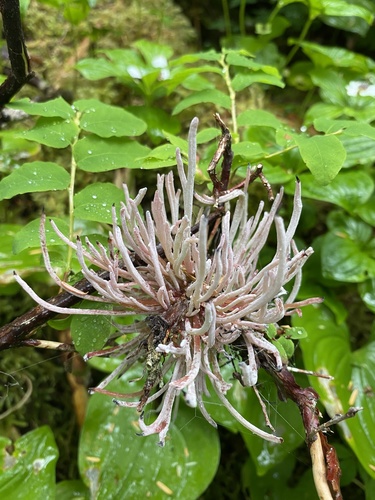
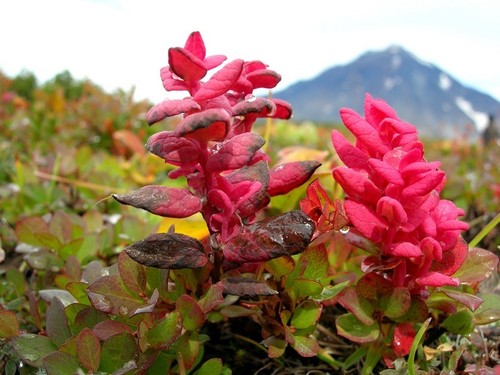
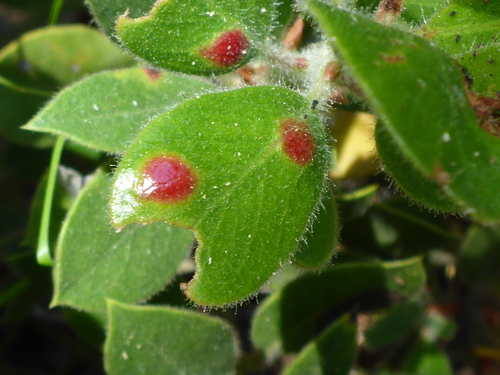
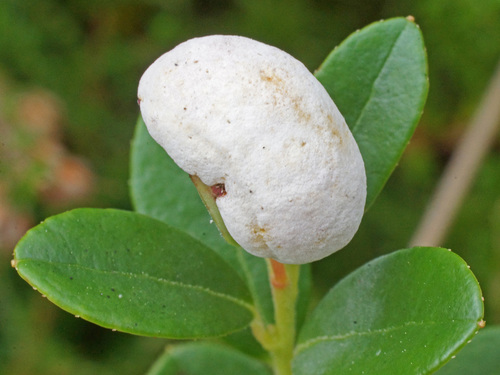
Exobasidium vaccinii (Fuckel) Woronin is a pathogenic plant fungus that causes characteristic disease symptoms in host tissues. In its pathogenic form, this fungus triggers tissue discoloration, and may also cause hypertrophy and hyperplasia of host leaves and meristems, depending on the host species. These abnormal growths often develop flower-like structures called "pseudoflowers". It can also produce green spots, sometimes with a red tint, on blueberry fruits, and these spots occasionally bear visible white spore masses. Symptoms caused by E. vaccinii in host plants are often distinct from those caused by other Exobasidium species, and traditional identification of Exobasidium species has relied on comparing spore size. In a typical disease cycle, leaves on infected shoots develop a greenish red to bright red discoloration at the time when healthy host plants would normally produce fruit. In late stages of disease development, the abaxial (lower) surface of infected leaves becomes covered in a white mass made up of sparse hyphae, basidia, basidiospores, and secondary spores, which in turn produce conidia. Basidiospores of E. vaccinii are musiform (banana-shaped), with a rounded apex and a distinct hilar region at the base of the spore. These spores are hyaline (transparent), measuring approximately 10-13 micrometers long and 3-4 micrometers wide. Some spores have a transverse medial septum that divides the spore into two nucleated compartments. Woronin first observed the ability of Exobasidium to produce asexual spores in 1867, and over a century later, scanning electron microscopy and transmission electron microscopy confirmed that E. vaccinii produces conidia from its secondary spores. There are no confirmed reports of E. vaccinii forming appressoria, while appressoria formation is well-documented in E. vexans, a related species pathogenic to tea, and in other members of Ustilagomycetes. The intercellular hyphae of E. vaccinii are septate, and produce short, lobed haustoria that penetrate host cells. When hyphae and haustoria make contact with host cells, they exert significant pressure that causes distortion of surrounding host tissues. Like other plant pathogenic fungi, E. vaccinii haustoria contain membranous inclusion bodies and are associated with electron-dense deposits. E. vaccinii is dimorphic, and can be grown in laboratory culture. In its non-pathogenic state in natural environments, it likely grows as a yeast-like form in soil or on plant surfaces, similar to many of its smut relatives. In its biotrophic pathogenic state, it obtains energy from ericaceous host plants. Most native and cultivated varieties of rhododendron and azalea are susceptible to infection, as are both highbush and lowbush blueberry cultivars. According to published studies, E. vaccinii is distributed across the Northern Hemisphere, including most of eastern North America and western Europe. It has also been reported on endemic Vaccinium species in parts of Asia. A previously reported endemic host population of E. vaccinii in Hawaii was later found to be infected by a distinct species, Exobasidium darwinii, rather than E. vaccinii. Spores are produced on basidia on the outer surface of galls, typically in late spring and early summer. Over time, mycelium growing in infected leaves spreads to colonize the host's rhizomes, where the infection becomes systemic. Any new shoots that grow from these colonized rhizomes are usually already infected, and do not produce flowers or fruit. Systemically infected plants also typically develop higher infection rates and larger gall loads.