About Exidia thuretiana (Lév.) Fr.
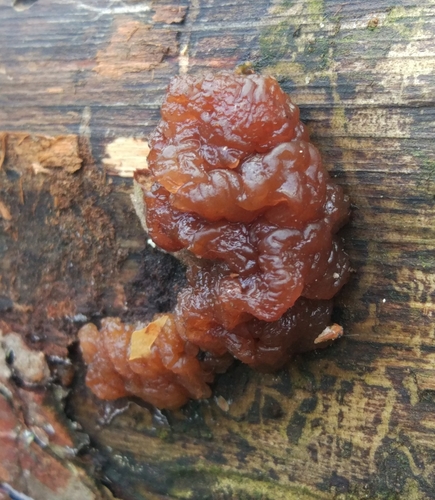
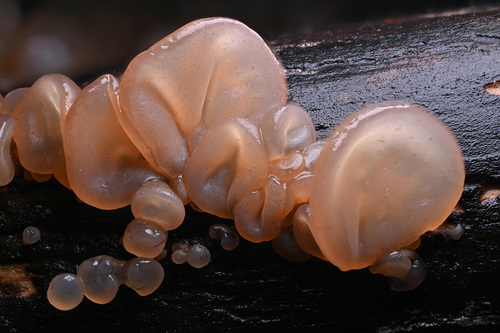
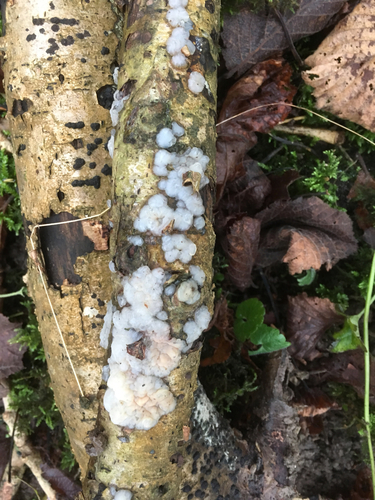
Exidia thuretiana produces individual, shallowly cushion-shaped (pulvinate), gelatinous fruit bodies that range from 0.2 to 1 centimeter (1⁄8 to 3⁄8 inch) in diameter. These fruit bodies rapidly coalesce, often growing along the underside of branches to extend up to 10 centimeters (4 inches) or more. The combined fruit masses are typically undulating or pleated, whitish in color, and sometimes bear ochre or pinkish tints. The upper spore-bearing surface, the hymenium, is smooth and opaque, but is commonly furrowed and folded. It may have a powder-like pruinose coating. As it ages, the hymenium develops into a thin, horny, yellowish film. The fungus produces a white spore print. It has no distinct taste or odor, and is inedible. This species is a wood-rotting fungus that grows most often on dead attached or fallen branches. It was first documented growing on beech, and still frequently occurs on this substrate, but it can also be found on other broadleaf trees and shrubs, including oak, hazel, ash, and apple. Exidia thuretiana usually produces fruit bodies in autumn and winter. It is widely distributed across Europe, North Africa, and northern Asia, and has also been collected from Greenland.