About Exidia recisa (Ditmar) Fr.
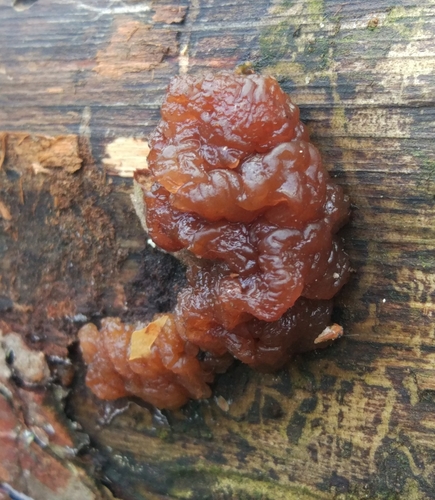
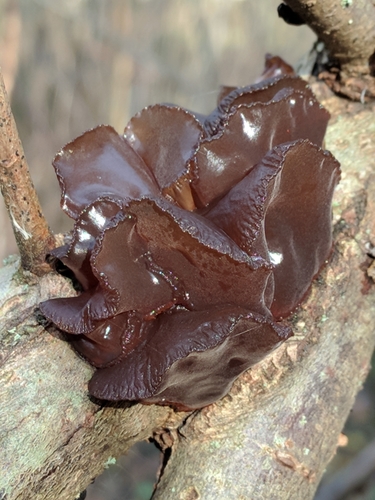
Exidia recisa (Ditmar) Fr. produces orange-brown or amber, gelatinous fruit bodies. Young fruit bodies are firm and shallowly conical, becoming lax and pendulous as they age, and grow to around 2.5 centimetres (1 inch) across. Fruit bodies typically grow in groups, and do not usually coalesce together. The upper spore-bearing surface is smooth and shiny, while the undersurface is smooth and matte. Each fruit body attaches to wood at a single point, and does not have a stem. The spore print of this species is white. Exidia recisa is a wood-rotting fungus that most often grows on dead attached twigs and branches. It was first documented growing on willow, and occurs most frequently on willow as a substrate. It has also been reported growing on alder and Prunus species. This species typically produces fruit bodies in autumn and winter. It is widely distributed across Europe; its distribution outside of Europe is uncertain, because it has only been distinguished from morphologically similar species in North America and Asia fairly recently. DNA sequencing evidence confirms that Exidia recisa is present in North America, where the more common similar species is E. crenata.