About Exidia glandulosa (Bull.) Fr.
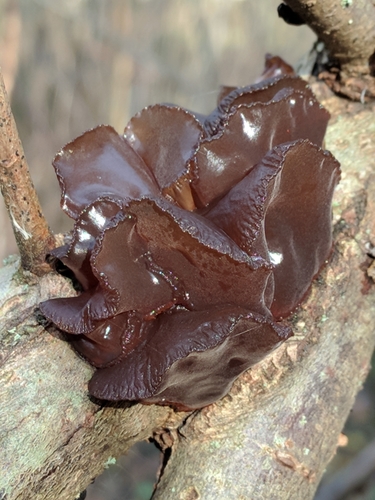
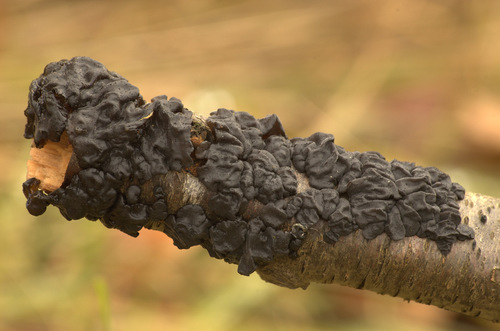
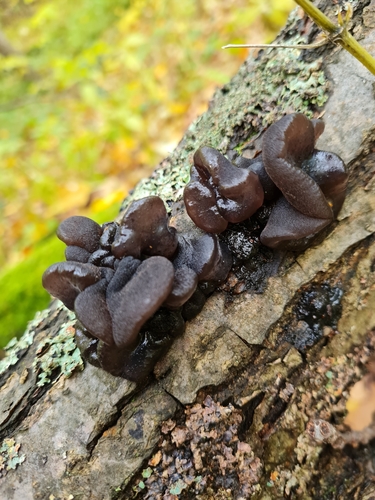
Exidia glandulosa (Bull.) Fr. produces dark sepia to blackish, rubbery-gelatinous fruit bodies that are top-shaped, like an inverted cone, and around 3 cm (1.2 in) across. Individual fruit bodies sometimes fuse together into masses that can reach 20 cm in length. Fresh fruit bodies are firm, but become lax and distorted as they age or in wet weather. They grow singly or in small clusters. The upper, spore-bearing surface is shiny, and dotted with small pimples or pegs. The undersurface is initially smooth and matt, but later develops a dense covering of small gelatinous spines. Fruit bodies attach to their growing substrate at the base, produce a white spore print, and shrink to form a flattened black crust when dried. This is a wood-rotting pioneer species that can colonize living or recently dead wood. It typically grows on dead attached branches of broadleaf trees, especially oak, and occasionally on hazel or beech. One study of wood decay in attached oak branches found that Exidia glandulosa is part of a community of eight basidiomycetous fungi consistently associated with the decay of dying branches on living trees. Its specific role in this process is to disintegrate vascular cambium tissue, which loosens the attached bark. The species can persist for some time on fallen branches and logs. Fruit bodies are normally produced in autumn and winter. Its global distribution outside Europe is uncertain, due to confusion with the similar species Exidia nigricans.