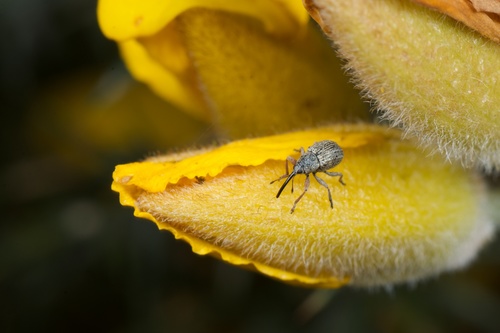
About Exapion ulicis (Forster, 1771)
Exapion ulicis, formerly classified as Apion ulicis, is a species of straight-snouted weevil commonly known as the Gorse Seed Weevil. This weevil is used as a biological pest control agent against Common Gorse, Ulex europaeus, which is categorized as a noxious weed in some countries. Adult weevils are light gray in color, with a long snout that reaches half the total length of their body. Fully grown adults measure between 2 and 3 millimeters in total length. Adults feed on gorse by using their snout to dig into the soft tissue of the plant's stems and spines, leaving behind distinctive round feeding holes. The larval stage of this weevil causes more damage to gorse than adults do. Larvae hatch from eggs laid inside gorse seed pods, then feed on the gorse seeds for six to eight weeks. After feeding concludes, larvae enter the pupal stage that lasts approximately two months. This weevil species is native to western Europe. It was first introduced to New Zealand in 1931, and introduced to California as a gorse control agent in the 1950s. It is currently established in gorse populations across the western United States and Hawaii. By destroying gorse seeds, this weevil reduces the spread of the plant, which makes seed destruction the primary mechanism of its biological control effect. The species cannot eliminate existing stands of gorse, because the damage caused by adult feeding is not severe enough to destroy or significantly weaken entire mature plants.