About Exaireta spinigera (Wiedemann, 1830)
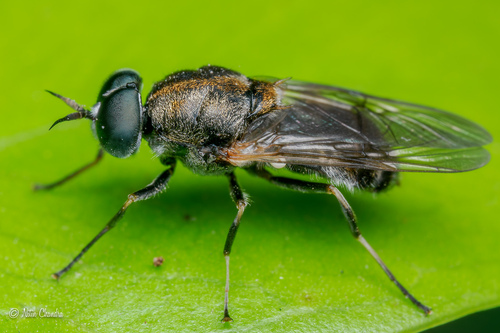
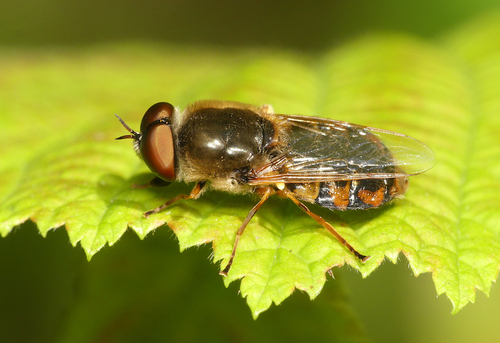
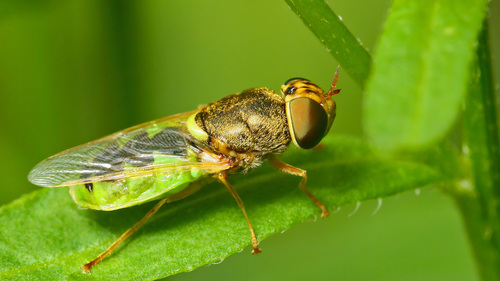
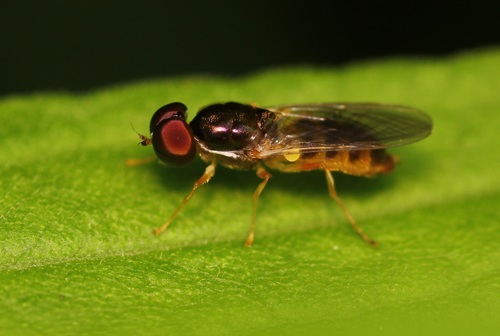
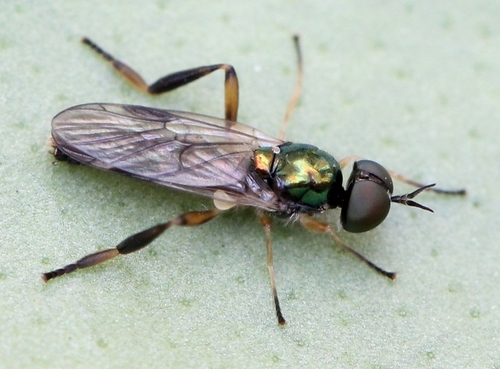
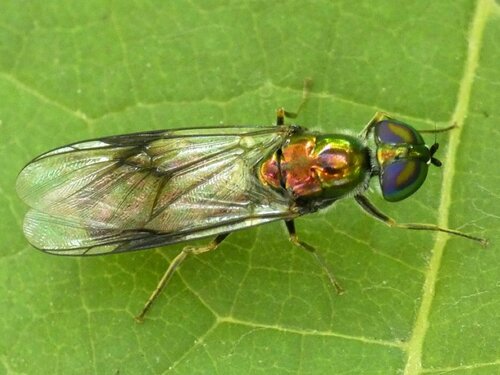
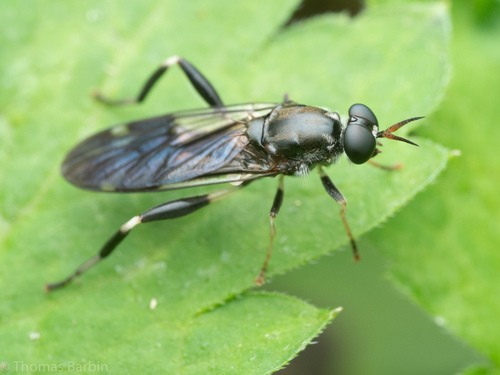
Exaireta spinigera, a species of soldier fly in the Stratiomyidae family, has a black body with violet undertones, shaded wings, and a metallic shine on its abdomen, a trait shared with other Stratiomyidae. This fly measures 14 to 16 mm in total length; historical records note males reach 9 to 10 mm long with 7 to 8 mm wings, while females reach 13 to 15 mm long with 11 to 12 mm wings. It has an elongated abdomen, and four yellow-tipped spikes protrude from its scutellum, the structure located near the thorax. Like other Stratiomyidae, it has characteristic antennae made up of three distinct segments. Both adult flies and larvae have flattened bodies, another common trait for the family, but no additional sources are available to describe the morphology of larvae or eggs of this species. Exaireta spinigera is native to Australia, but has been introduced to multiple other regions and countries including New Zealand, Hawaii, North America, Europe, and Russia. It was first recorded in Honolulu, Hawaii in the 1890s, and was commonly established across Hawaii by the 1900s. It was later detected in Santa Barbara, California, North America, in 1985. In Europe, it was first recorded on the Italian Peninsula, has spread across Italy, and has since been found in France. The most recent new record of this species is from Alder on the Black Sea coast of Russia. It has a widespread distribution and likely occurs in other unrecorded countries. In New Zealand, Exaireta spinigera occurs across both the North and South Islands. Its southernmost recorded location in New Zealand is Papatowai, and its northernmost recorded location is Pupuke; it has also historically been found in Auckland, Whangārei, and Wellington. Larvae of Exaireta spinigera prefer to live in decaying organic matter, and are commonly found in residential compost bins. Adult garden soldier flies are also often found hovering around decaying organic matter, and are commonly seen in residential gardens. In Australia, Exaireta spinigera has a seasonal activity pattern with two peaks: one peak runs from March to May, starting in April (Autumn), and a second runs from September to December (Spring). This species is active during the day. Females prefer to lay eggs directly into substrates like decaying organic matter, but little is known about the species' rearing, full life cycle, or mating behavior. For Stratiomyidae, pupae develop inside the larval skin, which does not change during this process. It has been hypothesized that Exaireta spinigera larvae move to drier locations to pupate when conditions become too moist, but this behavior has never been observed. There is currently no published literature covering the full life cycle, mating behavior, and rearing behavior of this species.