About Evasterias troschelii (Stimpson, 1862)
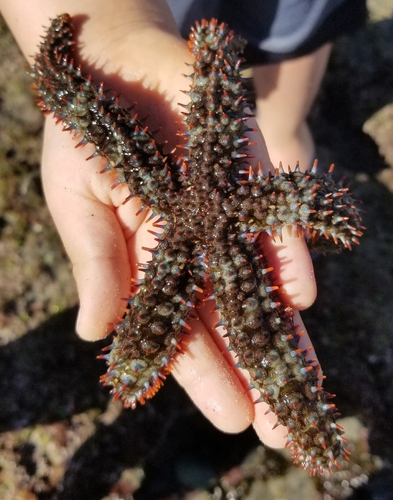
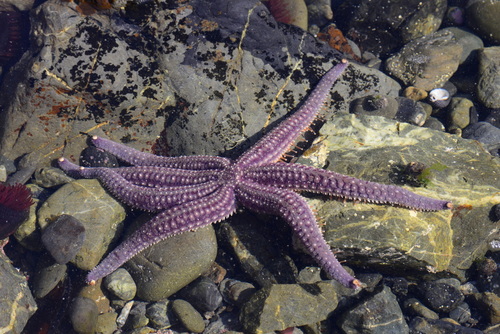
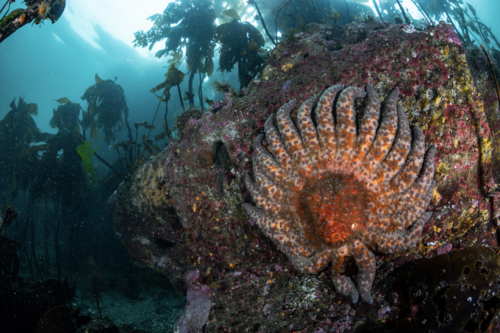
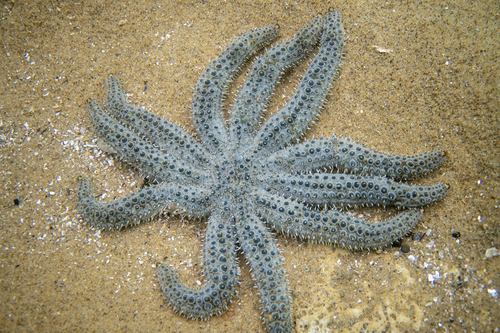
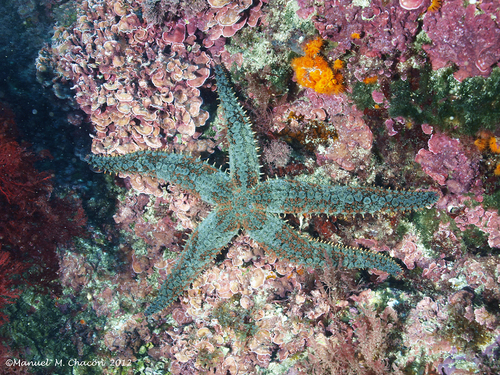
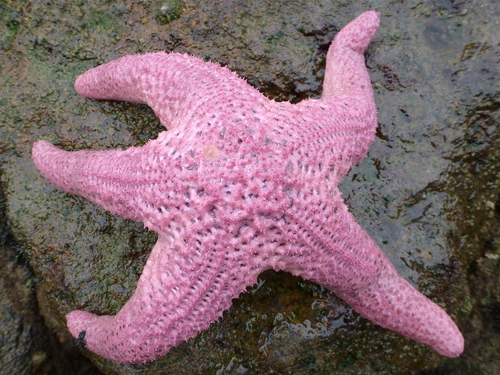
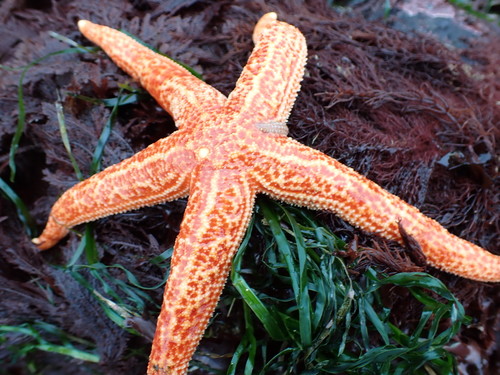
Evasterias troschelii, commonly called the mottled star, is a large starfish that can reach a radius of up to 28 centimetres (11 in). It has a small central disc and five long, narrow arms that are often turned upward at the tips. The widest point of each arm is located a short distance away from the edge of the central disc. The aboral (upper or dorsal) surface of the disc is covered by a network of calcareous plates that bear spines around 2 mm (0.1 in) long. These larger spines are surrounded by smaller spines, plus crossed and straight pedicellariae—minute pincer-like structures with two jaws. An irregular line of white-tipped spines runs down the center of each arm, and the entire upper surface feels rough to the touch. On the oral (lower or ventral) surface, a long ambulacral groove extends from the central mouth to the tip of each arm. This groove holds four rows of tube feet, with clumps of pedicellariae and spines positioned on either side. The colour of this species is highly variable, and includes plain or mottled shades of orange, brown, greenish-grey, bluish-grey, and pale purple. The outer edges of the arms often have a contrasting coloured rim, and the underside is typically pale brown.
Evasterias troschelii is found along the west coast of North America. Its range extends from the Pribilof Islands, Alaska, southward to Monterey Bay, California, though it is rarely seen south of Puget Sound. It also occurs in Bechevinskaya Bay, Kamchatka. It is most commonly found on rocks and pebbles, and occasionally occurs on sand. It inhabits depths down to approximately 70 to 75 metres (230 to 246 ft). In bays and other sheltered locations, it largely displaces the other common local sea star species, the purple sea star (Pisaster ochraceus).