About Eutropis macularia (Blyth, 1853)
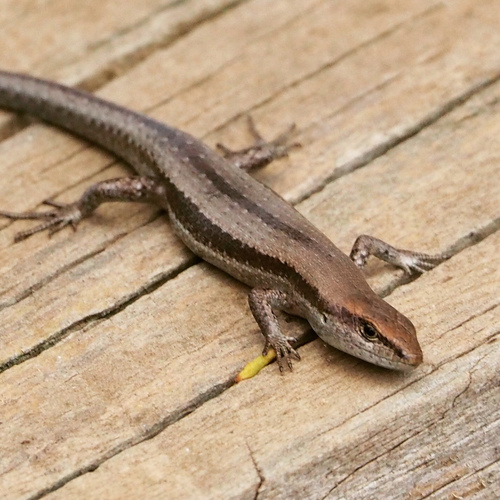
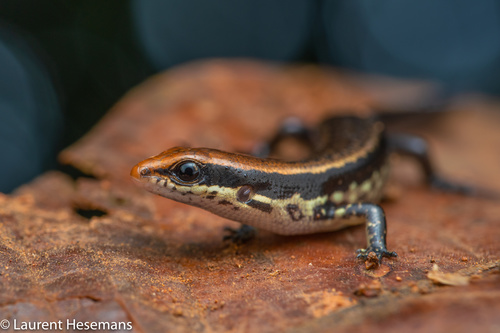
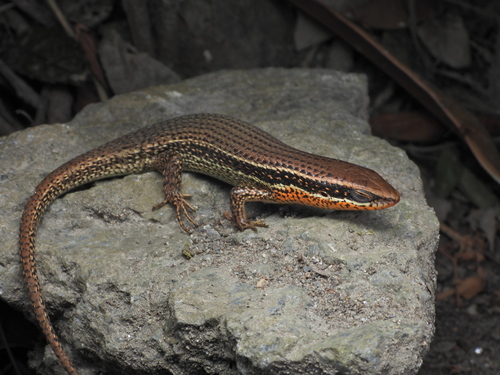
Eutropis macularia, commonly called the bronze grass skink, has a cylindrical body. Its dorsal scales have 5–8 keels, while ventral scales are smooth. Like other species in the Eutropis genus, its scales are keeled overall. A pair of dorsolateral bands run from above the eye to the base of the tail. The snout is short, acuminate, and bears an obtuse keel; the lower eyelid is covered in scales. The nostril sits behind the vertical suture between the rostral scale and the first labial scale. The ear opening is oval, and is roughly the same size as a lateral scale, or slightly smaller. Dorsal, nuchal, and lateral scales have five to seven sharp keels, and 26 to 30 approximately equally sized scales encircle the middle of the body. When pressed against the body, the limbs meet or overlap. Digits are short, and the lamellae between digits are smooth. The tail is 1.25 to 1.75 times the length of the head and body combined. This species is brown or olive-brown on the upper body; its sides are darker and usually marked with white spots that have black edges. The back may be uniform in color, marked with black spots, or marked with one or two black longitudinal lines. Sometimes, two light lateral lines are present on each side, and are only clearly defined in the neck region. Underparts are yellowish in preserved specimens. Overall body color can be deep brown, olive, or bronze-brown, and the dorsolateral bands may be light or yellow. Black spots sometimes appear on the base of the tail. Breeding males have orange coloration on the lateral sides of their body. Juveniles are grey with a bronze-colored head. The species reaches a maximum total length of 23 cm (9 in); a more common total length is 16 cm (6 in), with a snout-to-vent length of 7 cm (2.8 in). Just above the ankle on the leg, there is a specialized group of scales that forms a refuge for chigger mites. This skink is distributed across Bangladesh, Bhutan, Cambodia, India, Laos, northwestern Malaysia, Myanmar, Nepal, Pakistan, Sri Lanka, Thailand, and Vietnam. Its type locality is Rangpur, Bengal, which is in present-day Bangladesh. It occupies deciduous forests, evergreen forests, plantations, areas of leaf litter, grasslands, and rocky areas with scattered trees, occurring at altitudes up to approximately 1,500 m (5,000 ft). Like other skinks, the bronze grass skink feeds on insects and other invertebrates. It hides in ground holes, rock crevices, and under rocks. Females lay several small clutches of eggs each year, with each clutch holding three to six eggs. A study conducted in the southern Western Ghats found Eutropis macularia to be the most frequently encountered reptile in the study area's plantations, orchards, and gardens, and the species is active both during the day and at night. This skink prefers areas with a high canopy, deep leaf litter, and dense cover of shrubs and herbs. It is strictly terrestrial and rather shy.