About Eutropis carinata (Schneider, 1801)
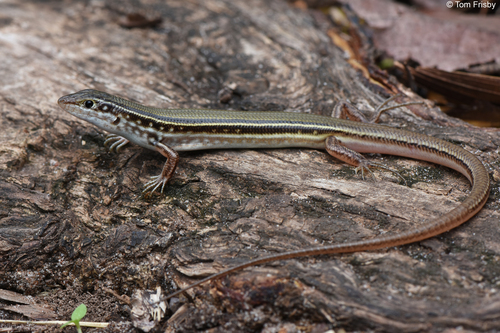
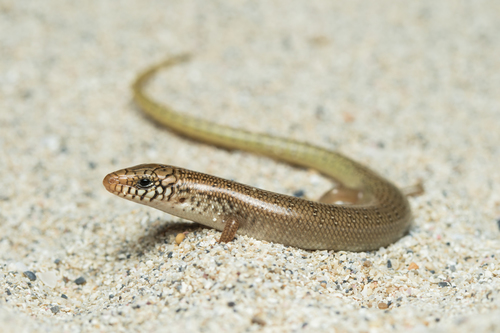
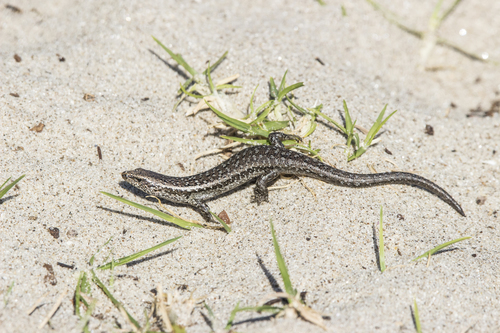
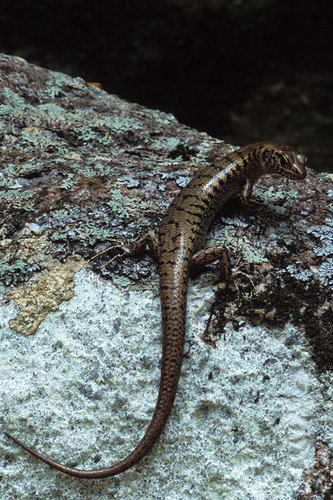
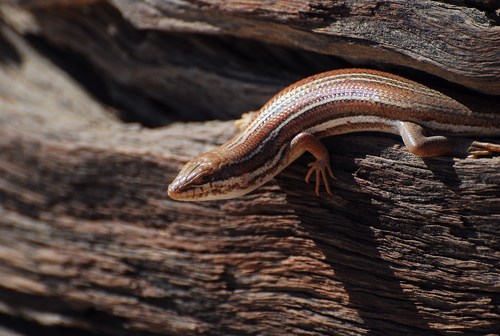
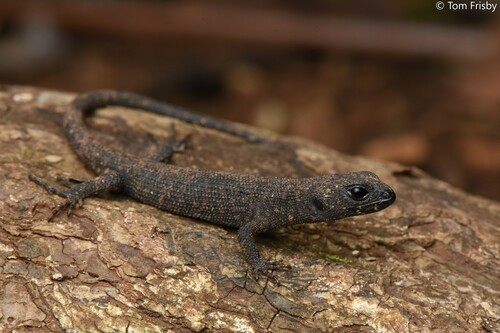
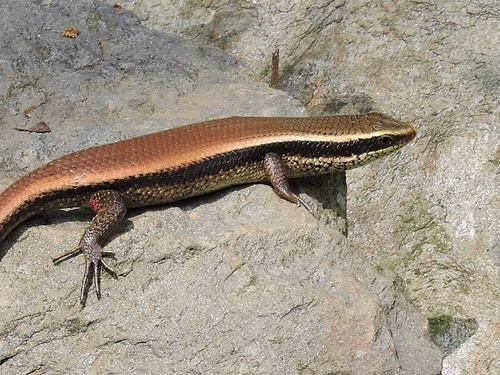
Eutropis carinata, first described by Schneider in 1801, has a robust body, a moderate, obtuse snout, and scaly lower eyelids. Its vertebral scales are smooth, and the ear opening is roundish to sub-triangular. The upper body is colored brown, olive, or bronze, and may be uniform, or marked with dark brown or black spots, or longitudinal streaks along the lateral margins of the scales. The sides are dark brown or chestnut, and may or may not have light spots. A pale dorso-lateral line runs from above the eye to the base of the tail. The underparts are whitish or yellowish. This species reaches a maximum total length of 37 cm, with a common total length of 25 cm, and a typical snout-vent length of 9 cm. The previously recognized Sri Lankan population Eutropis carinata lankae is now treated as a separate full species, Eutropis lankae. Eutropis carinata is frequently found in Bangladesh, India (excluding northwestern India), the Maldives, Myanmar, and Nepal; its presence in Bhutan is unconfirmed. It is a diurnal terrestrial species, often seen basking or foraging in open areas. Eutropis carinata is oviparous. Females lay clutches of 2 to 20 eggs at a time between August and September, in holes the individuals dig themselves or under fallen logs. The eggs measure 11 by 17 mm. Hatchlings emerge between May and June, and measure 12 to 12.5 cm (snout-vent length). In Mysore, southern India, the male reproductive cycle has peak testicular size, maximum spermatogenic activity, and maximum steroidogenic activity during October to November. This timing aligns with the female reproductive cycle, which generally falls during the region's dry post-rainy season.