About Eutrigla gurnardus (Linnaeus, 1758)
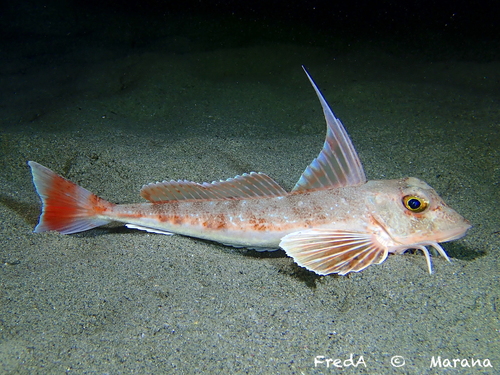
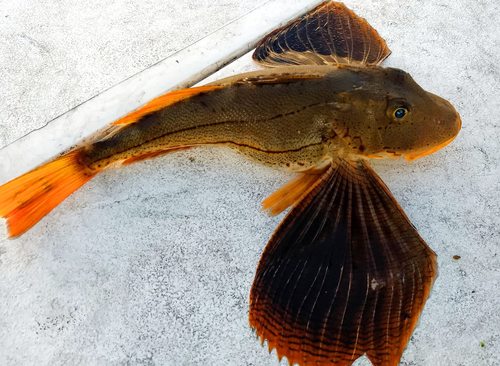
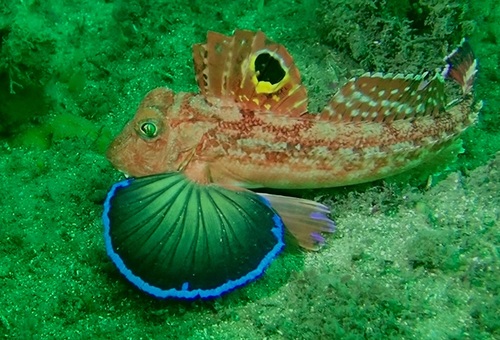
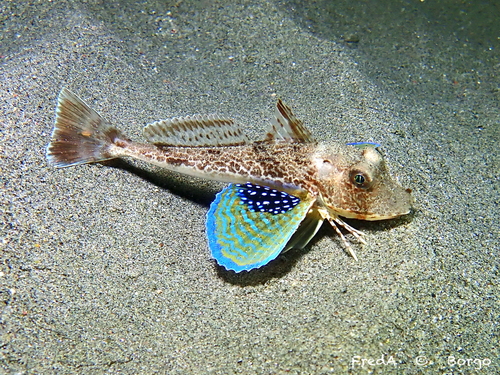
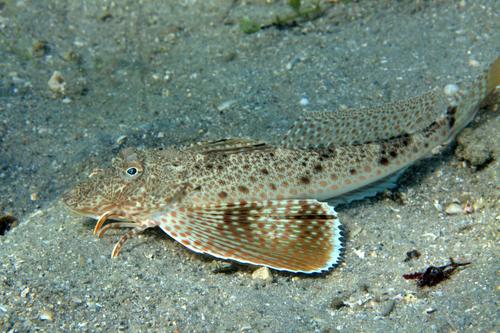
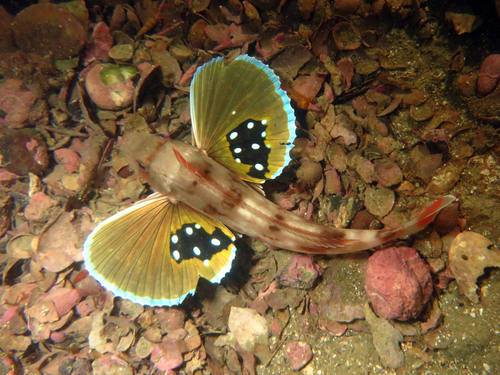
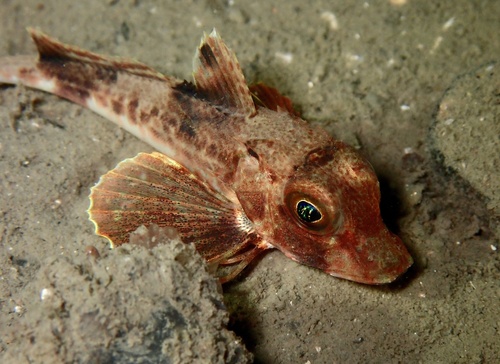
Eutrigla gurnardus, commonly known as the grey gurnard, has a large head and lacks a deep occipital groove. It has two dorsal fins: the first holds 7–10 spines, and the second holds 18–20 rays. Its anal fin has 17–20 rays, and its short pectoral fins extend only to the origin of the anal fin. Scales along the lateral line are slightly larger than the scales covering the rest of the body; these lateral line scales have a spiny keel and a toothed rear edge. The breast has no scales, while the belly is only partially covered in scales. The grey gurnard's colouration is variable, but it is most often greyish-brown, rarely dull red, with red tinges on its back and flanks. Its underside is cream coloured, and its back and flanks are typically covered in small white spots. A large, circular black mark is present on the first dorsal fin. This species reaches a maximum total length of 60 centimetres (24 in), with a more common total length of 30 centimetres (12 in), and the maximum published weight for the species is 956 grams (2.108 lb). The grey gurnard is distributed across the eastern Atlantic Ocean, ranging from Iceland and Norway south to Morocco, and is also found in the North Sea, the southern Baltic Sea, and off the coast of Madeira. In the Mediterranean Sea, its range stretches from eastern Spain to Turkey, and extends into the Black Sea. This fish is most common on sandy seabeds, but occurs less often on rocky substrates and in muddy areas, ranging from the shoreline down to 140 metres (460 ft). In the eastern Ionian Sea, it has been recorded at depths as great as 340 metres (1,120 ft). It is a predatory species that feeds on crustaceans—mainly shrimps and shore crabs—and small fish including gobies, flatfish, young Atlantic herring, and sand eels. Like other sea robins, grey gurnards produce sounds. Sound production in this species is most often linked to competition for food. Smaller individuals produce more sounds overall than larger individuals, and emit more "grunts" than "knocks". This is likely because smaller grey gurnards more frequently use contest tactics to compete for food, while larger individuals mostly rely on scrambling for food. In Ireland, this species has the common names cuckoo fish, knoud, and noud.