About Eutricha capensis (Linnaeus, 1767)
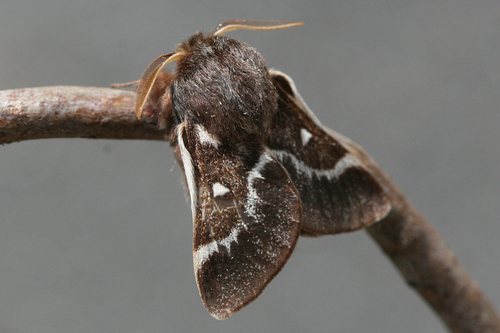
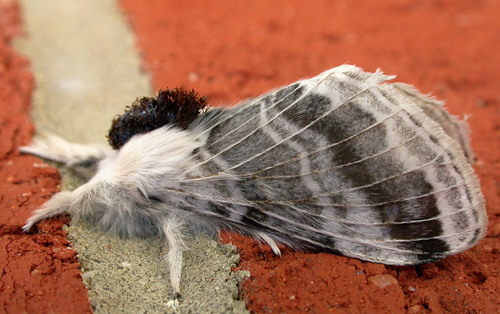
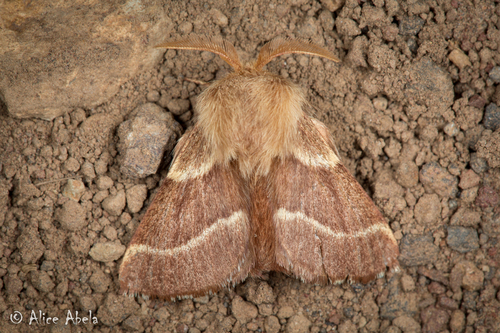
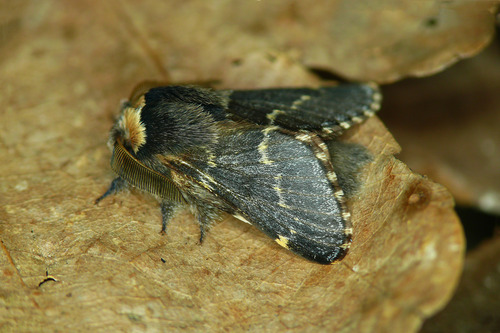
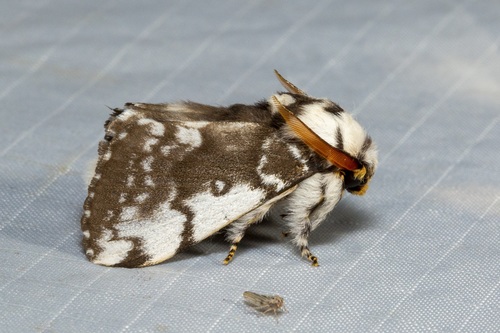
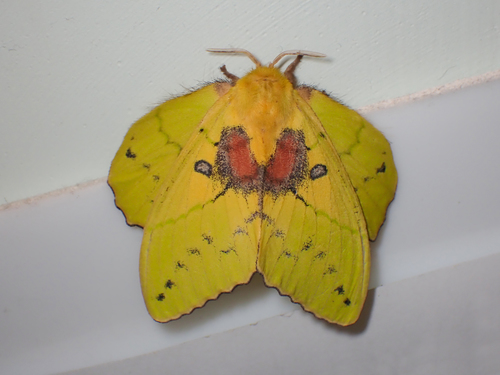
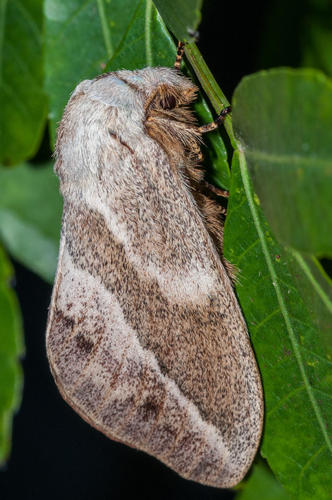
This moth species is scientifically named Eutricha capensis (Linnaeus, 1767), commonly called the Cape lappet moth. Adult moths are large and stocky, with an average wingspan of approximately 70 mm (2.8 inches). Both the fore wings and hind wings are reddish brown. Fore wings are flecked with yellow and marked with three wavy white stripes. Females are typically larger and paler in color than males. Adult Cape lappet moths do not have fully developed mouthparts, so they cannot feed. Female antennae are deeply pectinate and reach the full length of the thorax. The larvae are distinctly hairy, with rows of long orange hair tufts running along the sides of their bodies. At the head, there are three large coppery tufts and two smaller purple tufts. A row of black triangles runs along the dorsal side of the caterpillars, with a white band flanking each side of the row. There is no scientific consensus on the full range of this moth in southern Africa. All sources agree that South Africa is the species' primary range, but other sources also document its presence in Malawi, Mozambique, and Tanzania. Because caterpillars can feed on a wide variety of plants, they are common in both domestic gardens and more remote wild areas. Caterpillars are gregarious and clump together in groups; the reason for this aggregation behaviour is not well understood, and several theories have been proposed. A 2013 study found that for E. capensis specifically, this aggregating behaviour provides no benefit to caterpillars for either water conservation or energy conservation. Recorded host plants for E. capensis larvae include: Acacia cyclops, Acacia mearnsii, Acacia saligna, Acacia karroo, Bauhinia, Celtis africana, Chrysanthemoides monilifera, Chrysanthemoides incana, Cupressus macrocarpa, Combretum molle, Eucalyptus macarthurii, Eucalyptus paniculata, Euclea racemosa, Mangifera indica, Pinus patula, Pinus radiata, Pinus elliottii, Pinus montezumae, Populus, Prunus armeniaca, Prunus persica, Rhus lancea, Searsia lucida, Rhus crenata, Schinus molle, Schinus terebinthifolius, Rosa banksiae, and Taxodium distichum. Adult moths emerge in early summer, and are non-aggressive when disturbed.