About Eutoxeres aquila (Bourcier, 1847)
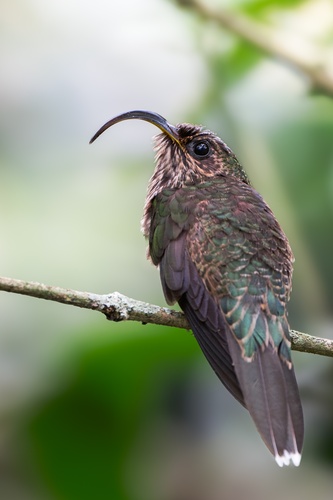
Description: The most prominent feature of the white-tipped sicklebill is its strongly decurved bill that curves through a quarter circle. The maxilla is yellow and the mandible is yellow. This species measures about 11.5 to 13.5 cm (4.5 to 5.3 inches) long, and weighs between 8.6 and 14.5 g (0.30 to 0.51 oz). Males and females have identical plumage patterns. Adult white-tipped sicklebills have green upperparts, blackish throat and chest, and the rest of their underparts are striped with green and white. Their tail is mostly green, with the outer pair of tail feathers being more dusky and ending in white tips. Juveniles have a scaly appearance.
Distribution and habitat: The northernmost subspecies of white-tipped sicklebill, E. a. salvini, occurs in Costa Rica, Panama, and western Colombia. E. a. heterurus is found from Colombia's Cauca Department south through western Ecuador, and there is at least one confirmed record of this subspecies in Mérida, western Venezuela. The nominate subspecies E. a. aquila ranges from eastern Colombia south through eastern Ecuador into northern Peru. The species inhabits the understory of montane evergreen forest. In Costa Rica, it occurs between 300 and 700 m (980 and 2,300 ft) elevation on the Caribbean side, and between 1,000 and 1,200 m (3,300 and 3,900 ft) on the Pacific side. In western Colombia, it is found from sea level up to 1,400 m (4,600 ft), and in the Magdalena River valley it occurs between 1,600 and 2,100 m (5,200 and 6,900 ft). In Peru, it is found between 750 and 2,000 m (2,460 and 6,560 ft) elevation.