About Euthyrhynchus floridanus (Linnaeus, 1767)
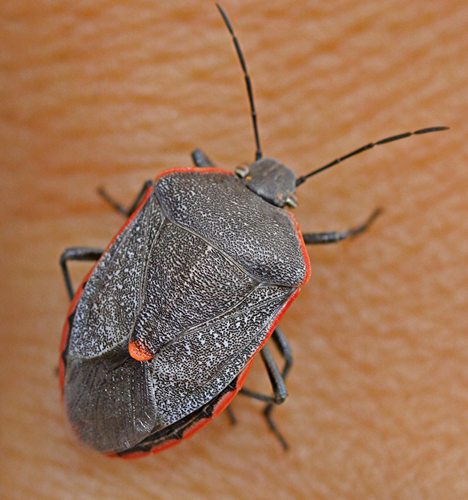
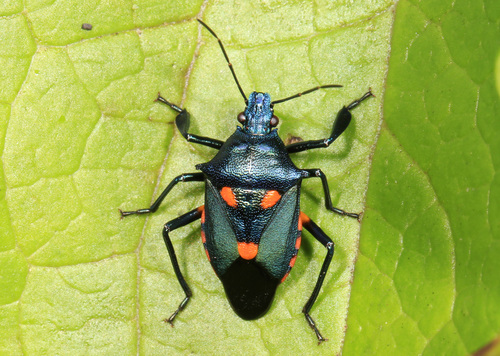
Euthyrhynchus floridanus, commonly called the Florida predatory stink bug, shows clear size difference between adult sexes. Adult males reach approximately 12 mm (0.5 in) in length, while adult females can grow up to 17 mm (0.7 in) long. Overall appearance is somewhat variable across individuals, but the base body color is most often bluish-black or purplish-brown. This species has characteristic red spots on the sides and rear of the scutellum, plus a distinctive spine on the humerus. Unlike other similar species found in Florida, Euthyrhynchus floridanus does not have a spine on the underside of the front leg femur. The first segment of its beak-like mouthparts is short and thick, which contrasts with the slender mouthparts of its close herbivorous, sap-sucking relatives. In terms of ecology, female Florida predatory stink bugs lay egg batches holding between 20 and 90 eggs. The eggs are barrel-shaped, and have several small projections along the edge of the operculum. Nymphs go through five instars during growth; they have bluish-black heads and thoraxes, and red abdomens. First instar nymphs remain close to their original egg mass, and later instars also tend to group together, sometimes sharing and feeding on a single common prey item. In laboratory settings, nymphs have been recorded feeding on greater wax moth (Galleria mellonella) larvae, multiple life stages of the Mexican bean beetle (Epilachna varivestis), tobacco budworm (Heliothis virescens) larvae, and black cutworm (Agrotis ipsilon) larvae. Additional confirmed prey items include beetles, planthoppers, weevils, long-tailed skipper (Urbanus proteus) larvae, and the southern green stink bug (Nezara viridula). These insects have been found on a wide variety of plant types, including ornamental plants, citrus, weeds, grasses, trees, and bushes, as well as in other habitats. Compared to its close relatives in the subfamily Asopinae, Euthyrhynchus floridanus has a much longer development period. At 24 °C (75 °F), eggs hatch after 35 days, and nymphal development takes 65 days. At 27 °C (81 °F), egg hatching takes 20 days and nymphal development takes 40 days, respectively. Adult females require approximately a fortnight to reach sexual maturity, and lay a total of around 140 eggs over their lifetime. Because of this long development time, Euthyrhynchus floridanus populations do not increase as quickly as populations of other stink bug species with shorter life cycles.