About Euthynnus lineatus Kishinouye, 1920
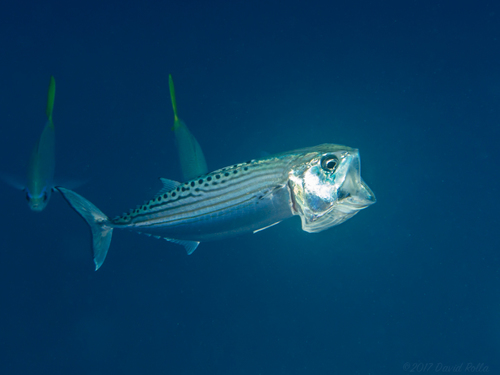
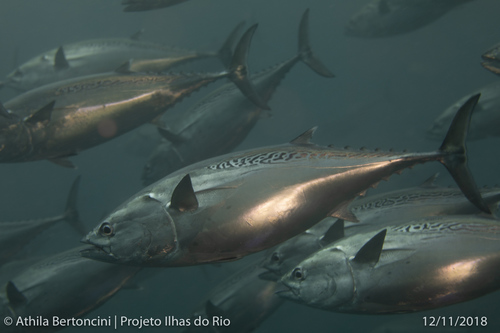
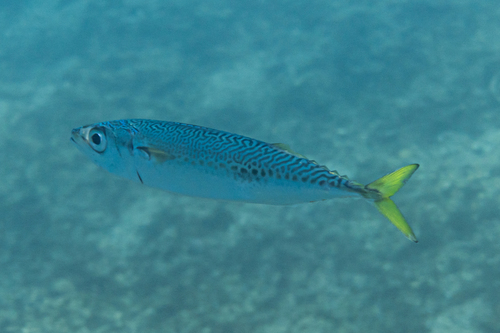
This species, scientifically named Euthynnus lineatus Kishinouye, 1920, has between 10 and 15 spines total across its dorsal fins. The anterior spines of its first dorsal fin are much taller than the middle spines, which gives this fin a concave outline. Its anal fin holds 11 to 12 soft rays, and the species has a total vertebra count of 37. Almost its entire body is scaleless, with the only exceptions being the lateral line and a distinct structure called a "corselet"; this species also lacks a swim bladder. It is typically iridescent blue in color, with black 3 to 5 horizontal stripes forming black markings on its back, plus a variable number of black or dark grey spots located above the pelvic fins. Some rare specimens have extensive light grey longitudinal stripes on their belly, while other individuals have few or no stripes of this type. After an individual dies, its characteristic markings often fade and become less prominent, but the species can still be identified by the presence of 2 or more spots positioned over the pelvic fins. Euthynnus lineatus can grow to a maximum length of 92 centimetres, which is 36 inches, and reach a maximum weight of 11.6 kilograms, which is 26 pounds. This species is distributed across the Eastern tropical Pacific, ranging from San Simeon, California down to northern Peru, and also occurs in the Galápagos Islands.