About Euthynnus alletteratus (Rafinesque, 1810)
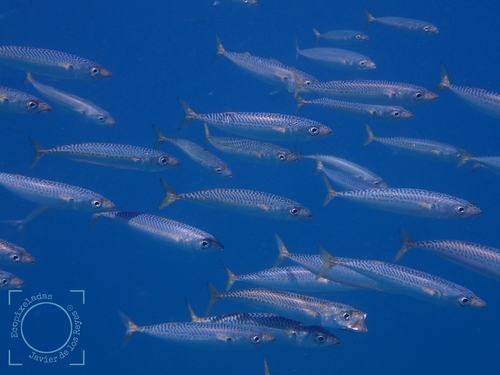
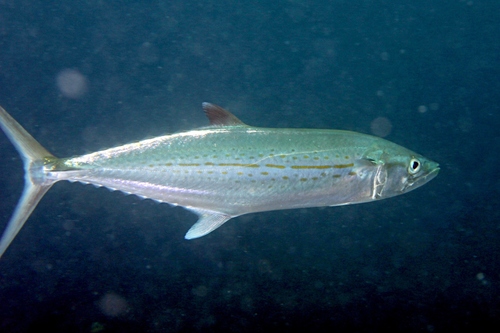
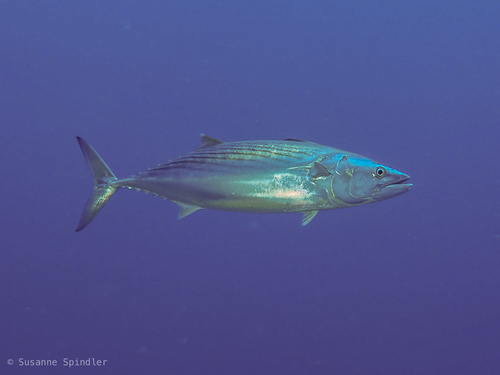
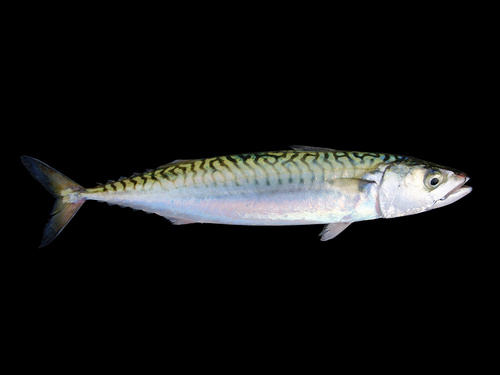
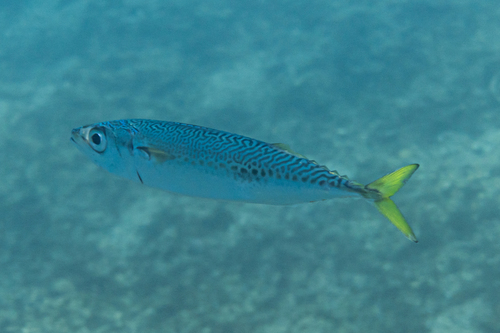
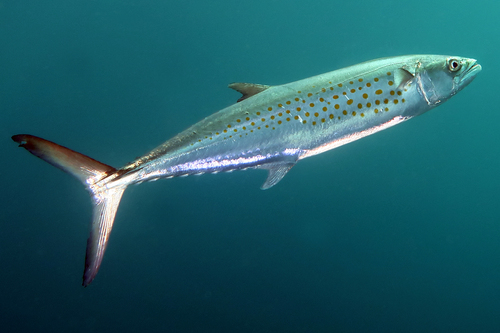
Euthynnus alletteratus, commonly known as the little tunny, is smaller in body size than other tuna species. It has a compact, streamlined, torpedo-shaped robust body adapted for powerful, fast swimming that supports both bursts of speed and swimming endurance. It has a large mouth with rigid jaws and a slightly protruding lower jaw; a single row of small, inwardly curved, cone-shaped teeth sits on the palate, no teeth are present on the vomer (the small bone at the roof of the mouth), and the tongue bears two longitudinal ridges. Its snout is shorter than the remainder of the head. The little tunny has a first dorsal fin with 10 to 15 tall, descending spines, followed by a much smaller second dorsal fin, then eight finlets. A small gap separates the bases of the two dorsal fins. The anal fin has 11 to 15 weakly defined rays, and is followed by seven finlets. Its pectoral fins are short, do not reach the end of the first dorsal fin, and are connected to the pelvic fins by interpelvic processes. There are 37–45 gill rakers (bony projections from the gills) on the first gill arch. The little tunny has no scales across most of its body, except along the lateral line and on the corselet, a thick band of scales that circles the body. Its typical coloration is metallic blue or blue-green, with dark wavy stripes located above the lateral line. These "worm-like" lines sit within a clearly defined border that never extends forward past the middle of the first dorsal fin. The belly is bright white, with three to seven dark, fingerprint-like spots around the pectoral and pelvic fins. The little tunny is often confused with similar species including skipjack tuna, frigate tuna, Atlantic bonito, and bullet tuna; its closest relatives are kawakawa and black skipjack. Its unique markings distinguish it from similar Atlantic species: no other related Atlantic species has the scattering of dark fingerprint-like spots between the pectoral and pelvic fins. The first dorsal fin of the Atlantic bonito is lower and more sloping than that of the little tunny. Its lack of vomer teeth separates it from close Pacific relatives kawakawa and black skipjack. The dorsal fins of bullet and frigate mackerel are more widely spaced than those of the little tunny. Unlike the little tunny, skipjack tuna has no markings on its back and has broad, straight stripes on its underside. The little tunny reaches a maximum weight of 12 kg (26 lb) in the Mediterranean, with an average weight of around 7 kg (15 lb) across its entire range. Its maximum fork length (the distance from the tip of the snout to the fork of the tail) is about 100 cm (39 in) in the Mediterranean and about 90 cm (35 in) in the Atlantic. The average fork length of an adult little tunny across its full range is about 85 cm (33 in). While some individuals may reach 100 cm (39 in) or longer, most commonly they grow to around 64 cm (25 in). The largest little tunny ever recorded measured 120 cm (47 in) and weighed 17 kg (37 lb). Females reach sexual maturity at a fork length of 27 to 37 cm (11–15 in), while males reach maturity at a fork length of about 40 cm (16 in). The little tunny inhabits neritic waters of temperate and tropical zones in the Atlantic Ocean, and is also found in the Mediterranean Sea and the Black Sea. In the eastern Atlantic, its range extends from Skagerrak to South Africa. Despite this broad latitudinal range, it is rare north of the Iberian Peninsula and south of Brazil. Along the Atlantic coast of the United States, it can be found as far north as Cape Cod, Massachusetts, as far south as the tip of Florida, and throughout the Gulf of Mexico. Compared to most other tunas, the little tunny lives much closer to shore, in and around inlets, points, jetties, and sandbars. These areas host large schools of the little tunny's preferred bait fish: sardines and menhaden, which suit the little tunny's feeding behavior. While it is abundant in offshore ocean waters, it is unusual to find the little tunny in the brackish water of estuaries; only very young individuals enter estuaries in South Africa. It prefers relatively warm water between 24–30 °C (75–86 °F). It migrates south during fall and winter, and north during spring, traveling through coastal waters. It is less migratory than other tuna species. The little tunny is typically a schooling species, and forms schools grouped primarily by fish size rather than species, so other Scombridae (such as Atlantic bonito) may join its schools. These schools can cover areas up to 3.2 kilometres long and contain more than 5000 individuals. Juvenile little tunny form tight schools in offshore waters. Larger schools are more common offshore, while smaller groups may travel far into inshore areas. Little tunny spawn in water of at least 25 °C (77 °F). In the Atlantic Ocean, spawning occurs between April and November. In the Mediterranean, the spawning season generally runs from May to September, with the most intense spawning happening between July and August. Major spawning areas are offshore, in waters 30 to 40 metres deep. Females are prolific, and can release a total of 1.75 million eggs in multiple clutches over one mating season. Males release sperm into the water column, where eggs are fertilized. The fertilized eggs are buoyant, spherical, transparent, and pelagic; an oil droplet inside the egg increases its buoyancy. Eggs range from 0.8 mm to 1.1 mm in diameter, and are light amber in color. Larvae hatch 24 hours after fertilization, and measure approximately 3 mm. Pigmentation develops in the eyes 48 hours after hatching. Teeth and fins develop when larvae reach 3.7–14 mm in length. Once larvae grow to between 14 mm and 174 mm long, they take on adult appearance, with an elongated body shape. Research shows it takes approximately 3 years for the little tunny's gonads to reach sexual maturity. The average fork length of a sexually mature little tunny is 38 cm (15 in).