About Euthrix laeta (Walker, 1855)
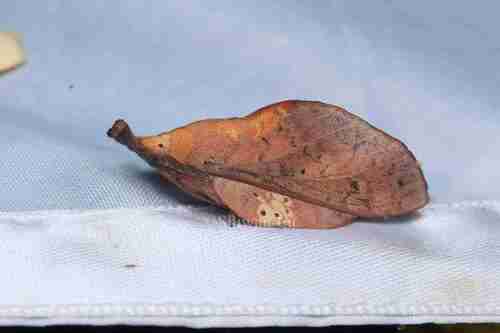
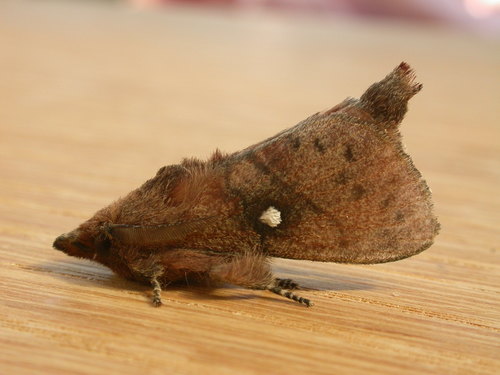
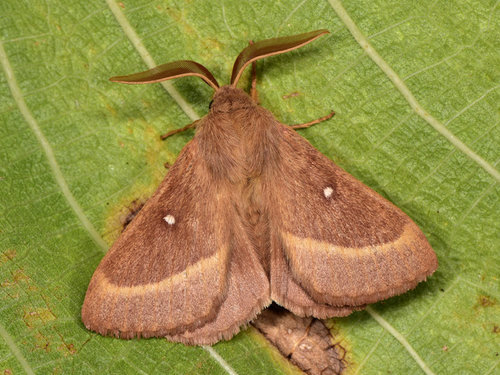
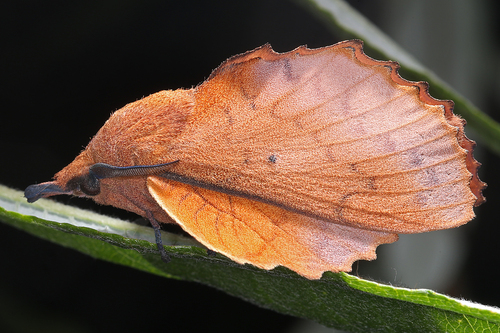
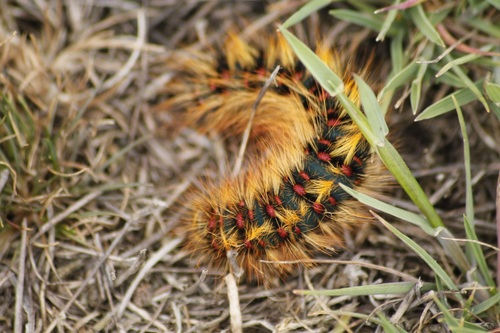
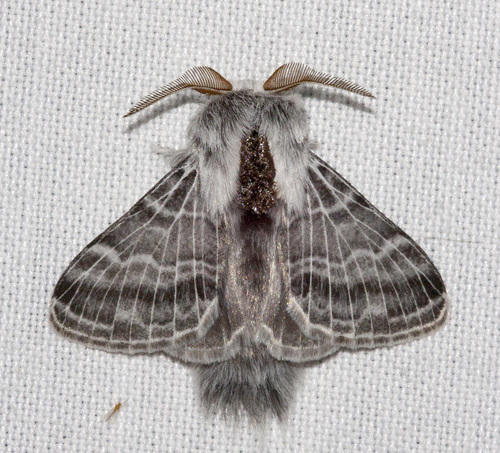
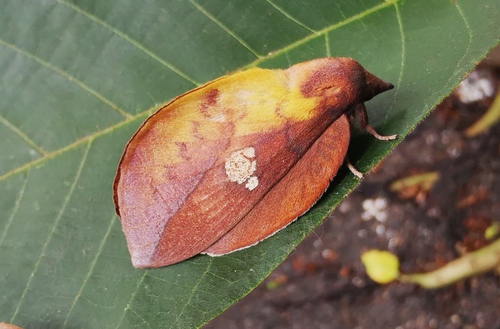
Euthrix laeta was first described by Walker in 1855. Adults have a bright lilac reddish body color. Antennae are bipectinate, meaning they are comb-like on both sides, in both sexes, while females have shorter rami than males. Males have a wingspan of 33–55 mm, and females have a wingspan of 50–70 mm; females are much larger and more robust than males. The forewings are leaf-shaped, with an oblique postmedial yellow patch on the dorsal surface that sometimes has a violet tint. The hindwings are lightly divided into darker zones. The subspecies Euthrix laeta divisa found in Sri Lanka is much darker than the nominal form. Adult Euthrix laeta have been collected in habitats associated with rainforest and coastal environments. The caterpillar of Euthrix laeta has a brown to ash gray body, with black and gray speckles along its dorsal surface. White to yellow spots and streaks are grouped together to form a complete marbled pattern. A dorso-median line of black setae is present on the caterpillar's mesothorax. Caterpillars are known to feed on Lespedeza species and Dalbergia species. This species is distributed across South Asia (including India, Sri Lanka, Nepal, Pakistan, and Bangladesh), extending through the Russian Far East, China, Siberia, Japan, and Korea, and reaching the Southeast Asian region of Sundaland.