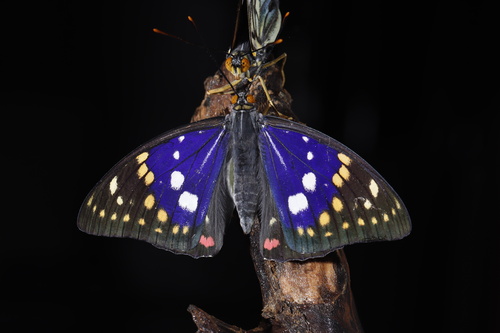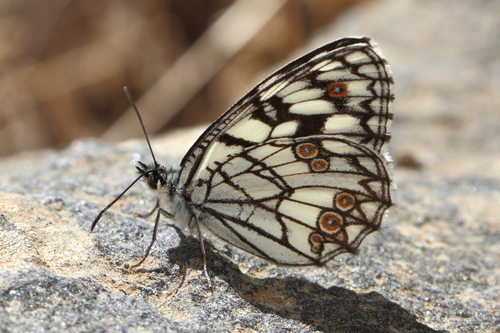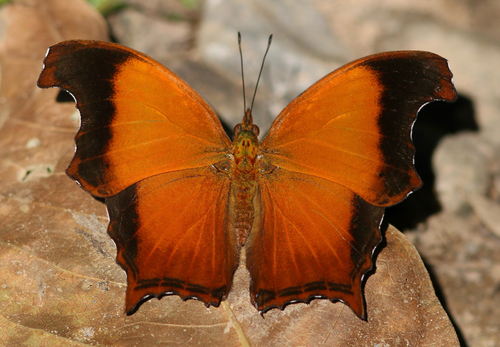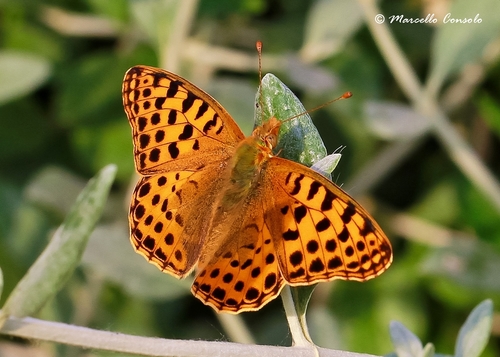
About Euthalia adonia Cramer, 1782
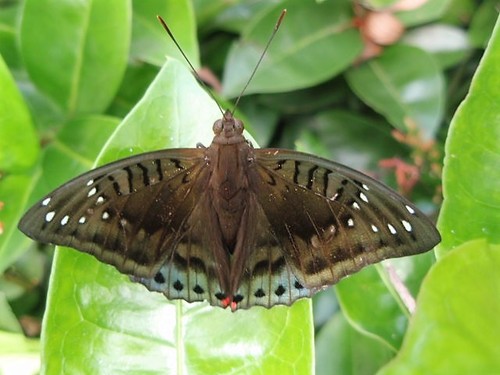
Euthalia adonia Cramer, 1782 is a primarily insular species, unlike Euthalia lubentina. It is only found on the continental Asian mainland in Farther India, and ranges as far as the Smaller Sunda Islands. Males of this species differ from male E. lubentina in the following features: the white submarginal dots on the forewing are smaller, and positioned vertically one above the other. The upper surface of the wing lacks red cellular spots. Males can be identified by the vertical, band-shaped white median area of the forewing, which generally extends onto the hindwing, and this band varies in form by locality. Most males also have red median spots on the forewing that are nearly twice as large as those of E. lubentina, but this trait does not hold true for populations from smaller islands. The sexual organs of E. adonia closely resemble those of E. lubentina, but the uncus is somewhat longer and more robust, the valve bears two distinct distal teeth that are not present in E. lubentina, and the structure is not distended ventrally. As with other species in the lubentina group, the third subcostal branch of the forewing arises at an equal distance beyond the cell in both sexes; this trait distinguishes the lubentina group from other Euthaliidi. The early life stages of E. adonia have not been documented. Reports note that adult E. adonia visit fallen fruit, but the original author never managed to collect specimens on suspended bananas. E. adonia prefers lowland habitats, and is even rarer than E. lubentina. E. adonia Cr. (129 e) was originally described and illustrated from a female specimen collected at Samsrang on the northeast coast of Java. Published illustrations of the species depict specimens collected near Sukabumi in western Java. Female specimens from the area around Malang in eastern Java have noticeably broader white bands and transcellular spots on the forewing. The species is very scarce, and occurs from sea level up to an altitude of approximately 2000 feet.