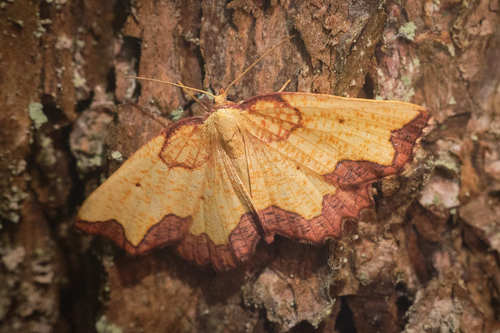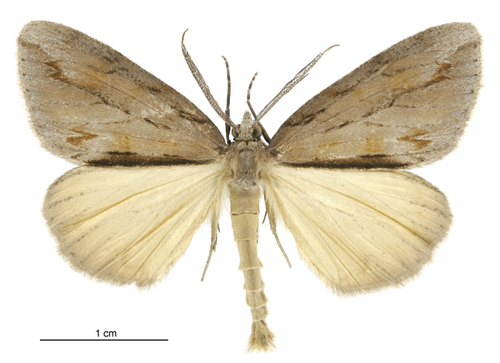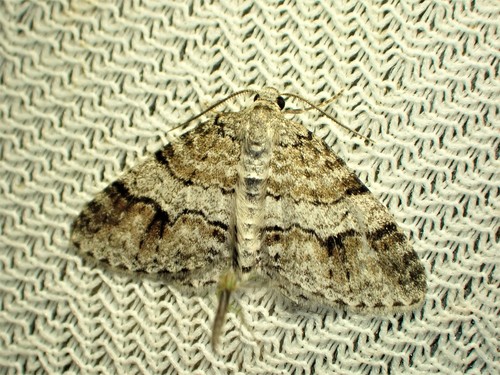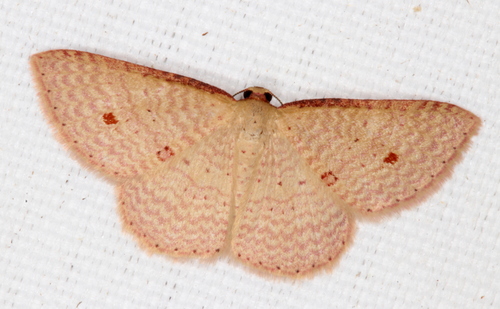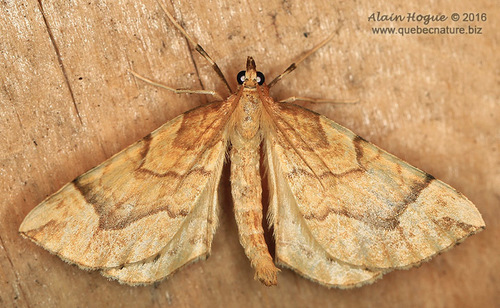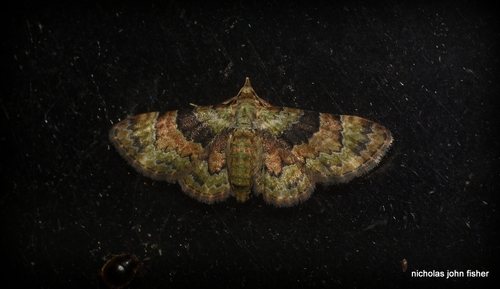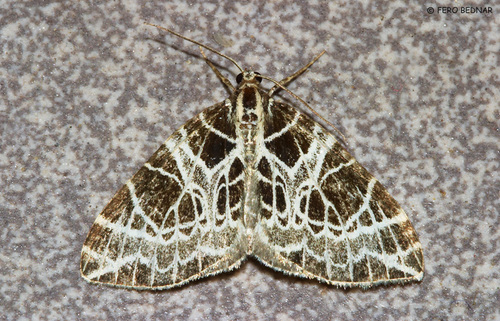
About Eustroma reticulata (Denis & Schiffermüller), 1775
The wingspan of Eustroma reticulata ranges from 20 to 25 millimetres (0.79 to 0.98 in). This species produces one generation per year, with adult moths active on the wing during July and August. Adults begin flying at dusk, are attracted to light, and can be flushed from their foodplant during the day, or observed resting close to the plant. Females lay eggs singly on the larval foodplant, and larvae can be found from July to September. Larvae feed at night on touch-me-not balsam (Impatiens noli-tangere); young larvae create holes in the leaves, while older larvae feed inside developing seedpods. In captive settings, larvae will feed on other balsam species such as orange balsam (Impatiens capensis), but will not feed on Indian balsam (Impatiens glandulifera), which has become naturalised in the Lake District and outcompetes native touch-me-not balsam. The species overwinters as a pupa, in an earthen cocoon located in moist ground near its foodplant. Eustroma reticulata is distributed across Europe, western and central Siberia, northern Mongolia, the Amur region, Khabarovsk, Primorsk, Sakhalin, the Kuril Islands, China, the Korean Peninsula, and Japan. In Great Britain, it is one of the rarest moth species, found only in the Lake District and at two sites in north Lancashire. The moth came close to extinction during the 1980s and 1990s, but monitoring at nineteen sites shows the species has responded well to conservation management, with an over 900% increase in abundance since 2000. Historically, the moth was also found in Wales: near Bala in 1930, and near Dolgellau in 1973.