About Eusmilia fastigiata (Pallas, 1766)
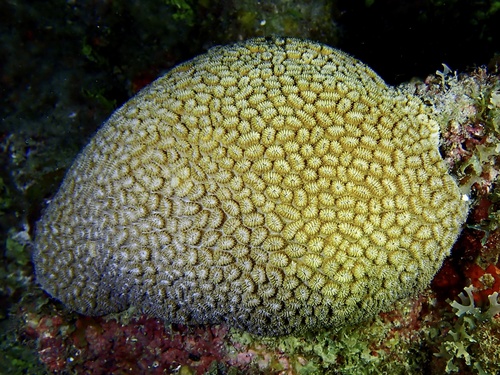
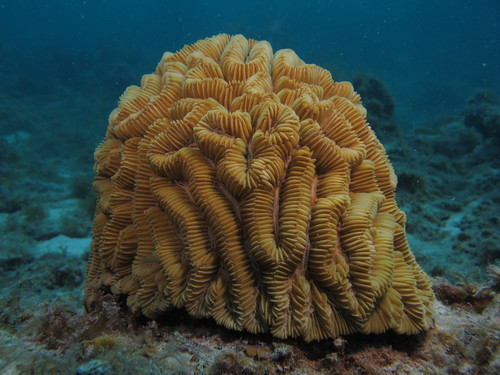
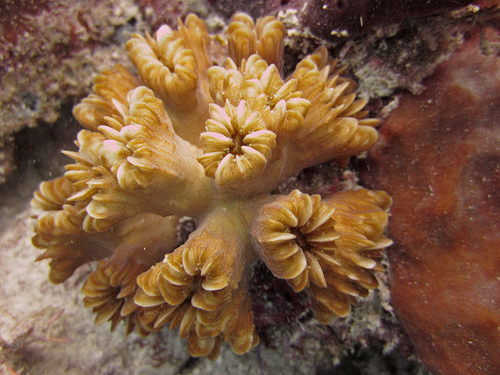
Eusmilia fastigiata, commonly known as the smooth flower coral, is a colonial coral species that grows to roughly 50 centimetres (20 inches) across. It forms a low stony mound made of calcium carbonate, whose surface is covered in tubular projections called corallites, which occur in groups of one to three. Coral polyps emerge from these corallites; polyps are either round or oval, with the oval form being more common at moderate depths. The polyps are large and widely spaced, and are connected by a layer of translucent, jelly-like mesoglea tissue called coenosarc that covers the surface of the carbonate skeleton. During the day, polyps retract back into their cup-shaped corallites. Corallites have large, smooth-edged ridges called septa, and polyps have matching grooves at their base. At night, polyps stretch out their translucent white tentacles to feed, giving the coral the appearance of open flowers. This coral is usually cream, yellow, or pale brown, and often has a green or pink tinge. Smooth flower coral is distributed in the Caribbean, the Gulf of Mexico, the Bahamas, and southern Florida. It occurs at depths down to approximately 60 metres (200 feet), and is most common between 5 and 30 metres (16 and 98 feet). It grows on both the back and front edges of reefs, and is sometimes positioned under overhangs created by larger corals. It is listed as critically endangered on the IUCN Red List of Threatened Species. Reproduction in this species involves the release of gametes into the water. Fertilized eggs develop into planula larvae that become part of the zooplankton and drift with ocean currents. After going through several larval stages, the larva settles on the seabed and undergoes metamorphosis into a single polyp. The base of this polyp secretes a calcium carbonate skeleton, and the founding polyp produces a new colony through budding of new polyps.